Event submissions
Published
This submission belongs to the session S1. Microbial Characterization and Bioprocess of the event The 3rd International Electronic Conference on Microbiology
Published date
31 Mar, 2025
Academic Editor
'%3e%3cpath%20d='M12.6657%2010.9104C12.4185%2010.325%2012.0599%209.79327%2011.6097%209.34482C11.1609%208.89508%2010.6293%208.5365%2010.0442%208.28888C10.0389%208.28626%2010.0337%208.28495%2010.0285%208.28233C10.8446%207.69279%2011.3752%206.73249%2011.3752%205.64904C11.3752%203.8542%209.92103%202.39999%208.1262%202.39999C6.33136%202.39999%204.87715%203.8542%204.87715%205.64904C4.87715%206.73249%205.40774%207.69279%206.22393%208.28364C6.21869%208.28626%206.21345%208.28757%206.20821%208.29019C5.62129%208.5378%205.09463%208.89284%204.64265%209.34613C4.1929%209.79493%203.83432%2010.3266%203.58671%2010.9117C3.34345%2011.4845%203.21226%2012.0987%203.20023%2012.7209C3.19988%2012.7349%203.20233%2012.7488%203.20744%2012.7619C3.21255%2012.7749%203.22022%2012.7867%203.22998%2012.7968C3.23975%2012.8068%203.25142%2012.8147%203.26431%2012.8202C3.2772%2012.8256%203.29105%2012.8284%203.30504%2012.8284H4.09109C4.14874%2012.8284%204.19459%2012.7825%204.1959%2012.7262C4.2221%2011.7148%204.62823%2010.7676%205.34617%2010.0497C6.08899%209.30683%207.0755%208.89808%208.1262%208.89808C9.17689%208.89808%2010.1634%209.30683%2010.9062%2010.0497C11.6242%2010.7676%2012.0303%2011.7148%2012.0565%2012.7262C12.0578%2012.7838%2012.1037%2012.8284%2012.1613%2012.8284H12.9474C12.9613%2012.8284%2012.9752%2012.8256%2012.9881%2012.8202C13.001%2012.8147%2013.0126%2012.8068%2013.0224%2012.7968C13.0322%2012.7867%2013.0398%2012.7749%2013.0449%2012.7619C13.0501%2012.7488%2013.0525%2012.7349%2013.0522%2012.7209C13.0391%2012.0947%2012.9094%2011.4855%2012.6657%2010.9104ZM8.1262%207.9024C7.52486%207.9024%206.9589%207.6679%206.53312%207.24211C6.10733%206.81633%205.87283%206.25037%205.87283%205.64904C5.87283%205.0477%206.10733%204.48174%206.53312%204.05596C6.9589%203.63018%207.52486%203.39567%208.1262%203.39567C8.72753%203.39567%209.29349%203.63018%209.71927%204.05596C10.1451%204.48174%2010.3796%205.0477%2010.3796%205.64904C10.3796%206.25037%2010.1451%206.81633%209.71927%207.24211C9.29349%207.6679%208.72753%207.9024%208.1262%207.9024Z'%20fill='%235D1EE1'/%3e%3c/g%3e%3c/svg%3e) Laurent Dufossé
Laurent DufosséCitation
Michelle Shereen Alves Castanheira, Stephanie Morais, Luís Lima, Isabel Seguro, Marlene Santos, João Pacheco, M. Fátima Barroso, An innovative electrochemical nanogenosensor for the detection of Candida species, in Proceedings of The 3rd International Electronic Conference on Microbiology, 1 April–3 April 2025, MDPI: Basel, Switzerland
Share
Email
Facebook
Twitter
LinkedIn
An innovative electrochemical nanogenosensor for the detection of Candida species
'%3e%3cpath%20d='M12.6647%2010.9104C12.4176%2010.325%2012.0589%209.7933%2011.6088%209.34485C11.16%208.89511%2010.6283%208.53653%2010.0432%208.28891C10.038%208.28629%2010.0327%208.28498%2010.0275%208.28236C10.8437%207.69282%2011.3743%206.73252%2011.3743%205.64907C11.3743%203.85423%209.92005%202.40002%208.12522%202.40002C6.33038%202.40002%204.87618%203.85423%204.87618%205.64907C4.87618%206.73252%205.40677%207.69282%206.22296%208.28367C6.21772%208.28629%206.21248%208.2876%206.20724%208.29022C5.62031%208.53783%205.09365%208.89287%204.64167%209.34616C4.19192%209.79496%203.83334%2010.3266%203.58573%2010.9117C3.34247%2011.4846%203.21128%2012.0987%203.19925%2012.721C3.1989%2012.735%203.20135%2012.7489%203.20646%2012.7619C3.21157%2012.7749%203.21924%2012.7868%203.22901%2012.7968C3.23877%2012.8068%203.25045%2012.8148%203.26334%2012.8202C3.27623%2012.8256%203.29007%2012.8284%203.30406%2012.8284H4.09012C4.14776%2012.8284%204.19362%2012.7825%204.19493%2012.7262C4.22113%2011.7148%204.62726%2010.7676%205.34519%2010.0497C6.08802%209.30686%207.07452%208.89811%208.12522%208.89811C9.17592%208.89811%2010.1624%209.30686%2010.9052%2010.0497C11.6232%2010.7676%2012.0293%2011.7148%2012.0555%2012.7262C12.0568%2012.7839%2012.1027%2012.8284%2012.1603%2012.8284H12.9464C12.9604%2012.8284%2012.9742%2012.8256%2012.9871%2012.8202C13%2012.8148%2013.0117%2012.8068%2013.0214%2012.7968C13.0312%2012.7868%2013.0389%2012.7749%2013.044%2012.7619C13.0491%2012.7489%2013.0515%2012.735%2013.0512%2012.721C13.0381%2012.0947%2012.9084%2011.4856%2012.6647%2010.9104ZM8.12522%207.90243C7.52388%207.90243%206.95792%207.66793%206.53214%207.24215C6.10636%206.81636%205.87185%206.2504%205.87185%205.64907C5.87185%205.04773%206.10636%204.48177%206.53214%204.05599C6.95792%203.63021%207.52388%203.3957%208.12522%203.3957C8.72655%203.3957%209.29252%203.63021%209.7183%204.05599C10.1441%204.48177%2010.3786%205.04773%2010.3786%205.64907C10.3786%206.2504%2010.1441%206.81636%209.7183%207.24215C9.29252%207.66793%208.72655%207.90243%208.12522%207.90243Z'%20fill='%235D1EE1'/%3e%3c/g%3e%3c/svg%3e)
Michelle Shereen Alves Castanheira 1,2,3
Stephanie Morais 1

Luís Lima 3
Isabel Seguro 1
Marlene Santos 2

João Pacheco 1

M. Fátima Barroso 1
1. REQUIMTE/LAQV-Instituto Superior de Engenharia do Porto, Instituto Politécnico do Porto, Portugal
2. REQUIMTE|LAQV, Escola Superior de Saúde, Instituto Politécnico do Porto, Portugal
3. Centro de Investigação, Instituto Português de Oncologia do Porto Francisco Gentil, E.P.E., Portugal
Abstract
Despite tremendous progress in the prevention and treatment of fungal infections, invasive fungi like Candida species remain the major cause of morbidity and mortality worldwide [1]. In fact, the Global Action Fund for Fungal Infections estimates that each year, almost 300 million individuals contract a fungal infection, and over 1.5 million of them died as a result [1,2]. Candida can enter the bloodstream and spread to internal organs, but it can also commonly cause surface infections, like those in the skin or mucous membranes, which can be readily and effectively treated [3]. This fungal infection has been observed in high-risk patients, such as those receiving allogeneic stem-cell transplants and those receiving high-dose chemotherapy for acute leukemia [4]. These patients are more vulnerable to infections since their immune systems are weakened during the transplant process. Systemic fungal infections are still difficult to diagnose. Therefore, developing early diagnosis methods that are more precise, sensitive, and effective is required. A quick, easy, and accurate method for identifying fungal infections in patients following hematopoietic stem cell transplantation (HSCT) was devised in this study. To overcome this problem, an electrochemical nanogenosensor for the detection of Candida albicans was developed. This nanogenosensor was assembled in an innovative low-cost electrochemical paper-based analytical device (ePAD). The electrochemical signal's sensitivity was increased through the application of a sandwich hybridization procedure. Preliminary findings indicate that these nanogenosensors can be used to identify Candida spp. in a synthetic fungus sample. Despite these findings, work is being performed to enhance the nanogenosensor for the quantification of Candida albicans, and this procedure will be verified through more study. The application in a hospital context will be covered in future studies in terms of sensitivity, accuracy, response time, issues, and potential.
Keywords
Fungal infections
nanogenosensor
Candida albicans
Poster
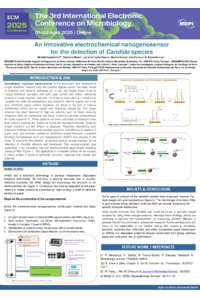
Poster_The 3rd International Electronic Conference on Microbiology2025_Michelle Castanheira.pdf
Exploring Beer By-products as Novel Antibacterial Ingredients for Health Care Products
Rapid Benchtop Purification of SARS-CoV-2 for Immunological Studies: Minimizing Cytotoxic Effects on Monocytes