Event submissions
Published
This submission belongs to the session S4. Emerging Infectious Diseases of the event The 3rd International Electronic Conference on Microbiology
Published date
31 Mar, 2025
Academic Editor
'%3e%3cpath%20d='M12.6657%2010.9104C12.4185%2010.325%2012.0599%209.79327%2011.6097%209.34482C11.1609%208.89508%2010.6293%208.5365%2010.0442%208.28888C10.0389%208.28626%2010.0337%208.28495%2010.0285%208.28233C10.8446%207.69279%2011.3752%206.73249%2011.3752%205.64904C11.3752%203.8542%209.92103%202.39999%208.1262%202.39999C6.33136%202.39999%204.87715%203.8542%204.87715%205.64904C4.87715%206.73249%205.40774%207.69279%206.22393%208.28364C6.21869%208.28626%206.21345%208.28757%206.20821%208.29019C5.62129%208.5378%205.09463%208.89284%204.64265%209.34613C4.1929%209.79493%203.83432%2010.3266%203.58671%2010.9117C3.34345%2011.4845%203.21226%2012.0987%203.20023%2012.7209C3.19988%2012.7349%203.20233%2012.7488%203.20744%2012.7619C3.21255%2012.7749%203.22022%2012.7867%203.22998%2012.7968C3.23975%2012.8068%203.25142%2012.8147%203.26431%2012.8202C3.2772%2012.8256%203.29105%2012.8284%203.30504%2012.8284H4.09109C4.14874%2012.8284%204.19459%2012.7825%204.1959%2012.7262C4.2221%2011.7148%204.62823%2010.7676%205.34617%2010.0497C6.08899%209.30683%207.0755%208.89808%208.1262%208.89808C9.17689%208.89808%2010.1634%209.30683%2010.9062%2010.0497C11.6242%2010.7676%2012.0303%2011.7148%2012.0565%2012.7262C12.0578%2012.7838%2012.1037%2012.8284%2012.1613%2012.8284H12.9474C12.9613%2012.8284%2012.9752%2012.8256%2012.9881%2012.8202C13.001%2012.8147%2013.0126%2012.8068%2013.0224%2012.7968C13.0322%2012.7867%2013.0398%2012.7749%2013.0449%2012.7619C13.0501%2012.7488%2013.0525%2012.7349%2013.0522%2012.7209C13.0391%2012.0947%2012.9094%2011.4855%2012.6657%2010.9104ZM8.1262%207.9024C7.52486%207.9024%206.9589%207.6679%206.53312%207.24211C6.10733%206.81633%205.87283%206.25037%205.87283%205.64904C5.87283%205.0477%206.10733%204.48174%206.53312%204.05596C6.9589%203.63018%207.52486%203.39567%208.1262%203.39567C8.72753%203.39567%209.29349%203.63018%209.71927%204.05596C10.1451%204.48174%2010.3796%205.0477%2010.3796%205.64904C10.3796%206.25037%2010.1451%206.81633%209.71927%207.24211C9.29349%207.6679%208.72753%207.9024%208.1262%207.9024Z'%20fill='%235D1EE1'/%3e%3c/g%3e%3c/svg%3e) Nico Jehmlich
Nico JehmlichCitation
Ayesha Zahid, Jennifer C. Wilson, I Darren Grice, Ian R. Peak, Development of a Novel Multicomponent Vaccine to Address the Burden of Otitis Media in High-Risk Populations, in Proceedings of The 3rd International Electronic Conference on Microbiology, 1 April–3 April 2025, MDPI: Basel, Switzerland
Share
Email
Facebook
Twitter
LinkedIn
Development of a Novel Multicomponent Vaccine to Address the Burden of Otitis Media in High-Risk Populations
'%3e%3cpath%20d='M12.6647%2010.9104C12.4176%2010.325%2012.0589%209.7933%2011.6088%209.34485C11.16%208.89511%2010.6283%208.53653%2010.0432%208.28891C10.038%208.28629%2010.0327%208.28498%2010.0275%208.28236C10.8437%207.69282%2011.3743%206.73252%2011.3743%205.64907C11.3743%203.85423%209.92005%202.40002%208.12522%202.40002C6.33038%202.40002%204.87618%203.85423%204.87618%205.64907C4.87618%206.73252%205.40677%207.69282%206.22296%208.28367C6.21772%208.28629%206.21248%208.2876%206.20724%208.29022C5.62031%208.53783%205.09365%208.89287%204.64167%209.34616C4.19192%209.79496%203.83334%2010.3266%203.58573%2010.9117C3.34247%2011.4846%203.21128%2012.0987%203.19925%2012.721C3.1989%2012.735%203.20135%2012.7489%203.20646%2012.7619C3.21157%2012.7749%203.21924%2012.7868%203.22901%2012.7968C3.23877%2012.8068%203.25045%2012.8148%203.26334%2012.8202C3.27623%2012.8256%203.29007%2012.8284%203.30406%2012.8284H4.09012C4.14776%2012.8284%204.19362%2012.7825%204.19493%2012.7262C4.22113%2011.7148%204.62726%2010.7676%205.34519%2010.0497C6.08802%209.30686%207.07452%208.89811%208.12522%208.89811C9.17592%208.89811%2010.1624%209.30686%2010.9052%2010.0497C11.6232%2010.7676%2012.0293%2011.7148%2012.0555%2012.7262C12.0568%2012.7839%2012.1027%2012.8284%2012.1603%2012.8284H12.9464C12.9604%2012.8284%2012.9742%2012.8256%2012.9871%2012.8202C13%2012.8148%2013.0117%2012.8068%2013.0214%2012.7968C13.0312%2012.7868%2013.0389%2012.7749%2013.044%2012.7619C13.0491%2012.7489%2013.0515%2012.735%2013.0512%2012.721C13.0381%2012.0947%2012.9084%2011.4856%2012.6647%2010.9104ZM8.12522%207.90243C7.52388%207.90243%206.95792%207.66793%206.53214%207.24215C6.10636%206.81636%205.87185%206.2504%205.87185%205.64907C5.87185%205.04773%206.10636%204.48177%206.53214%204.05599C6.95792%203.63021%207.52388%203.3957%208.12522%203.3957C8.72655%203.3957%209.29252%203.63021%209.7183%204.05599C10.1441%204.48177%2010.3786%205.04773%2010.3786%205.64907C10.3786%206.2504%2010.1441%206.81636%209.7183%207.24215C9.29252%207.66793%208.72655%207.90243%208.12522%207.90243Z'%20fill='%235D1EE1'/%3e%3c/g%3e%3c/svg%3e)
Ayesha Zahid 1,2
Jennifer C. Wilson 2
I Darren Grice 1,2
Ian R. Peak 1,2
1. Institute for Biomedicine and Glycomics, Griffith University, Gold Coast, QLD, Australia.
2. School of Pharmacy and Medical Science, Griffith University, Gold Coast, QLD, Australia
Abstract
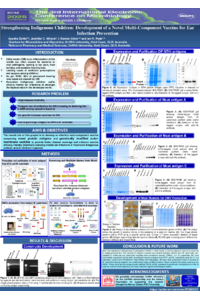
Background: Middle ear infection (otitis media) remains the most common childhood disease diagnosed among Australian Indigenous children. Despite extensive antibiotic usage, it persists as a significant health concern, characterized by substantial morbidity and economic burden. Streptococcus pneumoniae, non-typeable Haemophilus influenzae, and Moraxella catarrhalis are the most common culprits responsible for acute otitis media. Currently, pneumococcal and influenza vaccines are utilized as a preventive measure against otitis media. However, their efficacy is limited to prevent carriage and/or illness induced by non-vaccine serotypes. Otitis media stemming from non-vaccine serotype pneumococci, non-typeable H. influenzae, and M. catarrhalis continue to pose significant healthcare challenges.
Methods and Findings: Given the expansive heterogeneity of pathogens involved in otitis media, a multicomponent vaccine is essential to confer adequate protection. This study is focused on devising a novel multicomponent vaccine targeting two major etiological agents, H. influenzae and M. catarrhalis. Our vaccine formulation features novel protein antigens derived from M. catarrhalis, non-typeable H. influenzae, and genetically modified outer-membrane vesicles (OMVs) from M. catarrhalis. We successfully expressed and purified recombinant protein antigens from NTHi and M. catarrhalis using E. coli expression system and immobilized metal affinity chromatography. We also developed knockout mutants of M. catarrhalis lacking targeted immunodominant strain-variable proteins. These mutants are currently being used to purify OMVs. Preclinical investigations will encompass a rigorous evaluation of vaccine immunogenicity and cross-reactivity against heterologous strains in mice.
Conclusion: By combining novel protein antigens with genetically modified outer-membrane vesicles, this study aims to overcome the limitations of current vaccine approaches. Forthcoming preclinical evaluations will provide critical insights into its immunogenicity and cross-reactivity, paving the way for future advancements in otitis media prevention.
Keywords
Otitis media
Protein antigens
OMVs
Vaccine development
H. influenzae
and M. catarrhalis
Poster
Ayesha Zahid-ECM 2025.pdf
Microbial Diversity in Composting: identification and analysis of Fungus-related and bacterial communities for enhanced organic waste recycling
Use of medicinal plants for treatment and prophylaxis of canine parasitic infections: a literature review