Event submissions
Published
This submission belongs to the session S1. Microbial Characterization and Bioprocess of the event The 3rd International Electronic Conference on Microbiology
Published date
31 Mar, 2025
Academic Editor
'%3e%3cpath%20d='M12.6657%2010.9104C12.4185%2010.325%2012.0599%209.79327%2011.6097%209.34482C11.1609%208.89508%2010.6293%208.5365%2010.0442%208.28888C10.0389%208.28626%2010.0337%208.28495%2010.0285%208.28233C10.8446%207.69279%2011.3752%206.73249%2011.3752%205.64904C11.3752%203.8542%209.92103%202.39999%208.1262%202.39999C6.33136%202.39999%204.87715%203.8542%204.87715%205.64904C4.87715%206.73249%205.40774%207.69279%206.22393%208.28364C6.21869%208.28626%206.21345%208.28757%206.20821%208.29019C5.62129%208.5378%205.09463%208.89284%204.64265%209.34613C4.1929%209.79493%203.83432%2010.3266%203.58671%2010.9117C3.34345%2011.4845%203.21226%2012.0987%203.20023%2012.7209C3.19988%2012.7349%203.20233%2012.7488%203.20744%2012.7619C3.21255%2012.7749%203.22022%2012.7867%203.22998%2012.7968C3.23975%2012.8068%203.25142%2012.8147%203.26431%2012.8202C3.2772%2012.8256%203.29105%2012.8284%203.30504%2012.8284H4.09109C4.14874%2012.8284%204.19459%2012.7825%204.1959%2012.7262C4.2221%2011.7148%204.62823%2010.7676%205.34617%2010.0497C6.08899%209.30683%207.0755%208.89808%208.1262%208.89808C9.17689%208.89808%2010.1634%209.30683%2010.9062%2010.0497C11.6242%2010.7676%2012.0303%2011.7148%2012.0565%2012.7262C12.0578%2012.7838%2012.1037%2012.8284%2012.1613%2012.8284H12.9474C12.9613%2012.8284%2012.9752%2012.8256%2012.9881%2012.8202C13.001%2012.8147%2013.0126%2012.8068%2013.0224%2012.7968C13.0322%2012.7867%2013.0398%2012.7749%2013.0449%2012.7619C13.0501%2012.7488%2013.0525%2012.7349%2013.0522%2012.7209C13.0391%2012.0947%2012.9094%2011.4855%2012.6657%2010.9104ZM8.1262%207.9024C7.52486%207.9024%206.9589%207.6679%206.53312%207.24211C6.10733%206.81633%205.87283%206.25037%205.87283%205.64904C5.87283%205.0477%206.10733%204.48174%206.53312%204.05596C6.9589%203.63018%207.52486%203.39567%208.1262%203.39567C8.72753%203.39567%209.29349%203.63018%209.71927%204.05596C10.1451%204.48174%2010.3796%205.0477%2010.3796%205.64904C10.3796%206.25037%2010.1451%206.81633%209.71927%207.24211C9.29349%207.6679%208.72753%207.9024%208.1262%207.9024Z'%20fill='%235D1EE1'/%3e%3c/g%3e%3c/svg%3e) Nico Jehmlich
Nico JehmlichCitation
Filip Jacek Kot, Marta Książczyk, Gabriela Bugla-Płoskońska, Evaluation of in vivo and in vitro pathogenicity of selected Staphylococcus aureus strains isolated from humans and animals., in Proceedings of The 3rd International Electronic Conference on Microbiology, 1 April–3 April 2025, MDPI: Basel, Switzerland
Share
Email
Facebook
Twitter
LinkedIn
Evaluation of in vivo and in vitro pathogenicity of selected Staphylococcus aureus strains isolated from humans and animals.
'%3e%3cpath%20d='M12.6647%2010.9104C12.4176%2010.325%2012.0589%209.7933%2011.6088%209.34485C11.16%208.89511%2010.6283%208.53653%2010.0432%208.28891C10.038%208.28629%2010.0327%208.28498%2010.0275%208.28236C10.8437%207.69282%2011.3743%206.73252%2011.3743%205.64907C11.3743%203.85423%209.92005%202.40002%208.12522%202.40002C6.33038%202.40002%204.87618%203.85423%204.87618%205.64907C4.87618%206.73252%205.40677%207.69282%206.22296%208.28367C6.21772%208.28629%206.21248%208.2876%206.20724%208.29022C5.62031%208.53783%205.09365%208.89287%204.64167%209.34616C4.19192%209.79496%203.83334%2010.3266%203.58573%2010.9117C3.34247%2011.4846%203.21128%2012.0987%203.19925%2012.721C3.1989%2012.735%203.20135%2012.7489%203.20646%2012.7619C3.21157%2012.7749%203.21924%2012.7868%203.22901%2012.7968C3.23877%2012.8068%203.25045%2012.8148%203.26334%2012.8202C3.27623%2012.8256%203.29007%2012.8284%203.30406%2012.8284H4.09012C4.14776%2012.8284%204.19362%2012.7825%204.19493%2012.7262C4.22113%2011.7148%204.62726%2010.7676%205.34519%2010.0497C6.08802%209.30686%207.07452%208.89811%208.12522%208.89811C9.17592%208.89811%2010.1624%209.30686%2010.9052%2010.0497C11.6232%2010.7676%2012.0293%2011.7148%2012.0555%2012.7262C12.0568%2012.7839%2012.1027%2012.8284%2012.1603%2012.8284H12.9464C12.9604%2012.8284%2012.9742%2012.8256%2012.9871%2012.8202C13%2012.8148%2013.0117%2012.8068%2013.0214%2012.7968C13.0312%2012.7868%2013.0389%2012.7749%2013.044%2012.7619C13.0491%2012.7489%2013.0515%2012.735%2013.0512%2012.721C13.0381%2012.0947%2012.9084%2011.4856%2012.6647%2010.9104ZM8.12522%207.90243C7.52388%207.90243%206.95792%207.66793%206.53214%207.24215C6.10636%206.81636%205.87185%206.2504%205.87185%205.64907C5.87185%205.04773%206.10636%204.48177%206.53214%204.05599C6.95792%203.63021%207.52388%203.3957%208.12522%203.3957C8.72655%203.3957%209.29252%203.63021%209.7183%204.05599C10.1441%204.48177%2010.3786%205.04773%2010.3786%205.64907C10.3786%206.2504%2010.1441%206.81636%209.7183%207.24215C9.29252%207.66793%208.72655%207.90243%208.12522%207.90243Z'%20fill='%235D1EE1'/%3e%3c/g%3e%3c/svg%3e)
Filip Jacek Kot 1

Marta Książczyk 1
Gabriela Bugla-Płoskońska 1
1. Department of Microbiology, Faculty of Biological Sciences, University of Wrocław, Poland
Abstract
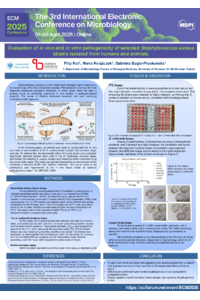
Staphylococcus aureus is a major pathogen responsible for numerous human and animal diseases, including Staphylococcal scalded skin syndrome, folliculitis, and mastitis. Known for its virulence factors, it can evade host immune responses and enhance colonization. Recent research has focused on alternative in vivo models, such as the Galleria mellonella larval model, which offers a cost-effective, less harmful, and accessible approach to studying pathogens and testing therapies. This model is compatible with the 3R principle (replacement, reduction, and refinement).
In this study, the virulence of 35 S. aureus strains isolated from humans, dogs, and cats was assessed both in vivo and in vitro. The bactericidal effect of a commercial human serum reagent on these strains was evaluated, and selected isolates were tested in the G. mellonella model. Biofilm formation was also analyzed using the crystal violet assay. Most strains were resistant to the human serum reagent, with only three being susceptible. In the larval model, varying levels of virulence were observed. Biofilm formation was detected in only five out of thirty-five strains.
No significant differences in serum resistance were observed between strains from different hosts. The Gram-positive structure of S. aureus likely explains this. Strains exhibiting the MRS (Methicillin-resistant Staphylococcus) phenotype caused higher mortality in the larvae, and those capable of forming biofilms displayed both low and high virulence levels in vivo on the larval model.
This study was partially financed by an internal grant of the University of Wrocław IDUB titled "Galleria mellonella - the use of larvae in the optimization and improvement of the in vivo insect model for bacterial pathogenicity studies.", No. BPIDUB.7.2024
The tested strains were graciously provided by the Wrocław University of Environmental and Life Sciences, Department of Epizootiology and Clinic of Birds and Exotic Animals.
Keywords
Galleria mellonella
Staphylococcus aureus
model organism
blood serum
Poster
Evaluation of in vivo and in vitro pathogenicity of selected Staphylococcus aureus strains isolated from humans and animals.pdf
First report of potential pathogenic fungus Papiliotrema aurea in Glossiphonia complanata: Implications for leech-mediated fungal transmission
The effect of Light and temperature on the accumulation of β‑carotene in Rhodotorula yeasts