Event submissions
Published
This submission belongs to the session S7. Microbe-Plant Interactions of the event The 3rd International Electronic Conference on Microbiology
Published date
31 Mar, 2025
Academic Editor
'%3e%3cpath%20d='M12.6657%2010.9104C12.4185%2010.325%2012.0599%209.79327%2011.6097%209.34482C11.1609%208.89508%2010.6293%208.5365%2010.0442%208.28888C10.0389%208.28626%2010.0337%208.28495%2010.0285%208.28233C10.8446%207.69279%2011.3752%206.73249%2011.3752%205.64904C11.3752%203.8542%209.92103%202.39999%208.1262%202.39999C6.33136%202.39999%204.87715%203.8542%204.87715%205.64904C4.87715%206.73249%205.40774%207.69279%206.22393%208.28364C6.21869%208.28626%206.21345%208.28757%206.20821%208.29019C5.62129%208.5378%205.09463%208.89284%204.64265%209.34613C4.1929%209.79493%203.83432%2010.3266%203.58671%2010.9117C3.34345%2011.4845%203.21226%2012.0987%203.20023%2012.7209C3.19988%2012.7349%203.20233%2012.7488%203.20744%2012.7619C3.21255%2012.7749%203.22022%2012.7867%203.22998%2012.7968C3.23975%2012.8068%203.25142%2012.8147%203.26431%2012.8202C3.2772%2012.8256%203.29105%2012.8284%203.30504%2012.8284H4.09109C4.14874%2012.8284%204.19459%2012.7825%204.1959%2012.7262C4.2221%2011.7148%204.62823%2010.7676%205.34617%2010.0497C6.08899%209.30683%207.0755%208.89808%208.1262%208.89808C9.17689%208.89808%2010.1634%209.30683%2010.9062%2010.0497C11.6242%2010.7676%2012.0303%2011.7148%2012.0565%2012.7262C12.0578%2012.7838%2012.1037%2012.8284%2012.1613%2012.8284H12.9474C12.9613%2012.8284%2012.9752%2012.8256%2012.9881%2012.8202C13.001%2012.8147%2013.0126%2012.8068%2013.0224%2012.7968C13.0322%2012.7867%2013.0398%2012.7749%2013.0449%2012.7619C13.0501%2012.7488%2013.0525%2012.7349%2013.0522%2012.7209C13.0391%2012.0947%2012.9094%2011.4855%2012.6657%2010.9104ZM8.1262%207.9024C7.52486%207.9024%206.9589%207.6679%206.53312%207.24211C6.10733%206.81633%205.87283%206.25037%205.87283%205.64904C5.87283%205.0477%206.10733%204.48174%206.53312%204.05596C6.9589%203.63018%207.52486%203.39567%208.1262%203.39567C8.72753%203.39567%209.29349%203.63018%209.71927%204.05596C10.1451%204.48174%2010.3796%205.0477%2010.3796%205.64904C10.3796%206.25037%2010.1451%206.81633%209.71927%207.24211C9.29349%207.6679%208.72753%207.9024%208.1262%207.9024Z'%20fill='%235D1EE1'/%3e%3c/g%3e%3c/svg%3e) Nico Jehmlich
Nico JehmlichCitation
Gabriela Cristina Sarti, Josefina Ana Eva Cristóbal-Miguez, Marta Kaplanski, Isabel María Maza, Antonio Paz-González, Ernesto Benito Giardina, Ana Rosa García, Mirta Esther Galelli, A reclamation strategy to stabilize degraded riverbanks: prospective benefits of using plant growth-stimulating bacteria associated with the riparian plant Salvia procurrens, in Proceedings of The 3rd International Electronic Conference on Microbiology, 1 April–3 April 2025, MDPI: Basel, Switzerland
Share
Email
Facebook
Twitter
LinkedIn
A reclamation strategy to stabilize degraded riverbanks: prospective benefits of using plant growth-stimulating bacteria associated with the riparian plant Salvia procurrens
'%3e%3cpath%20d='M12.6647%2010.9104C12.4176%2010.325%2012.0589%209.7933%2011.6088%209.34485C11.16%208.89511%2010.6283%208.53653%2010.0432%208.28891C10.038%208.28629%2010.0327%208.28498%2010.0275%208.28236C10.8437%207.69282%2011.3743%206.73252%2011.3743%205.64907C11.3743%203.85423%209.92005%202.40002%208.12522%202.40002C6.33038%202.40002%204.87618%203.85423%204.87618%205.64907C4.87618%206.73252%205.40677%207.69282%206.22296%208.28367C6.21772%208.28629%206.21248%208.2876%206.20724%208.29022C5.62031%208.53783%205.09365%208.89287%204.64167%209.34616C4.19192%209.79496%203.83334%2010.3266%203.58573%2010.9117C3.34247%2011.4846%203.21128%2012.0987%203.19925%2012.721C3.1989%2012.735%203.20135%2012.7489%203.20646%2012.7619C3.21157%2012.7749%203.21924%2012.7868%203.22901%2012.7968C3.23877%2012.8068%203.25045%2012.8148%203.26334%2012.8202C3.27623%2012.8256%203.29007%2012.8284%203.30406%2012.8284H4.09012C4.14776%2012.8284%204.19362%2012.7825%204.19493%2012.7262C4.22113%2011.7148%204.62726%2010.7676%205.34519%2010.0497C6.08802%209.30686%207.07452%208.89811%208.12522%208.89811C9.17592%208.89811%2010.1624%209.30686%2010.9052%2010.0497C11.6232%2010.7676%2012.0293%2011.7148%2012.0555%2012.7262C12.0568%2012.7839%2012.1027%2012.8284%2012.1603%2012.8284H12.9464C12.9604%2012.8284%2012.9742%2012.8256%2012.9871%2012.8202C13%2012.8148%2013.0117%2012.8068%2013.0214%2012.7968C13.0312%2012.7868%2013.0389%2012.7749%2013.044%2012.7619C13.0491%2012.7489%2013.0515%2012.735%2013.0512%2012.721C13.0381%2012.0947%2012.9084%2011.4856%2012.6647%2010.9104ZM8.12522%207.90243C7.52388%207.90243%206.95792%207.66793%206.53214%207.24215C6.10636%206.81636%205.87185%206.2504%205.87185%205.64907C5.87185%205.04773%206.10636%204.48177%206.53214%204.05599C6.95792%203.63021%207.52388%203.3957%208.12522%203.3957C8.72655%203.3957%209.29252%203.63021%209.7183%204.05599C10.1441%204.48177%2010.3786%205.04773%2010.3786%205.64907C10.3786%206.2504%2010.1441%206.81636%209.7183%207.24215C9.29252%207.66793%208.72655%207.90243%208.12522%207.90243Z'%20fill='%235D1EE1'/%3e%3c/g%3e%3c/svg%3e)
Gabriela Cristina Sarti 1,2
Josefina Ana Eva Cristóbal-Miguez 1
Marta Kaplanski 3
Isabel María Maza 3

Antonio Paz-González 2
Ernesto Benito Giardina 3
Ana Rosa García 1
Mirta Esther Galelli 4
1. Inorganic and Analytical Chemistry Cathedra, Department of Natural Resources and Environment, Faculty of Agronomy, University of Buenos Aires, Av. San Martín 4453, Buenos Aires C1417DSE, Argentina
2. AQUATERRA Research Group, Interdisciplinary Center for Chemistry and Biology, CICA, As Carballeiras, s/n Campus de Elviña, University of A Coruna, 15008 Coruna, Spain
3. School of Floriculture and Gardening "Juan O. Hall". Department of Agricultural Engineering and Land Use, Faculty of Agronomy, University of Buenos Aires, Av. San Martín 4453, Buenos Aires C1417DSE, Argentina
4. Agrofood Area, Department of Applied Biology and Food, Faculty of Agronomy, University of Buenos Aires, Av. San Martín 4453, Buenos Aires C1417DSE, Argentina
Abstract
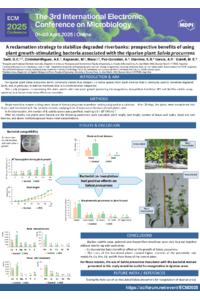
The riparian plant Salvia procurrens Benth (commonly named blue creeper) is a native species from South America that is commonly used to remediate degraded lands, and in particular, to stabilize riverbanks due to its environmental adaptation. This study proposes co-inoculating this plant species with two plant growth-promoting microorganisms, Azospirillum brasilense SP7 and Bacillus subtilis subsp. spizizenii, to enhance restoration effects on riversides. Single-node blue creeper cuttings were placed in forestry plug trays to produce rooting using sand as a substrate. After 20 days, the plants were transplanted into 3L pots and inoculated with the bacterial mixture, applying 5 mL of inoculum at the base of each plant's stem. After six months, the plants were harvest and the following parameters were evaluated: plant height, root length, number of leaves and nodes, shoot and root biomass, and above- and belowground heavy metal concentrations. In the bioinoculant, the number of B. subtilis spores was quantified, reaching 1.6 × 10⁵ CFU mL⁻¹. Bacterial inoculation had positive effects, increasing plant height (37%), root length (8%), and the number of leaves (57%) with respect to the control, but it had no effect on the number of nodes. Shoot and root dry weight in the inoculated plants more than doubled compared to the control, increasing by 117% and 167%, respectively. The roots of the inoculated plants showed higher contents of Fe, Cu, Mn, Cd, and Pb than those of the control plant. In particular, root Pb levels were more than 100% higher in the inoculated plants than in the non-inoculated plants. Co-inoculation was proven to have a beneficial effect not only in enhancing the growth of S. procurrens, making it ideal as ground cover in revegetation programs for riparian areas, but also for its capacity to accumulate metals.
Keywords
PGPR
Salvia procurens
Bacillus subtilis
Poster
Sarti GC.pdf
Silent mupirocin resistance in methicillin-resistant Staphylococcus aureus
Characteristics of Biofilms Formed by Bacillus subtilis subsp. spizizenii Growing in a Simple Culture Medium with two Different Carbon Sources