Event submissions
Published
This submission belongs to the session S1. Microbial Characterization and Bioprocess of the event The 3rd International Electronic Conference on Microbiology
Published date
31 Mar, 2025
Academic Editor
'%3e%3cpath%20d='M12.6657%2010.9104C12.4185%2010.325%2012.0599%209.79327%2011.6097%209.34482C11.1609%208.89508%2010.6293%208.5365%2010.0442%208.28888C10.0389%208.28626%2010.0337%208.28495%2010.0285%208.28233C10.8446%207.69279%2011.3752%206.73249%2011.3752%205.64904C11.3752%203.8542%209.92103%202.39999%208.1262%202.39999C6.33136%202.39999%204.87715%203.8542%204.87715%205.64904C4.87715%206.73249%205.40774%207.69279%206.22393%208.28364C6.21869%208.28626%206.21345%208.28757%206.20821%208.29019C5.62129%208.5378%205.09463%208.89284%204.64265%209.34613C4.1929%209.79493%203.83432%2010.3266%203.58671%2010.9117C3.34345%2011.4845%203.21226%2012.0987%203.20023%2012.7209C3.19988%2012.7349%203.20233%2012.7488%203.20744%2012.7619C3.21255%2012.7749%203.22022%2012.7867%203.22998%2012.7968C3.23975%2012.8068%203.25142%2012.8147%203.26431%2012.8202C3.2772%2012.8256%203.29105%2012.8284%203.30504%2012.8284H4.09109C4.14874%2012.8284%204.19459%2012.7825%204.1959%2012.7262C4.2221%2011.7148%204.62823%2010.7676%205.34617%2010.0497C6.08899%209.30683%207.0755%208.89808%208.1262%208.89808C9.17689%208.89808%2010.1634%209.30683%2010.9062%2010.0497C11.6242%2010.7676%2012.0303%2011.7148%2012.0565%2012.7262C12.0578%2012.7838%2012.1037%2012.8284%2012.1613%2012.8284H12.9474C12.9613%2012.8284%2012.9752%2012.8256%2012.9881%2012.8202C13.001%2012.8147%2013.0126%2012.8068%2013.0224%2012.7968C13.0322%2012.7867%2013.0398%2012.7749%2013.0449%2012.7619C13.0501%2012.7488%2013.0525%2012.7349%2013.0522%2012.7209C13.0391%2012.0947%2012.9094%2011.4855%2012.6657%2010.9104ZM8.1262%207.9024C7.52486%207.9024%206.9589%207.6679%206.53312%207.24211C6.10733%206.81633%205.87283%206.25037%205.87283%205.64904C5.87283%205.0477%206.10733%204.48174%206.53312%204.05596C6.9589%203.63018%207.52486%203.39567%208.1262%203.39567C8.72753%203.39567%209.29349%203.63018%209.71927%204.05596C10.1451%204.48174%2010.3796%205.0477%2010.3796%205.64904C10.3796%206.25037%2010.1451%206.81633%209.71927%207.24211C9.29349%207.6679%208.72753%207.9024%208.1262%207.9024Z'%20fill='%235D1EE1'/%3e%3c/g%3e%3c/svg%3e) Laurent Dufossé
Laurent DufosséCitation
Gabriela Cristina Sarti, Josefina Ana Eva Cristóbal-Miguez, Antonio Paz-González, Ivanna Lorena Avram, Elizabeth García-Guzmán, Andrea Belén Alegre, Ana Rosa García, Mirta Esther Galelli, Characteristics of Biofilms Formed by Bacillus subtilis subsp. spizizenii Growing in a Simple Culture Medium with two Different Carbon Sources, in Proceedings of The 3rd International Electronic Conference on Microbiology, 1 April–3 April 2025, MDPI: Basel, Switzerland
Share
Email
Facebook
Twitter
LinkedIn
Characteristics of Biofilms Formed by Bacillus subtilis subsp. spizizenii Growing in a Simple Culture Medium with two Different Carbon Sources
'%3e%3cpath%20d='M12.6647%2010.9104C12.4176%2010.325%2012.0589%209.7933%2011.6088%209.34485C11.16%208.89511%2010.6283%208.53653%2010.0432%208.28891C10.038%208.28629%2010.0327%208.28498%2010.0275%208.28236C10.8437%207.69282%2011.3743%206.73252%2011.3743%205.64907C11.3743%203.85423%209.92005%202.40002%208.12522%202.40002C6.33038%202.40002%204.87618%203.85423%204.87618%205.64907C4.87618%206.73252%205.40677%207.69282%206.22296%208.28367C6.21772%208.28629%206.21248%208.2876%206.20724%208.29022C5.62031%208.53783%205.09365%208.89287%204.64167%209.34616C4.19192%209.79496%203.83334%2010.3266%203.58573%2010.9117C3.34247%2011.4846%203.21128%2012.0987%203.19925%2012.721C3.1989%2012.735%203.20135%2012.7489%203.20646%2012.7619C3.21157%2012.7749%203.21924%2012.7868%203.22901%2012.7968C3.23877%2012.8068%203.25045%2012.8148%203.26334%2012.8202C3.27623%2012.8256%203.29007%2012.8284%203.30406%2012.8284H4.09012C4.14776%2012.8284%204.19362%2012.7825%204.19493%2012.7262C4.22113%2011.7148%204.62726%2010.7676%205.34519%2010.0497C6.08802%209.30686%207.07452%208.89811%208.12522%208.89811C9.17592%208.89811%2010.1624%209.30686%2010.9052%2010.0497C11.6232%2010.7676%2012.0293%2011.7148%2012.0555%2012.7262C12.0568%2012.7839%2012.1027%2012.8284%2012.1603%2012.8284H12.9464C12.9604%2012.8284%2012.9742%2012.8256%2012.9871%2012.8202C13%2012.8148%2013.0117%2012.8068%2013.0214%2012.7968C13.0312%2012.7868%2013.0389%2012.7749%2013.044%2012.7619C13.0491%2012.7489%2013.0515%2012.735%2013.0512%2012.721C13.0381%2012.0947%2012.9084%2011.4856%2012.6647%2010.9104ZM8.12522%207.90243C7.52388%207.90243%206.95792%207.66793%206.53214%207.24215C6.10636%206.81636%205.87185%206.2504%205.87185%205.64907C5.87185%205.04773%206.10636%204.48177%206.53214%204.05599C6.95792%203.63021%207.52388%203.3957%208.12522%203.3957C8.72655%203.3957%209.29252%203.63021%209.7183%204.05599C10.1441%204.48177%2010.3786%205.04773%2010.3786%205.64907C10.3786%206.2504%2010.1441%206.81636%209.7183%207.24215C9.29252%207.66793%208.72655%207.90243%208.12522%207.90243Z'%20fill='%235D1EE1'/%3e%3c/g%3e%3c/svg%3e)
Gabriela Cristina Sarti 1,2
Josefina Ana Eva Cristóbal-Miguez 1

Antonio Paz-González 2
Ivanna Lorena Avram 1
Elizabeth García-Guzmán 1
Andrea Belén Alegre 1
Ana Rosa García 1
Mirta Esther Galelli 3
1. Inorganic and Analytical Chemistry Cathedra, Department of Natural Resources and Environment, Faculty of Agronomy, University of Buenos Aires, Av. San Martín 4453, Buenos Aires C1417DSE, Argentina
2. AQUATERRA Research Group, Interdisciplinary Center for Chemistry and Biology, CICA, As Carballeiras, s/n Campus de Elviña, University of A Coruna, 15008 Coruna, Spain
3. Agrofood Area, Department of Applied Biology and Food, Faculty of Agronomy, University of Buenos Aires, Av. San Martín 4453, Buenos Aires C1417DSE, Argentina
Abstract
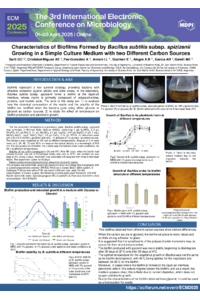
Biofilms represent a key survival strategy, providing bacteria with effective protection against abiotic and biotic stress. In the laboratory, Bacillus subtilis subsp. spizizenii forms a biofilm at the liquid–air interface, the matrix of which is primarily composed of polysaccharides, proteins, and nucleic acids. The aims of this study are as follows: 1) to evaluate how the chemical composition of the matrix and the stability of the biofilm are modified when the bacteria grow using either glucose or glycerol as carbon sources; 2) to study the effect of temperature on biofilm production and planktonic growth. The bacteria were cultured in a saline medium with 55 mM L-glutamic acid and 1% glucose or glycerol at different temperatures. Biofilm was produced under static conditions and planktonic cells by shaking at 150 rpm. Biofilms were analyzed by high-resolution chromatography. In the presence of glucose, polysaccharide monomers at the biofilm matrix showed substitutions that conferred acidic properties. This biofilm disintegrated after 5 days at 20 °C and 15 days at 4 °C. In contrast, when cultured with glycerol, the polysaccharide sugars were neutral, and the biofilm disintegrated after 20 days at 20 °C and 60 days at 4 °C; visually, this biofilm was more compact. Planktonic growth of B. subtilis was highest at 45 °C, whereas the maximum biofilm formation (1.2 mg/mL of culture) was achieved between 30 °C and 37 °C. In the static cultures, the planktonic form of B. subtillis disappeared within 24 hours after biofilm synthesis. In conclusion, the biofilms obtained from different carbon sources show differences, suggesting that the substituents of the polysaccharide monomers might be crucial for their structural properties. Moreover, in cases where the biofilm was formed at the liquid–air interface, the planktonic cells developed in this culture migrated toward the biofilm and as a result, the medium appeared clear; this was likely due to to nutrient depletion, which does not support planktonic growth.
Keywords
biofilm
Bacillus subtilis
glycerol
Poster
Sarti GC Biofilm.pdf
A reclamation strategy to stabilize degraded riverbanks: prospective benefits of using plant growth-stimulating bacteria associated with the riparian plant Salvia procurrens
Preliminary data on biodiversity effects of replacing plastic row covers with legume and non-leguminous covers in organic artichoke cropping