Event submissions
Published
This submission belongs to the session S1. Microbial Characterization and Bioprocess of the event The 3rd International Electronic Conference on Microbiology
Published date
31 Mar, 2025
Academic Editor
'%3e%3cpath%20d='M12.6657%2010.9104C12.4185%2010.325%2012.0599%209.79327%2011.6097%209.34482C11.1609%208.89508%2010.6293%208.5365%2010.0442%208.28888C10.0389%208.28626%2010.0337%208.28495%2010.0285%208.28233C10.8446%207.69279%2011.3752%206.73249%2011.3752%205.64904C11.3752%203.8542%209.92103%202.39999%208.1262%202.39999C6.33136%202.39999%204.87715%203.8542%204.87715%205.64904C4.87715%206.73249%205.40774%207.69279%206.22393%208.28364C6.21869%208.28626%206.21345%208.28757%206.20821%208.29019C5.62129%208.5378%205.09463%208.89284%204.64265%209.34613C4.1929%209.79493%203.83432%2010.3266%203.58671%2010.9117C3.34345%2011.4845%203.21226%2012.0987%203.20023%2012.7209C3.19988%2012.7349%203.20233%2012.7488%203.20744%2012.7619C3.21255%2012.7749%203.22022%2012.7867%203.22998%2012.7968C3.23975%2012.8068%203.25142%2012.8147%203.26431%2012.8202C3.2772%2012.8256%203.29105%2012.8284%203.30504%2012.8284H4.09109C4.14874%2012.8284%204.19459%2012.7825%204.1959%2012.7262C4.2221%2011.7148%204.62823%2010.7676%205.34617%2010.0497C6.08899%209.30683%207.0755%208.89808%208.1262%208.89808C9.17689%208.89808%2010.1634%209.30683%2010.9062%2010.0497C11.6242%2010.7676%2012.0303%2011.7148%2012.0565%2012.7262C12.0578%2012.7838%2012.1037%2012.8284%2012.1613%2012.8284H12.9474C12.9613%2012.8284%2012.9752%2012.8256%2012.9881%2012.8202C13.001%2012.8147%2013.0126%2012.8068%2013.0224%2012.7968C13.0322%2012.7867%2013.0398%2012.7749%2013.0449%2012.7619C13.0501%2012.7488%2013.0525%2012.7349%2013.0522%2012.7209C13.0391%2012.0947%2012.9094%2011.4855%2012.6657%2010.9104ZM8.1262%207.9024C7.52486%207.9024%206.9589%207.6679%206.53312%207.24211C6.10733%206.81633%205.87283%206.25037%205.87283%205.64904C5.87283%205.0477%206.10733%204.48174%206.53312%204.05596C6.9589%203.63018%207.52486%203.39567%208.1262%203.39567C8.72753%203.39567%209.29349%203.63018%209.71927%204.05596C10.1451%204.48174%2010.3796%205.0477%2010.3796%205.64904C10.3796%206.25037%2010.1451%206.81633%209.71927%207.24211C9.29349%207.6679%208.72753%207.9024%208.1262%207.9024Z'%20fill='%235D1EE1'/%3e%3c/g%3e%3c/svg%3e) Laurent Dufossé
Laurent DufosséCitation
Nataliia Tkachuk, Liubov Zelena, Yaroslav Novikov, Evaluation of the sensitivity of sulfate-reducing bacteria and indicators of the microbiologically influenced corrosion of steel under the influence of dimethyl sulfoxide, in Proceedings of The 3rd International Electronic Conference on Microbiology, 1 April–3 April 2025, MDPI: Basel, Switzerland
Share
Email
Facebook
Twitter
LinkedIn
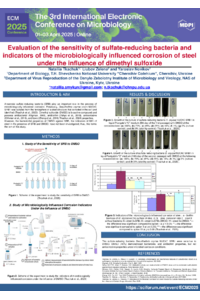
Evaluation of the sensitivity of sulfate-reducing bacteria and indicators of the microbiologically influenced corrosion of steel under the influence of dimethyl sulfoxide
'%3e%3cpath%20d='M12.6647%2010.9104C12.4176%2010.325%2012.0589%209.7933%2011.6088%209.34485C11.16%208.89511%2010.6283%208.53653%2010.0432%208.28891C10.038%208.28629%2010.0327%208.28498%2010.0275%208.28236C10.8437%207.69282%2011.3743%206.73252%2011.3743%205.64907C11.3743%203.85423%209.92005%202.40002%208.12522%202.40002C6.33038%202.40002%204.87618%203.85423%204.87618%205.64907C4.87618%206.73252%205.40677%207.69282%206.22296%208.28367C6.21772%208.28629%206.21248%208.2876%206.20724%208.29022C5.62031%208.53783%205.09365%208.89287%204.64167%209.34616C4.19192%209.79496%203.83334%2010.3266%203.58573%2010.9117C3.34247%2011.4846%203.21128%2012.0987%203.19925%2012.721C3.1989%2012.735%203.20135%2012.7489%203.20646%2012.7619C3.21157%2012.7749%203.21924%2012.7868%203.22901%2012.7968C3.23877%2012.8068%203.25045%2012.8148%203.26334%2012.8202C3.27623%2012.8256%203.29007%2012.8284%203.30406%2012.8284H4.09012C4.14776%2012.8284%204.19362%2012.7825%204.19493%2012.7262C4.22113%2011.7148%204.62726%2010.7676%205.34519%2010.0497C6.08802%209.30686%207.07452%208.89811%208.12522%208.89811C9.17592%208.89811%2010.1624%209.30686%2010.9052%2010.0497C11.6232%2010.7676%2012.0293%2011.7148%2012.0555%2012.7262C12.0568%2012.7839%2012.1027%2012.8284%2012.1603%2012.8284H12.9464C12.9604%2012.8284%2012.9742%2012.8256%2012.9871%2012.8202C13%2012.8148%2013.0117%2012.8068%2013.0214%2012.7968C13.0312%2012.7868%2013.0389%2012.7749%2013.044%2012.7619C13.0491%2012.7489%2013.0515%2012.735%2013.0512%2012.721C13.0381%2012.0947%2012.9084%2011.4856%2012.6647%2010.9104ZM8.12522%207.90243C7.52388%207.90243%206.95792%207.66793%206.53214%207.24215C6.10636%206.81636%205.87185%206.2504%205.87185%205.64907C5.87185%205.04773%206.10636%204.48177%206.53214%204.05599C6.95792%203.63021%207.52388%203.3957%208.12522%203.3957C8.72655%203.3957%209.29252%203.63021%209.7183%204.05599C10.1441%204.48177%2010.3786%205.04773%2010.3786%205.64907C10.3786%206.2504%2010.1441%206.81636%209.7183%207.24215C9.29252%207.66793%208.72655%207.90243%208.12522%207.90243Z'%20fill='%235D1EE1'/%3e%3c/g%3e%3c/svg%3e)
Nataliia Tkachuk 1
Liubov Zelena 2
Yaroslav Novikov 3
1. Department of Biology, Faculty of Mathematics and Natural Sciences, T.H. Shevchenko National University “Chernihiv Colehium”, 14013 Chernihiv, Ukraine
2. Department of Virus Reproduction, Danylo Zabolotny Institute Microbiology and Virology NAS of Ukraine, Kyiv, Ukraine
3. Department of Biology, T.H. Shevchenko National University “Chernihiv Colehium”
Abstract
Anaerobic sulfate-reducing bacteria (SRB) play an important role in the process of microbiologically influenced corrosion (MIC). In the study of corrosion processes without bacteria with the participation of DMSO, an increase in the rate of corrosion of metals was shown. However, the bactericidal properties of DMSO against SRB, the indicators of MIC of steel in the presence of SRB and DMSO, have not been investigated; thus, this forms the aim of this study. The sensitivity of SRB Desulfovibrio oryzae strain NUChC SRB1 (accession number in GenBank is MT102713.1) to DMSO at concentrations of 1%-100% (v/v) was investigated by the method of dilution in liquid Postgate’s “C” medium. The corrosion activity of D. oryzae strain NUChC SRB1 against steel 3 with the addition DMSO (final concentration of 45%) was investigated by the biofilm formation ability based on biofilm biomass on the surface of steel samples (crystal violet method) and the effect on corrosion rate (gravimetric method). SRB and DMSO were not added in the control. Corrosion research took place for 35 days in Eppendorf-type tubes (50 mL) under anaerobic conditions and at a temperature of 29 ± 2 ºС. Statistical analysis was carried out. It was found that DMSO with a concentration of 10% to 100% exhibits antibacterial properties against the studied SRB. Adding DMSO to the medium with bacteria ensured a significant reduction in biofilm biomass. Therefore, DMSO, despite its bactericidal properties and ability to inhibit biofilm formation, does not demonstrate inhibiting activity against microbiologically influenced corrosion in the presence of SRB.
Keywords
microbiologically influenced corrosion
soil microbiology
sulfate-reducing bacteria
dimethyl sulfoxide
Poster
sciforum-105068-Tkachuk_Zelena_Novikov.pdf
Harnessing Antioxidant-Producing Rhizobacteria to Boost Loquat Oxidative Stress Defense Under Adverse Environmental Conditions