Event submissions
Published
This submission belongs to the session S6. Antioxidants Extraction, Assay and Industrial Applications of the event The 2nd International Electronic Conference on Antioxidants
Published date
04 Apr, 2025
Academic Editor
'%3e%3cpath%20d='M12.6657%2010.9104C12.4185%2010.325%2012.0599%209.79327%2011.6097%209.34482C11.1609%208.89508%2010.6293%208.5365%2010.0442%208.28888C10.0389%208.28626%2010.0337%208.28495%2010.0285%208.28233C10.8446%207.69279%2011.3752%206.73249%2011.3752%205.64904C11.3752%203.8542%209.92103%202.39999%208.1262%202.39999C6.33136%202.39999%204.87715%203.8542%204.87715%205.64904C4.87715%206.73249%205.40774%207.69279%206.22393%208.28364C6.21869%208.28626%206.21345%208.28757%206.20821%208.29019C5.62129%208.5378%205.09463%208.89284%204.64265%209.34613C4.1929%209.79493%203.83432%2010.3266%203.58671%2010.9117C3.34345%2011.4845%203.21226%2012.0987%203.20023%2012.7209C3.19988%2012.7349%203.20233%2012.7488%203.20744%2012.7619C3.21255%2012.7749%203.22022%2012.7867%203.22998%2012.7968C3.23975%2012.8068%203.25142%2012.8147%203.26431%2012.8202C3.2772%2012.8256%203.29105%2012.8284%203.30504%2012.8284H4.09109C4.14874%2012.8284%204.19459%2012.7825%204.1959%2012.7262C4.2221%2011.7148%204.62823%2010.7676%205.34617%2010.0497C6.08899%209.30683%207.0755%208.89808%208.1262%208.89808C9.17689%208.89808%2010.1634%209.30683%2010.9062%2010.0497C11.6242%2010.7676%2012.0303%2011.7148%2012.0565%2012.7262C12.0578%2012.7838%2012.1037%2012.8284%2012.1613%2012.8284H12.9474C12.9613%2012.8284%2012.9752%2012.8256%2012.9881%2012.8202C13.001%2012.8147%2013.0126%2012.8068%2013.0224%2012.7968C13.0322%2012.7867%2013.0398%2012.7749%2013.0449%2012.7619C13.0501%2012.7488%2013.0525%2012.7349%2013.0522%2012.7209C13.0391%2012.0947%2012.9094%2011.4855%2012.6657%2010.9104ZM8.1262%207.9024C7.52486%207.9024%206.9589%207.6679%206.53312%207.24211C6.10733%206.81633%205.87283%206.25037%205.87283%205.64904C5.87283%205.0477%206.10733%204.48174%206.53312%204.05596C6.9589%203.63018%207.52486%203.39567%208.1262%203.39567C8.72753%203.39567%209.29349%203.63018%209.71927%204.05596C10.1451%204.48174%2010.3796%205.0477%2010.3796%205.64904C10.3796%206.25037%2010.1451%206.81633%209.71927%207.24211C9.29349%207.6679%208.72753%207.9024%208.1262%207.9024Z'%20fill='%235D1EE1'/%3e%3c/g%3e%3c/svg%3e) Alessandra Napolitano
Alessandra NapolitanoCitation
Ivan Cruz-Chamorro, Eva-María Valero-Blanco, Rocío Rodríguez-Arcos, Justo Pedroche, Guillermo Santos-Sánchez, Isabel Cerrillo, Blanca Escudero-López, María-Soledad Fernández-Pachón, Wines from honey-fermented orange juice possess antioxidant properties, in Proceedings of The 2nd International Electronic Conference on Antioxidants, 7 April–9 April 2025, MDPI: Basel, Switzerland
Share
Email
Facebook
Twitter
LinkedIn
Wines from honey-fermented orange juice possess antioxidant properties

Ivan Cruz-Chamorro 1,2
'%3e%3cpath%20d='M12.6647%2010.9104C12.4176%2010.325%2012.0589%209.7933%2011.6088%209.34485C11.16%208.89511%2010.6283%208.53653%2010.0432%208.28891C10.038%208.28629%2010.0327%208.28498%2010.0275%208.28236C10.8437%207.69282%2011.3743%206.73252%2011.3743%205.64907C11.3743%203.85423%209.92005%202.40002%208.12522%202.40002C6.33038%202.40002%204.87618%203.85423%204.87618%205.64907C4.87618%206.73252%205.40677%207.69282%206.22296%208.28367C6.21772%208.28629%206.21248%208.2876%206.20724%208.29022C5.62031%208.53783%205.09365%208.89287%204.64167%209.34616C4.19192%209.79496%203.83334%2010.3266%203.58573%2010.9117C3.34247%2011.4846%203.21128%2012.0987%203.19925%2012.721C3.1989%2012.735%203.20135%2012.7489%203.20646%2012.7619C3.21157%2012.7749%203.21924%2012.7868%203.22901%2012.7968C3.23877%2012.8068%203.25045%2012.8148%203.26334%2012.8202C3.27623%2012.8256%203.29007%2012.8284%203.30406%2012.8284H4.09012C4.14776%2012.8284%204.19362%2012.7825%204.19493%2012.7262C4.22113%2011.7148%204.62726%2010.7676%205.34519%2010.0497C6.08802%209.30686%207.07452%208.89811%208.12522%208.89811C9.17592%208.89811%2010.1624%209.30686%2010.9052%2010.0497C11.6232%2010.7676%2012.0293%2011.7148%2012.0555%2012.7262C12.0568%2012.7839%2012.1027%2012.8284%2012.1603%2012.8284H12.9464C12.9604%2012.8284%2012.9742%2012.8256%2012.9871%2012.8202C13%2012.8148%2013.0117%2012.8068%2013.0214%2012.7968C13.0312%2012.7868%2013.0389%2012.7749%2013.044%2012.7619C13.0491%2012.7489%2013.0515%2012.735%2013.0512%2012.721C13.0381%2012.0947%2012.9084%2011.4856%2012.6647%2010.9104ZM8.12522%207.90243C7.52388%207.90243%206.95792%207.66793%206.53214%207.24215C6.10636%206.81636%205.87185%206.2504%205.87185%205.64907C5.87185%205.04773%206.10636%204.48177%206.53214%204.05599C6.95792%203.63021%207.52388%203.3957%208.12522%203.3957C8.72655%203.3957%209.29252%203.63021%209.7183%204.05599C10.1441%204.48177%2010.3786%205.04773%2010.3786%205.64907C10.3786%206.2504%2010.1441%206.81636%209.7183%207.24215C9.29252%207.66793%208.72655%207.90243%208.12522%207.90243Z'%20fill='%235D1EE1'/%3e%3c/g%3e%3c/svg%3e)
Eva-María Valero-Blanco 1

Rocío Rodríguez-Arcos 3
Justo Pedroche 4

Guillermo Santos-Sánchez 5

Isabel Cerrillo 6
Blanca Escudero-López 1

María-Soledad Fernández-Pachón 6
1. Área de Nutrición y Bromatología, Departamento de Biología Molecular e Ingeniería Bioquímica, Universidad Pablo de Olavide, Ctra. Utrera Km 1, 41013 Seville, Spain
2. Facultad de Enfermería, Universidad de Castilla-La Mancha, 02071 Albacete, Spain
3. Grupo Fitoquímicos y Calidad de los Alimentos, Instituto de la Grasa-CSIC, 41013 Seville, Spain
4. Department of Food & Health, Instituto de la Grasa, CSIC, Ctra, Utrera Km 1, 41013 Seville, Spain.
5. Instituto de Investigación en Ciencias de la Alimentación, CIAL (CSIC-UAM), 28049 Madrid, Spain
6. Área de Nutrición y Bromatología, Departamento de Biología Molecular e Ingeniería Bioquímica, Universidad Pablo de Olavide, Ctra. Utrera Km 1, 41013 Sevilla, Spain
Abstract
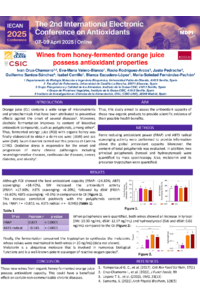
Orange juice (OJ) contains a wide range of micronutrients and phytochemicals that have been found to exhibit preventive effects against the onset of several diseases. Moreover, alcoholic fermentation improves its content of bioactive antioxidant compounds. Thus, fermented orange juice (FOJ) with organic honey was finally investigated to obtain a demi-sec wine (dSW) and sec wine (SW). Sauro Giannini carried out this process at Cantina CITRO. Oxidative stress is responsible for the onset and progression of many chronic pathologies, including neurodegenerative diseases, cardiovascular diseases, cancer, diabetes, and obesity.
Thus, this study aimed to assess the antioxidant capacity of these new organic products to provide scientific evidence of their possible health benefits.
Using colorimetric assays, ferric reducing antioxidant power (FRAP) and ABTS radical scavenging activity (ARSA) were tested to provide information about the global antioxidant capacity. Moreover, the content of total polyphenols was evaluated. In addition, two principal polyphenols (tyrosol and hydroxytyrosol) were quantified by means of mass spectroscopy. Also, melatonin and its precursor tryptophan were quantified.
Although FOJ showed the best antioxidant capacity (FRAP: +24.30%; ARSA: +18.40%), SW increased the antioxidant activity (FRAP: +17.30%; ARSA: +6.20%), followed by dSW (FRAP: +16.60%; ARSA: +0.5%). This increase correlated positively with the polyphenol content (vs. FRAP: r = +0.872; vs. ABTS radical: r = −0.945). When polyphenols were quantified, both wines showed an increase in tyrosol (SW: 10.33 ng/mL; dSW: 12.57 ng/mL) and hydroxytyrosol (SW and dSW: 0.02 ng/mL) compared to the OJ. Finally, the fermentation consumed the tryptophan to synthesize the melatonin, whose values were maintained in both wines (≈ 20ng/mL). Melatonin is a ubiquitous molecule that is involved in numerous biological functions and is a well-known potent scavenger of reactive oxygen species.
In conclusion, these new wines from organic honey-fermented orange juice possess antioxidant capacity.
Keywords
Organic food
Tyrosol
FRAP
ABTS
Poster
Cruz-Chamorro et al.pdf
Sustainable Antioxidants: Exploring Beer By-Products for Cosmetic and Pharmaceutical Applications