Event submissions
Published
This submission belongs to the session S6. Antioxidants Extraction, Assay and Industrial Applications of the event The 2nd International Electronic Conference on Antioxidants
Published date
04 Apr, 2025
Academic Editor
'%3e%3cpath%20d='M12.6657%2010.9104C12.4185%2010.325%2012.0599%209.79327%2011.6097%209.34482C11.1609%208.89508%2010.6293%208.5365%2010.0442%208.28888C10.0389%208.28626%2010.0337%208.28495%2010.0285%208.28233C10.8446%207.69279%2011.3752%206.73249%2011.3752%205.64904C11.3752%203.8542%209.92103%202.39999%208.1262%202.39999C6.33136%202.39999%204.87715%203.8542%204.87715%205.64904C4.87715%206.73249%205.40774%207.69279%206.22393%208.28364C6.21869%208.28626%206.21345%208.28757%206.20821%208.29019C5.62129%208.5378%205.09463%208.89284%204.64265%209.34613C4.1929%209.79493%203.83432%2010.3266%203.58671%2010.9117C3.34345%2011.4845%203.21226%2012.0987%203.20023%2012.7209C3.19988%2012.7349%203.20233%2012.7488%203.20744%2012.7619C3.21255%2012.7749%203.22022%2012.7867%203.22998%2012.7968C3.23975%2012.8068%203.25142%2012.8147%203.26431%2012.8202C3.2772%2012.8256%203.29105%2012.8284%203.30504%2012.8284H4.09109C4.14874%2012.8284%204.19459%2012.7825%204.1959%2012.7262C4.2221%2011.7148%204.62823%2010.7676%205.34617%2010.0497C6.08899%209.30683%207.0755%208.89808%208.1262%208.89808C9.17689%208.89808%2010.1634%209.30683%2010.9062%2010.0497C11.6242%2010.7676%2012.0303%2011.7148%2012.0565%2012.7262C12.0578%2012.7838%2012.1037%2012.8284%2012.1613%2012.8284H12.9474C12.9613%2012.8284%2012.9752%2012.8256%2012.9881%2012.8202C13.001%2012.8147%2013.0126%2012.8068%2013.0224%2012.7968C13.0322%2012.7867%2013.0398%2012.7749%2013.0449%2012.7619C13.0501%2012.7488%2013.0525%2012.7349%2013.0522%2012.7209C13.0391%2012.0947%2012.9094%2011.4855%2012.6657%2010.9104ZM8.1262%207.9024C7.52486%207.9024%206.9589%207.6679%206.53312%207.24211C6.10733%206.81633%205.87283%206.25037%205.87283%205.64904C5.87283%205.0477%206.10733%204.48174%206.53312%204.05596C6.9589%203.63018%207.52486%203.39567%208.1262%203.39567C8.72753%203.39567%209.29349%203.63018%209.71927%204.05596C10.1451%204.48174%2010.3796%205.0477%2010.3796%205.64904C10.3796%206.25037%2010.1451%206.81633%209.71927%207.24211C9.29349%207.6679%208.72753%207.9024%208.1262%207.9024Z'%20fill='%235D1EE1'/%3e%3c/g%3e%3c/svg%3e) Ren-You Gan
Ren-You GanCitation
Shiwa Chaubey, Nisheeth Rastogi, Manjoosha Srivastava, Bioactive Potential of Lantana camara Leaf Extracts: Phytochemical Composition, Antioxidant, Anti-Diabetic, and Antimicrobial Activities, and Molecular Docking analysis, in Proceedings of The 2nd International Electronic Conference on Antioxidants, 7 April–9 April 2025, MDPI: Basel, Switzerland
Share
Email
Facebook
Twitter
LinkedIn
Bioactive Potential of Lantana camara Leaf Extracts: Phytochemical Composition, Antioxidant, Anti-Diabetic, and Antimicrobial Activities, and Molecular Docking analysis
'%3e%3cpath%20d='M12.6647%2010.9104C12.4176%2010.325%2012.0589%209.7933%2011.6088%209.34485C11.16%208.89511%2010.6283%208.53653%2010.0432%208.28891C10.038%208.28629%2010.0327%208.28498%2010.0275%208.28236C10.8437%207.69282%2011.3743%206.73252%2011.3743%205.64907C11.3743%203.85423%209.92005%202.40002%208.12522%202.40002C6.33038%202.40002%204.87618%203.85423%204.87618%205.64907C4.87618%206.73252%205.40677%207.69282%206.22296%208.28367C6.21772%208.28629%206.21248%208.2876%206.20724%208.29022C5.62031%208.53783%205.09365%208.89287%204.64167%209.34616C4.19192%209.79496%203.83334%2010.3266%203.58573%2010.9117C3.34247%2011.4846%203.21128%2012.0987%203.19925%2012.721C3.1989%2012.735%203.20135%2012.7489%203.20646%2012.7619C3.21157%2012.7749%203.21924%2012.7868%203.22901%2012.7968C3.23877%2012.8068%203.25045%2012.8148%203.26334%2012.8202C3.27623%2012.8256%203.29007%2012.8284%203.30406%2012.8284H4.09012C4.14776%2012.8284%204.19362%2012.7825%204.19493%2012.7262C4.22113%2011.7148%204.62726%2010.7676%205.34519%2010.0497C6.08802%209.30686%207.07452%208.89811%208.12522%208.89811C9.17592%208.89811%2010.1624%209.30686%2010.9052%2010.0497C11.6232%2010.7676%2012.0293%2011.7148%2012.0555%2012.7262C12.0568%2012.7839%2012.1027%2012.8284%2012.1603%2012.8284H12.9464C12.9604%2012.8284%2012.9742%2012.8256%2012.9871%2012.8202C13%2012.8148%2013.0117%2012.8068%2013.0214%2012.7968C13.0312%2012.7868%2013.0389%2012.7749%2013.044%2012.7619C13.0491%2012.7489%2013.0515%2012.735%2013.0512%2012.721C13.0381%2012.0947%2012.9084%2011.4856%2012.6647%2010.9104ZM8.12522%207.90243C7.52388%207.90243%206.95792%207.66793%206.53214%207.24215C6.10636%206.81636%205.87185%206.2504%205.87185%205.64907C5.87185%205.04773%206.10636%204.48177%206.53214%204.05599C6.95792%203.63021%207.52388%203.3957%208.12522%203.3957C8.72655%203.3957%209.29252%203.63021%209.7183%204.05599C10.1441%204.48177%2010.3786%205.04773%2010.3786%205.64907C10.3786%206.2504%2010.1441%206.81636%209.7183%207.24215C9.29252%207.66793%208.72655%207.90243%208.12522%207.90243Z'%20fill='%235D1EE1'/%3e%3c/g%3e%3c/svg%3e)
Shiwa Chaubey 1
Nisheeth Rastogi 2
Manjoosha Srivastava 1
1. Phytochemistry, CSIR - National Botanical Research Institute (NBRI), Phytochemistry Division, Lucknow, 226002, India.
2. Department of Chemistry, Lucknow Christian Post-Graduate College, Lucknow 226018, Uttar Pradesh, India.
Abstract
Lantana camara, which is used in Indian traditional medicine, was analysed to determine its phytochemicals and biological activities. The leaves were dried (250 g) and subjected to maceration and Soxhlet extraction techniques, employing solvents of increasing polarity. Chemical profiling was carried out using GC-MS, and the concentration of phenolics, flavonoids, alkaloids, and other bioactive compounds were determined using UV spectrophotometry. Preliminary phytochemical tests also indicated the existence of these compounds in considerable quantities, therefore recommending their utilization in treatments. Antioxidant activity was determined using DPPH, FRAP, ABTS, phosphomolybdate, H₂O₂, •OH, nitric oxide, and Fe²⁺-chelating methods. The extracts had a relatively high antioxidant capacity, which decreased the oxidative damage at 50, 100, 150, 200, and 250 µg/mL. Antidiabetic activity was confirmed by testing for α-amylase inhibition using starch azure as a substrate. The inhibition profile was assessed at 595 nm, indicating that inhibition was dependent on the extract concentrations (10-100 µg/mL). The antibacterial activity of the extract was assessed using the agar well diffusion method, showing activity against Escherichia coli, Bacillus subtilis, Staphylococcus aureus, and Klebsiella pneumonia. The presence of antifungal activity against bacterial types such as Candida albicans, Aspergillus niger, Aspergillus flavus, and Aspergillus fumigatus showed that the plant has antifungal properties supported by its high-spectrum antimicrobial property. The molecular docking analytical results showed high-affinity interactions between the bioactive compound and the target protein, which further validated the plant's antioxidant and antimicrobial potential. Based on these outcomes, it seems that Lantana camara extracts have potential for utilization in the pharmaceutical and nutraceutical industries as natural antioxidants and antidiabetic and antimicrobial compounds. More research has to be carried out on their toxicity, medical uses, and other forms of extraction methods in order to increase efficacy and minimize toxicities.
Keywords
Lantana camara
Maceration
Soxhlet extraction
Phenolics
Flavonoids
Alkaloids
Antioxidant activity
Anti-diabetic activity
Antimicrobial activity
Molecular docking
Phytochemicals
GC-MS analysis
Poster
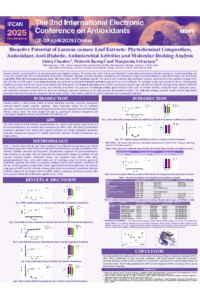
shiwa Antioxident.pdf
Grape pomace as significant source of antioxidants: Insights into variety effect and maximizing extraction yields
Optimizing the green synthesis of silver nanoparticles with pomegranate extract for antibacterial purposes: an innovative approach