Event submissions
Published
This submission belongs to the session S6. Antioxidants Extraction, Assay and Industrial Applications of the event The 2nd International Electronic Conference on Antioxidants
Published date
04 Apr, 2025
Academic Editor
'%3e%3cpath%20d='M12.6657%2010.9104C12.4185%2010.325%2012.0599%209.79327%2011.6097%209.34482C11.1609%208.89508%2010.6293%208.5365%2010.0442%208.28888C10.0389%208.28626%2010.0337%208.28495%2010.0285%208.28233C10.8446%207.69279%2011.3752%206.73249%2011.3752%205.64904C11.3752%203.8542%209.92103%202.39999%208.1262%202.39999C6.33136%202.39999%204.87715%203.8542%204.87715%205.64904C4.87715%206.73249%205.40774%207.69279%206.22393%208.28364C6.21869%208.28626%206.21345%208.28757%206.20821%208.29019C5.62129%208.5378%205.09463%208.89284%204.64265%209.34613C4.1929%209.79493%203.83432%2010.3266%203.58671%2010.9117C3.34345%2011.4845%203.21226%2012.0987%203.20023%2012.7209C3.19988%2012.7349%203.20233%2012.7488%203.20744%2012.7619C3.21255%2012.7749%203.22022%2012.7867%203.22998%2012.7968C3.23975%2012.8068%203.25142%2012.8147%203.26431%2012.8202C3.2772%2012.8256%203.29105%2012.8284%203.30504%2012.8284H4.09109C4.14874%2012.8284%204.19459%2012.7825%204.1959%2012.7262C4.2221%2011.7148%204.62823%2010.7676%205.34617%2010.0497C6.08899%209.30683%207.0755%208.89808%208.1262%208.89808C9.17689%208.89808%2010.1634%209.30683%2010.9062%2010.0497C11.6242%2010.7676%2012.0303%2011.7148%2012.0565%2012.7262C12.0578%2012.7838%2012.1037%2012.8284%2012.1613%2012.8284H12.9474C12.9613%2012.8284%2012.9752%2012.8256%2012.9881%2012.8202C13.001%2012.8147%2013.0126%2012.8068%2013.0224%2012.7968C13.0322%2012.7867%2013.0398%2012.7749%2013.0449%2012.7619C13.0501%2012.7488%2013.0525%2012.7349%2013.0522%2012.7209C13.0391%2012.0947%2012.9094%2011.4855%2012.6657%2010.9104ZM8.1262%207.9024C7.52486%207.9024%206.9589%207.6679%206.53312%207.24211C6.10733%206.81633%205.87283%206.25037%205.87283%205.64904C5.87283%205.0477%206.10733%204.48174%206.53312%204.05596C6.9589%203.63018%207.52486%203.39567%208.1262%203.39567C8.72753%203.39567%209.29349%203.63018%209.71927%204.05596C10.1451%204.48174%2010.3796%205.0477%2010.3796%205.64904C10.3796%206.25037%2010.1451%206.81633%209.71927%207.24211C9.29349%207.6679%208.72753%207.9024%208.1262%207.9024Z'%20fill='%235D1EE1'/%3e%3c/g%3e%3c/svg%3e) José A. Rufián-Henares
José A. Rufián-HenaresCitation
Inês Mansinhos, João Brás, Sandra Gonçalves, Raquel Rodríguez-Solana, Anabela Romano, Impact of UV-B Radiation on Antioxidant and Dye Removal Capacity of Thymus lotocephalus green extracts, in Proceedings of The 2nd International Electronic Conference on Antioxidants, 7 April–9 April 2025, MDPI: Basel, Switzerland
Share
Email
Facebook
Twitter
LinkedIn
Impact of UV-B Radiation on Antioxidant and Dye Removal Capacity of Thymus lotocephalus green extracts

Inês Mansinhos 1
'%3e%3cpath%20d='M12.6647%2010.9104C12.4176%2010.325%2012.0589%209.7933%2011.6088%209.34485C11.16%208.89511%2010.6283%208.53653%2010.0432%208.28891C10.038%208.28629%2010.0327%208.28498%2010.0275%208.28236C10.8437%207.69282%2011.3743%206.73252%2011.3743%205.64907C11.3743%203.85423%209.92005%202.40002%208.12522%202.40002C6.33038%202.40002%204.87618%203.85423%204.87618%205.64907C4.87618%206.73252%205.40677%207.69282%206.22296%208.28367C6.21772%208.28629%206.21248%208.2876%206.20724%208.29022C5.62031%208.53783%205.09365%208.89287%204.64167%209.34616C4.19192%209.79496%203.83334%2010.3266%203.58573%2010.9117C3.34247%2011.4846%203.21128%2012.0987%203.19925%2012.721C3.1989%2012.735%203.20135%2012.7489%203.20646%2012.7619C3.21157%2012.7749%203.21924%2012.7868%203.22901%2012.7968C3.23877%2012.8068%203.25045%2012.8148%203.26334%2012.8202C3.27623%2012.8256%203.29007%2012.8284%203.30406%2012.8284H4.09012C4.14776%2012.8284%204.19362%2012.7825%204.19493%2012.7262C4.22113%2011.7148%204.62726%2010.7676%205.34519%2010.0497C6.08802%209.30686%207.07452%208.89811%208.12522%208.89811C9.17592%208.89811%2010.1624%209.30686%2010.9052%2010.0497C11.6232%2010.7676%2012.0293%2011.7148%2012.0555%2012.7262C12.0568%2012.7839%2012.1027%2012.8284%2012.1603%2012.8284H12.9464C12.9604%2012.8284%2012.9742%2012.8256%2012.9871%2012.8202C13%2012.8148%2013.0117%2012.8068%2013.0214%2012.7968C13.0312%2012.7868%2013.0389%2012.7749%2013.044%2012.7619C13.0491%2012.7489%2013.0515%2012.735%2013.0512%2012.721C13.0381%2012.0947%2012.9084%2011.4856%2012.6647%2010.9104ZM8.12522%207.90243C7.52388%207.90243%206.95792%207.66793%206.53214%207.24215C6.10636%206.81636%205.87185%206.2504%205.87185%205.64907C5.87185%205.04773%206.10636%204.48177%206.53214%204.05599C6.95792%203.63021%207.52388%203.3957%208.12522%203.3957C8.72655%203.3957%209.29252%203.63021%209.7183%204.05599C10.1441%204.48177%2010.3786%205.04773%2010.3786%205.64907C10.3786%206.2504%2010.1441%206.81636%209.7183%207.24215C9.29252%207.66793%208.72655%207.90243%208.12522%207.90243Z'%20fill='%235D1EE1'/%3e%3c/g%3e%3c/svg%3e)
João Brás 1
Sandra Gonçalves 1

Raquel Rodríguez-Solana 1,2
Anabela Romano 1
1. MED – Mediterranean Institute for Agriculture, Environment and Development & CHANGE – Global Change and Sustainability Institute, Faculdade de Ciências e Tecnologia, Universidade do Algarve, Campus de Gambelas, 8005-139 Faro, Portugal
2. Department of Agroindustry and Food Quality, Andalusian Institute of Agricultural and Fisheries Research and Training (IFAPA), Rancho de la Merced Center, Carretera Cañada de la Loba (CA-3102) Km 3.1., SN, 11471 Jerez de la Frontera, Cádiz, Spain.
Abstract
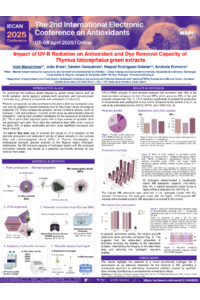
To counteract the oxidative stress induced by abiotic stress factors such as UV-B radiation, plants typically activate both enzymatic and non-enzymatic molecules (e.g., phenolic compounds) with antioxidant functions. The aim of this work was to evaluate the impact of UV-B radiation on the phenolics production and antioxidant activity of green from Thymus lotocephalus, an endangered aromatic species endemic to the Algarve (Portugal). Additionally, the methylene blue (MB) removal capacity of hydrogels loaded with the antioxidant extracts produced was tested as a potential eco-friendly strategy for dye removal from contaminated water. In vitro cultures (ICs) and micropropagated plants (MPs) of T. lotocephalus were subjected to two distinct treatments of UV-B radiation (4 hours/1 day or 4 hours/4 days). Following exposure to UV-B radiation, extracts were obtained through ultrasound-assisted extraction using a Natural Deep Eutectic Solvent, choline chloride--lactic acid (1:2). HPLC-HRMS analysis showed that UV-B significantly increased the production of the major compound (rosmarinic acid), especially in IC (+41% over the control). Furthermore, the antioxidant activity of the extracts, assessed through ABTS, DPPH, FRAP, and ORAC assays, was also enhanced by UV-B. Hydrogels were prepared by incorporating extracts from IC or MP. The ability of these hydrogels to adsorb MB was assessed, and the adsorption conditions were optimized using response surface methodology. Hydrogels made with UV-B-exposed MP extracts exhibited superior MB adsorption compared to controls. Antioxidant activity and MB adsorption were significantly positively correlated. This suggests that the antioxidant properties of phenolics enhance adsorption complex stability, maintaining adsorption site integrity and ensuring hydrogel's long-term stability. The findings highlight the potential of a novel eco-friendly hydrogel rich in antioxidants as effective adsorbents for MB removal. This innovation offers a sustainable approach to addressing wastewater pollution caused by synthetic dyes, contributing to environmental remediation efforts.
Keywords
Water pollution
sustainable hydrogel
polyphenols
HPLC-HRMS
antioxidant activity
Poster
Poster_sciforum-111711_InesMansinhos.pdf
Optimizing the green synthesis of silver nanoparticles with pomegranate extract for antibacterial purposes: an innovative approach
Phytochemical Screening and In Vitro Antioxidant Analysis of Medicinal Plants for Phyto-Pharmaceutical Resources