Event submissions
Published
This submission belongs to the session S3. Antioxidants in Chronic Disease: From Dietary Prevention to Therapeutic Intervention of the event The 2nd International Electronic Conference on Antioxidants
Published date
04 Apr, 2025
Academic Editor
'%3e%3cpath%20d='M12.6657%2010.9104C12.4185%2010.325%2012.0599%209.79327%2011.6097%209.34482C11.1609%208.89508%2010.6293%208.5365%2010.0442%208.28888C10.0389%208.28626%2010.0337%208.28495%2010.0285%208.28233C10.8446%207.69279%2011.3752%206.73249%2011.3752%205.64904C11.3752%203.8542%209.92103%202.39999%208.1262%202.39999C6.33136%202.39999%204.87715%203.8542%204.87715%205.64904C4.87715%206.73249%205.40774%207.69279%206.22393%208.28364C6.21869%208.28626%206.21345%208.28757%206.20821%208.29019C5.62129%208.5378%205.09463%208.89284%204.64265%209.34613C4.1929%209.79493%203.83432%2010.3266%203.58671%2010.9117C3.34345%2011.4845%203.21226%2012.0987%203.20023%2012.7209C3.19988%2012.7349%203.20233%2012.7488%203.20744%2012.7619C3.21255%2012.7749%203.22022%2012.7867%203.22998%2012.7968C3.23975%2012.8068%203.25142%2012.8147%203.26431%2012.8202C3.2772%2012.8256%203.29105%2012.8284%203.30504%2012.8284H4.09109C4.14874%2012.8284%204.19459%2012.7825%204.1959%2012.7262C4.2221%2011.7148%204.62823%2010.7676%205.34617%2010.0497C6.08899%209.30683%207.0755%208.89808%208.1262%208.89808C9.17689%208.89808%2010.1634%209.30683%2010.9062%2010.0497C11.6242%2010.7676%2012.0303%2011.7148%2012.0565%2012.7262C12.0578%2012.7838%2012.1037%2012.8284%2012.1613%2012.8284H12.9474C12.9613%2012.8284%2012.9752%2012.8256%2012.9881%2012.8202C13.001%2012.8147%2013.0126%2012.8068%2013.0224%2012.7968C13.0322%2012.7867%2013.0398%2012.7749%2013.0449%2012.7619C13.0501%2012.7488%2013.0525%2012.7349%2013.0522%2012.7209C13.0391%2012.0947%2012.9094%2011.4855%2012.6657%2010.9104ZM8.1262%207.9024C7.52486%207.9024%206.9589%207.6679%206.53312%207.24211C6.10733%206.81633%205.87283%206.25037%205.87283%205.64904C5.87283%205.0477%206.10733%204.48174%206.53312%204.05596C6.9589%203.63018%207.52486%203.39567%208.1262%203.39567C8.72753%203.39567%209.29349%203.63018%209.71927%204.05596C10.1451%204.48174%2010.3796%205.0477%2010.3796%205.64904C10.3796%206.25037%2010.1451%206.81633%209.71927%207.24211C9.29349%207.6679%208.72753%207.9024%208.1262%207.9024Z'%20fill='%235D1EE1'/%3e%3c/g%3e%3c/svg%3e) Alessandra Napolitano
Alessandra NapolitanoCitation
Filipa Teixeira, Marta Oliveira, Francisca Rodrigues, Actinidia arguta: A Natural Ally in Cutaneous Melanoma combat, in Proceedings of The 2nd International Electronic Conference on Antioxidants, 7 April–9 April 2025, MDPI: Basel, Switzerland
Share
Email
Facebook
Twitter
LinkedIn
Actinidia arguta: A Natural Ally in Cutaneous Melanoma combat
'%3e%3cpath%20d='M12.6647%2010.9104C12.4176%2010.325%2012.0589%209.7933%2011.6088%209.34485C11.16%208.89511%2010.6283%208.53653%2010.0432%208.28891C10.038%208.28629%2010.0327%208.28498%2010.0275%208.28236C10.8437%207.69282%2011.3743%206.73252%2011.3743%205.64907C11.3743%203.85423%209.92005%202.40002%208.12522%202.40002C6.33038%202.40002%204.87618%203.85423%204.87618%205.64907C4.87618%206.73252%205.40677%207.69282%206.22296%208.28367C6.21772%208.28629%206.21248%208.2876%206.20724%208.29022C5.62031%208.53783%205.09365%208.89287%204.64167%209.34616C4.19192%209.79496%203.83334%2010.3266%203.58573%2010.9117C3.34247%2011.4846%203.21128%2012.0987%203.19925%2012.721C3.1989%2012.735%203.20135%2012.7489%203.20646%2012.7619C3.21157%2012.7749%203.21924%2012.7868%203.22901%2012.7968C3.23877%2012.8068%203.25045%2012.8148%203.26334%2012.8202C3.27623%2012.8256%203.29007%2012.8284%203.30406%2012.8284H4.09012C4.14776%2012.8284%204.19362%2012.7825%204.19493%2012.7262C4.22113%2011.7148%204.62726%2010.7676%205.34519%2010.0497C6.08802%209.30686%207.07452%208.89811%208.12522%208.89811C9.17592%208.89811%2010.1624%209.30686%2010.9052%2010.0497C11.6232%2010.7676%2012.0293%2011.7148%2012.0555%2012.7262C12.0568%2012.7839%2012.1027%2012.8284%2012.1603%2012.8284H12.9464C12.9604%2012.8284%2012.9742%2012.8256%2012.9871%2012.8202C13%2012.8148%2013.0117%2012.8068%2013.0214%2012.7968C13.0312%2012.7868%2013.0389%2012.7749%2013.044%2012.7619C13.0491%2012.7489%2013.0515%2012.735%2013.0512%2012.721C13.0381%2012.0947%2012.9084%2011.4856%2012.6647%2010.9104ZM8.12522%207.90243C7.52388%207.90243%206.95792%207.66793%206.53214%207.24215C6.10636%206.81636%205.87185%206.2504%205.87185%205.64907C5.87185%205.04773%206.10636%204.48177%206.53214%204.05599C6.95792%203.63021%207.52388%203.3957%208.12522%203.3957C8.72655%203.3957%209.29252%203.63021%209.7183%204.05599C10.1441%204.48177%2010.3786%205.04773%2010.3786%205.64907C10.3786%206.2504%2010.1441%206.81636%209.7183%207.24215C9.29252%207.66793%208.72655%207.90243%208.12522%207.90243Z'%20fill='%235D1EE1'/%3e%3c/g%3e%3c/svg%3e)
Filipa Teixeira 1

Marta Oliveira 1

Francisca Rodrigues 1
1. REQUIMTE/LAQV, Instituto Superior de Engenharia do Porto, Portugal
Abstract
Cutaneous melanoma (CM) is the deadliest form of skin cancer, with a high metastatic potential and notable therapeutic resistance [1, 2]. As melanoma cellsoriginate from epidermal melanocytes, multiple development processes are shared with healthy cells [1]. Alterations in signaling pathways within pigment-producing melanocytes, as well as mutations in specific genes, may lead to impaired cell proliferation, disruption of cell cycle regulation and increased resistance to apoptosis, allowing for invasion and metastasis [3, 4]. For example, mutations in NRAS and BRAF genes lead to uncontrolled proliferation by activating MAPK and PI3K/AKT pathways [2, 3]. The treatment of CM poses considerable challenges due to its complex biology and ability to develop resistance to conventional therapies [5, 6]. Current CM treatments often include surgical excision, radiation, chemotherapy, immunotherapies and targeted molecular therapies, with special emphasis on the latter that have been focusing on key molecules, proteins and components of various signaling pathways regulating the development and progression of CM [6, 7]. In recent years, topical treatments have become the standard care for the treatment of early-stage melanoma or melanoma in situ, offering a less invasive alternative to surgery [7, 8]. Recent research has been exploring the potential of natural compounds and their analogues in the treatment of CM. In this context, Actinidia arguta arise as an excellent candidate due to its rich composition in phenolic acids, flavonoids, vitamins and other bioactive compounds [9, 10], with outstanding antioxidant, anti-inflammatory and anti-cancer properties [11, 12]. This work aims to explore the potential benefits of bioactive compounds from A. arguta by-products against CM. By offering new insights into the use of these compounds as complementary or alternative therapies, this study seeks to encourage scientists to develop new CM therapeutic strategies that are more effective and less toxic than conventional ones, providing a glimmer of hope in the fight against CM.
Keywords
Cutaneous melanoma
Actinidia arguta
Bioactive compounds
Signaling pathways
Poster
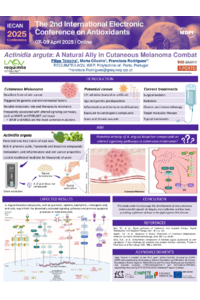
Poster_2th IECA_Filipa Teixeira.pdf
Study of Total Phenolics, Flavonoids and Antioxidant Activity of Pongamia pinnata leaves extract
Use of sprouting to modify the antioxidant activity and phenol content of Inga paterno seed flour