Event submissions
Published
This submission belongs to the session S6. Antioxidants Extraction, Assay and Industrial Applications of the event The 2nd International Electronic Conference on Antioxidants
Published date
04 Apr, 2025
Academic Editor
'%3e%3cpath%20d='M12.6657%2010.9104C12.4185%2010.325%2012.0599%209.79327%2011.6097%209.34482C11.1609%208.89508%2010.6293%208.5365%2010.0442%208.28888C10.0389%208.28626%2010.0337%208.28495%2010.0285%208.28233C10.8446%207.69279%2011.3752%206.73249%2011.3752%205.64904C11.3752%203.8542%209.92103%202.39999%208.1262%202.39999C6.33136%202.39999%204.87715%203.8542%204.87715%205.64904C4.87715%206.73249%205.40774%207.69279%206.22393%208.28364C6.21869%208.28626%206.21345%208.28757%206.20821%208.29019C5.62129%208.5378%205.09463%208.89284%204.64265%209.34613C4.1929%209.79493%203.83432%2010.3266%203.58671%2010.9117C3.34345%2011.4845%203.21226%2012.0987%203.20023%2012.7209C3.19988%2012.7349%203.20233%2012.7488%203.20744%2012.7619C3.21255%2012.7749%203.22022%2012.7867%203.22998%2012.7968C3.23975%2012.8068%203.25142%2012.8147%203.26431%2012.8202C3.2772%2012.8256%203.29105%2012.8284%203.30504%2012.8284H4.09109C4.14874%2012.8284%204.19459%2012.7825%204.1959%2012.7262C4.2221%2011.7148%204.62823%2010.7676%205.34617%2010.0497C6.08899%209.30683%207.0755%208.89808%208.1262%208.89808C9.17689%208.89808%2010.1634%209.30683%2010.9062%2010.0497C11.6242%2010.7676%2012.0303%2011.7148%2012.0565%2012.7262C12.0578%2012.7838%2012.1037%2012.8284%2012.1613%2012.8284H12.9474C12.9613%2012.8284%2012.9752%2012.8256%2012.9881%2012.8202C13.001%2012.8147%2013.0126%2012.8068%2013.0224%2012.7968C13.0322%2012.7867%2013.0398%2012.7749%2013.0449%2012.7619C13.0501%2012.7488%2013.0525%2012.7349%2013.0522%2012.7209C13.0391%2012.0947%2012.9094%2011.4855%2012.6657%2010.9104ZM8.1262%207.9024C7.52486%207.9024%206.9589%207.6679%206.53312%207.24211C6.10733%206.81633%205.87283%206.25037%205.87283%205.64904C5.87283%205.0477%206.10733%204.48174%206.53312%204.05596C6.9589%203.63018%207.52486%203.39567%208.1262%203.39567C8.72753%203.39567%209.29349%203.63018%209.71927%204.05596C10.1451%204.48174%2010.3796%205.0477%2010.3796%205.64904C10.3796%206.25037%2010.1451%206.81633%209.71927%207.24211C9.29349%207.6679%208.72753%207.9024%208.1262%207.9024Z'%20fill='%235D1EE1'/%3e%3c/g%3e%3c/svg%3e) Alessandra Napolitano
Alessandra NapolitanoCitation
Yuva Bellik, Ammar Sidi Mohammed Selles, Antioxidant properties of individual and combined extracts of honey and mint, in Proceedings of The 2nd International Electronic Conference on Antioxidants, 7 April–9 April 2025, MDPI: Basel, Switzerland
Share
Email
Facebook
Twitter
LinkedIn
Antioxidant properties of individual and combined extracts of honey and mint

Yuva Bellik 1
'%3e%3cpath%20d='M12.6647%2010.9104C12.4176%2010.325%2012.0589%209.7933%2011.6088%209.34485C11.16%208.89511%2010.6283%208.53653%2010.0432%208.28891C10.038%208.28629%2010.0327%208.28498%2010.0275%208.28236C10.8437%207.69282%2011.3743%206.73252%2011.3743%205.64907C11.3743%203.85423%209.92005%202.40002%208.12522%202.40002C6.33038%202.40002%204.87618%203.85423%204.87618%205.64907C4.87618%206.73252%205.40677%207.69282%206.22296%208.28367C6.21772%208.28629%206.21248%208.2876%206.20724%208.29022C5.62031%208.53783%205.09365%208.89287%204.64167%209.34616C4.19192%209.79496%203.83334%2010.3266%203.58573%2010.9117C3.34247%2011.4846%203.21128%2012.0987%203.19925%2012.721C3.1989%2012.735%203.20135%2012.7489%203.20646%2012.7619C3.21157%2012.7749%203.21924%2012.7868%203.22901%2012.7968C3.23877%2012.8068%203.25045%2012.8148%203.26334%2012.8202C3.27623%2012.8256%203.29007%2012.8284%203.30406%2012.8284H4.09012C4.14776%2012.8284%204.19362%2012.7825%204.19493%2012.7262C4.22113%2011.7148%204.62726%2010.7676%205.34519%2010.0497C6.08802%209.30686%207.07452%208.89811%208.12522%208.89811C9.17592%208.89811%2010.1624%209.30686%2010.9052%2010.0497C11.6232%2010.7676%2012.0293%2011.7148%2012.0555%2012.7262C12.0568%2012.7839%2012.1027%2012.8284%2012.1603%2012.8284H12.9464C12.9604%2012.8284%2012.9742%2012.8256%2012.9871%2012.8202C13%2012.8148%2013.0117%2012.8068%2013.0214%2012.7968C13.0312%2012.7868%2013.0389%2012.7749%2013.044%2012.7619C13.0491%2012.7489%2013.0515%2012.735%2013.0512%2012.721C13.0381%2012.0947%2012.9084%2011.4856%2012.6647%2010.9104ZM8.12522%207.90243C7.52388%207.90243%206.95792%207.66793%206.53214%207.24215C6.10636%206.81636%205.87185%206.2504%205.87185%205.64907C5.87185%205.04773%206.10636%204.48177%206.53214%204.05599C6.95792%203.63021%207.52388%203.3957%208.12522%203.3957C8.72655%203.3957%209.29252%203.63021%209.7183%204.05599C10.1441%204.48177%2010.3786%205.04773%2010.3786%205.64907C10.3786%206.2504%2010.1441%206.81636%209.7183%207.24215C9.29252%207.66793%208.72655%207.90243%208.12522%207.90243Z'%20fill='%235D1EE1'/%3e%3c/g%3e%3c/svg%3e)
Ammar Sidi Mohammed Selles 2
1. Department of Biological Sciences, Faculty of Life and Natural Sciences and of Earth and Universe Sciences, Mohamed El Bachir El Ibrahimi University, Bordj Bou Arreridj, 34000, Algeria.
2. Laboratory of Research on Local Animal Products, Veterinary Sciences Institute, University of Tiaret, 14000, Tiaret, Algeria
Abstract
Plant-based substances have been used in traditional medicine systems around the world. Plant materials with high contents of polyphenol and flavonoid compounds possess many biological and pharmacological properties. Many formulations based on polyphenols have been prepared in specific ratios and used for multiple purposes. The aim of the present study is to assess the level of bioactive compounds and antioxidant activity of individual extracts of mint (Mentha spicata) and honey and their combination. The total phenolic content (TPC) and the total flavonoid content (TFC) were determined spectrophotometrically. The antioxidant activity was assessed using different in vitro assays, including DPPH, ABTS, reducing power, and iron-chelation tests. According to the results, mint extracts exhibited the highest TPC (35.47 ± 0.08 mg GAE/g and 15.5 ± 0.06 mg GAE/g) and the highest TFC (32.03 ± 0.47 QE/g and 27.49 ± 0.32mg QE/g) compared to honey samples (0.35 ± 0.01 mg GAE/g and 0.32 ± 0.01 mg GAE/g for TPC and 0.23 ± 0.00 QE/g and 0.12 ± 0.01 QE/g for TFC). Both individual mint and honey extracts exhibited antioxidant activity. When combined, the honey--mint extracts demonstrated enhanced antioxidant activity compared to the individual extracts. The synergistic effect was particularly evident in the reducing power, DPPH, and ABTS assays. Meanwhile, honey--mint extracts showed low iron-chelating activity. This study provides scientific evidence supporting the traditional use of mint and honey together. The combined extract of mint and honey exhibited superior antioxidant activity compared to individual extracts, indicating that this combination may offer additional health benefits. Further research is needed to explore the potential applications of honey--mint mixtures as functional food additives or nutraceuticals.
Keywords
Honey
Mint
Polyphenols
Flavonoids
Individual
Combination
Antioxidant properties
Poster
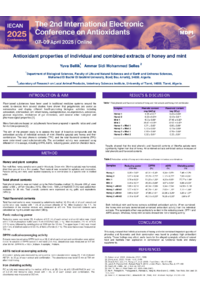
Poster Bellik - 2nd IECA 2025.pdf
Use of sprouting to modify the antioxidant activity and phenol content of Inga paterno seed flour
In Silico Comparative Analysis of Phytochemicals from Rubus fruticosus with relevance for neurodegenerative disease