Event submissions
Published
This submission belongs to the session S6. Antioxidants Extraction, Assay and Industrial Applications of the event The 2nd International Electronic Conference on Antioxidants
Published date
04 Apr, 2025
Academic Editor
'%3e%3cpath%20d='M12.6657%2010.9104C12.4185%2010.325%2012.0599%209.79327%2011.6097%209.34482C11.1609%208.89508%2010.6293%208.5365%2010.0442%208.28888C10.0389%208.28626%2010.0337%208.28495%2010.0285%208.28233C10.8446%207.69279%2011.3752%206.73249%2011.3752%205.64904C11.3752%203.8542%209.92103%202.39999%208.1262%202.39999C6.33136%202.39999%204.87715%203.8542%204.87715%205.64904C4.87715%206.73249%205.40774%207.69279%206.22393%208.28364C6.21869%208.28626%206.21345%208.28757%206.20821%208.29019C5.62129%208.5378%205.09463%208.89284%204.64265%209.34613C4.1929%209.79493%203.83432%2010.3266%203.58671%2010.9117C3.34345%2011.4845%203.21226%2012.0987%203.20023%2012.7209C3.19988%2012.7349%203.20233%2012.7488%203.20744%2012.7619C3.21255%2012.7749%203.22022%2012.7867%203.22998%2012.7968C3.23975%2012.8068%203.25142%2012.8147%203.26431%2012.8202C3.2772%2012.8256%203.29105%2012.8284%203.30504%2012.8284H4.09109C4.14874%2012.8284%204.19459%2012.7825%204.1959%2012.7262C4.2221%2011.7148%204.62823%2010.7676%205.34617%2010.0497C6.08899%209.30683%207.0755%208.89808%208.1262%208.89808C9.17689%208.89808%2010.1634%209.30683%2010.9062%2010.0497C11.6242%2010.7676%2012.0303%2011.7148%2012.0565%2012.7262C12.0578%2012.7838%2012.1037%2012.8284%2012.1613%2012.8284H12.9474C12.9613%2012.8284%2012.9752%2012.8256%2012.9881%2012.8202C13.001%2012.8147%2013.0126%2012.8068%2013.0224%2012.7968C13.0322%2012.7867%2013.0398%2012.7749%2013.0449%2012.7619C13.0501%2012.7488%2013.0525%2012.7349%2013.0522%2012.7209C13.0391%2012.0947%2012.9094%2011.4855%2012.6657%2010.9104ZM8.1262%207.9024C7.52486%207.9024%206.9589%207.6679%206.53312%207.24211C6.10733%206.81633%205.87283%206.25037%205.87283%205.64904C5.87283%205.0477%206.10733%204.48174%206.53312%204.05596C6.9589%203.63018%207.52486%203.39567%208.1262%203.39567C8.72753%203.39567%209.29349%203.63018%209.71927%204.05596C10.1451%204.48174%2010.3796%205.0477%2010.3796%205.64904C10.3796%206.25037%2010.1451%206.81633%209.71927%207.24211C9.29349%207.6679%208.72753%207.9024%208.1262%207.9024Z'%20fill='%235D1EE1'/%3e%3c/g%3e%3c/svg%3e) Ren-You Gan
Ren-You GanCitation
Roberta Pino, Vincenzo Sicari, Rosa Tundis, Monica Rosa Loizzo, Evaluation of bioactive compounds and antioxidant activity of ten seeds' residues from oil processing, in Proceedings of The 2nd International Electronic Conference on Antioxidants, 7 April–9 April 2025, MDPI: Basel, Switzerland
Share
Email
Facebook
Twitter
LinkedIn
Evaluation of bioactive compounds and antioxidant activity of ten seeds' residues from oil processing
'%3e%3cpath%20d='M12.6647%2010.9104C12.4176%2010.325%2012.0589%209.7933%2011.6088%209.34485C11.16%208.89511%2010.6283%208.53653%2010.0432%208.28891C10.038%208.28629%2010.0327%208.28498%2010.0275%208.28236C10.8437%207.69282%2011.3743%206.73252%2011.3743%205.64907C11.3743%203.85423%209.92005%202.40002%208.12522%202.40002C6.33038%202.40002%204.87618%203.85423%204.87618%205.64907C4.87618%206.73252%205.40677%207.69282%206.22296%208.28367C6.21772%208.28629%206.21248%208.2876%206.20724%208.29022C5.62031%208.53783%205.09365%208.89287%204.64167%209.34616C4.19192%209.79496%203.83334%2010.3266%203.58573%2010.9117C3.34247%2011.4846%203.21128%2012.0987%203.19925%2012.721C3.1989%2012.735%203.20135%2012.7489%203.20646%2012.7619C3.21157%2012.7749%203.21924%2012.7868%203.22901%2012.7968C3.23877%2012.8068%203.25045%2012.8148%203.26334%2012.8202C3.27623%2012.8256%203.29007%2012.8284%203.30406%2012.8284H4.09012C4.14776%2012.8284%204.19362%2012.7825%204.19493%2012.7262C4.22113%2011.7148%204.62726%2010.7676%205.34519%2010.0497C6.08802%209.30686%207.07452%208.89811%208.12522%208.89811C9.17592%208.89811%2010.1624%209.30686%2010.9052%2010.0497C11.6232%2010.7676%2012.0293%2011.7148%2012.0555%2012.7262C12.0568%2012.7839%2012.1027%2012.8284%2012.1603%2012.8284H12.9464C12.9604%2012.8284%2012.9742%2012.8256%2012.9871%2012.8202C13%2012.8148%2013.0117%2012.8068%2013.0214%2012.7968C13.0312%2012.7868%2013.0389%2012.7749%2013.044%2012.7619C13.0491%2012.7489%2013.0515%2012.735%2013.0512%2012.721C13.0381%2012.0947%2012.9084%2011.4856%2012.6647%2010.9104ZM8.12522%207.90243C7.52388%207.90243%206.95792%207.66793%206.53214%207.24215C6.10636%206.81636%205.87185%206.2504%205.87185%205.64907C5.87185%205.04773%206.10636%204.48177%206.53214%204.05599C6.95792%203.63021%207.52388%203.3957%208.12522%203.3957C8.72655%203.3957%209.29252%203.63021%209.7183%204.05599C10.1441%204.48177%2010.3786%205.04773%2010.3786%205.64907C10.3786%206.2504%2010.1441%206.81636%209.7183%207.24215C9.29252%207.66793%208.72655%207.90243%208.12522%207.90243Z'%20fill='%235D1EE1'/%3e%3c/g%3e%3c/svg%3e)
Roberta Pino 1
Vincenzo Sicari 2

Rosa Tundis 1

Monica Rosa Loizzo 1
1. Department of Pharmacy, Health and Nutritional Sciences, University of Calabria, 87036 Arcavacata di Rende (CS),
2. Department of Agraria, University “Mediterranea” of Reggio Calabria, Salita Melissari, Feo di Vito, Reggio Calabria (RC), 89124, Italy
Abstract
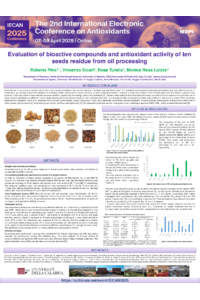
Recent studies have highlighted that waste from the food industries is often rich in bioactive compounds that can be recovered and used again in a different market, therefore always contributing to the food economy [1]. This study aimed to investigate the bioactive compounds and radical scavenging effect of extracts from exhausted matrices of oil extraction from Cannabis sativa, Juglans regia, Prunus dulcis, Coriandrum sativum, Triticum aestivum, Nigella sativa, Avena sativa, Glycine max, Pimpinella anisum, and Pinus pinea. For this purpose, exhausted matrices were extracted using n-hexane and ethanol as solvents. The extracts were analysed by GC-MS analysis, while TPC was analyzed using the Folin–Ciocalteau method [2]. The radical scavenging activity was assessed using the DPPH and ABTS tests [2]. Additionally, samples were investigated for their ability for protection from lipid peroxidation [2]. Walnut’s n-hexane extract exhibited the highest linoleic acid content (87.13%) . Anise extract by-products resulted in the richest TPC (35.8 mg GAE/ g extract). With regard to antioxidant activity, the almond by-product ethanolic extract exhibited the highest ABTS+· radical scavenging activity (IC50 of 2.6 ug/mL) whereas anise showed the highest DPPH radical scavenging potential (IC50 of 27.2 ug/mL) as well as the most promising protection from lipid peroxidation (IC50 of 14.1 ug/mL). Our results confirm that these by-products are still rich in active biological compounds. Therefore, these residues may be of interest to the food, nutraceutical and pharmaceutical industries in the continuous search for innovative products for healthy and nutritional applications for the extension of the shelf life of food products.
[1] da Silva, A.; Neuza, J Bioactive compounds of the lipid fractions of agro-industrial waste. Food Res. Int., 2014, 66, 493-50. https://doi.org/10.1016/j.foodres.2014.10.025. [2] Loizzo MR, Pugliese A, Bonesi M, Tenuta MC, Menichini F, Xiao J, Tundis R. Edible Flowers: A Rich Source of Phytochemicals with Antioxidant and Hypoglycemic Properties. J Agric Food Chem. 2016, 64. 2467-74. https://doi.org/10.1021/acs.jafc.5b03092.
Keywords
oil processing residue
antioxidant
bioactives
Poster
Poster n.2_R2 definitivo 27_02.pdf
In Silico Comparative Analysis of Phytochemicals from Rubus fruticosus with relevance for neurodegenerative disease
Oxidative Stress, Inflammation, and Obesity: Insights into Mechanisms and Therapeutic Targets