Event submissions
Published
This submission belongs to the session S6. Antioxidants Extraction, Assay and Industrial Applications of the event The 2nd International Electronic Conference on Antioxidants
Published date
04 Apr, 2025
Academic Editor
'%3e%3cpath%20d='M12.6657%2010.9104C12.4185%2010.325%2012.0599%209.79327%2011.6097%209.34482C11.1609%208.89508%2010.6293%208.5365%2010.0442%208.28888C10.0389%208.28626%2010.0337%208.28495%2010.0285%208.28233C10.8446%207.69279%2011.3752%206.73249%2011.3752%205.64904C11.3752%203.8542%209.92103%202.39999%208.1262%202.39999C6.33136%202.39999%204.87715%203.8542%204.87715%205.64904C4.87715%206.73249%205.40774%207.69279%206.22393%208.28364C6.21869%208.28626%206.21345%208.28757%206.20821%208.29019C5.62129%208.5378%205.09463%208.89284%204.64265%209.34613C4.1929%209.79493%203.83432%2010.3266%203.58671%2010.9117C3.34345%2011.4845%203.21226%2012.0987%203.20023%2012.7209C3.19988%2012.7349%203.20233%2012.7488%203.20744%2012.7619C3.21255%2012.7749%203.22022%2012.7867%203.22998%2012.7968C3.23975%2012.8068%203.25142%2012.8147%203.26431%2012.8202C3.2772%2012.8256%203.29105%2012.8284%203.30504%2012.8284H4.09109C4.14874%2012.8284%204.19459%2012.7825%204.1959%2012.7262C4.2221%2011.7148%204.62823%2010.7676%205.34617%2010.0497C6.08899%209.30683%207.0755%208.89808%208.1262%208.89808C9.17689%208.89808%2010.1634%209.30683%2010.9062%2010.0497C11.6242%2010.7676%2012.0303%2011.7148%2012.0565%2012.7262C12.0578%2012.7838%2012.1037%2012.8284%2012.1613%2012.8284H12.9474C12.9613%2012.8284%2012.9752%2012.8256%2012.9881%2012.8202C13.001%2012.8147%2013.0126%2012.8068%2013.0224%2012.7968C13.0322%2012.7867%2013.0398%2012.7749%2013.0449%2012.7619C13.0501%2012.7488%2013.0525%2012.7349%2013.0522%2012.7209C13.0391%2012.0947%2012.9094%2011.4855%2012.6657%2010.9104ZM8.1262%207.9024C7.52486%207.9024%206.9589%207.6679%206.53312%207.24211C6.10733%206.81633%205.87283%206.25037%205.87283%205.64904C5.87283%205.0477%206.10733%204.48174%206.53312%204.05596C6.9589%203.63018%207.52486%203.39567%208.1262%203.39567C8.72753%203.39567%209.29349%203.63018%209.71927%204.05596C10.1451%204.48174%2010.3796%205.0477%2010.3796%205.64904C10.3796%206.25037%2010.1451%206.81633%209.71927%207.24211C9.29349%207.6679%208.72753%207.9024%208.1262%207.9024Z'%20fill='%235D1EE1'/%3e%3c/g%3e%3c/svg%3e) Ren-You Gan
Ren-You GanCitation
Sefora Esposito, Marika Avitabile, Loredana Mariniello, Daniele Naviglio, Lucia Panzella, Maria Laura Alfieri, Concetta Valeria Lucia Giosafatto, Sustainable Biopesticides from Citrus waste: innovative extraction methods for eco-friendly crop protection, in Proceedings of The 2nd International Electronic Conference on Antioxidants, 7 April–9 April 2025, MDPI: Basel, Switzerland
Share
Email
Facebook
Twitter
LinkedIn
Sustainable Biopesticides from Citrus waste: innovative extraction methods for eco-friendly crop protection
'%3e%3cpath%20d='M12.6647%2010.9104C12.4176%2010.325%2012.0589%209.7933%2011.6088%209.34485C11.16%208.89511%2010.6283%208.53653%2010.0432%208.28891C10.038%208.28629%2010.0327%208.28498%2010.0275%208.28236C10.8437%207.69282%2011.3743%206.73252%2011.3743%205.64907C11.3743%203.85423%209.92005%202.40002%208.12522%202.40002C6.33038%202.40002%204.87618%203.85423%204.87618%205.64907C4.87618%206.73252%205.40677%207.69282%206.22296%208.28367C6.21772%208.28629%206.21248%208.2876%206.20724%208.29022C5.62031%208.53783%205.09365%208.89287%204.64167%209.34616C4.19192%209.79496%203.83334%2010.3266%203.58573%2010.9117C3.34247%2011.4846%203.21128%2012.0987%203.19925%2012.721C3.1989%2012.735%203.20135%2012.7489%203.20646%2012.7619C3.21157%2012.7749%203.21924%2012.7868%203.22901%2012.7968C3.23877%2012.8068%203.25045%2012.8148%203.26334%2012.8202C3.27623%2012.8256%203.29007%2012.8284%203.30406%2012.8284H4.09012C4.14776%2012.8284%204.19362%2012.7825%204.19493%2012.7262C4.22113%2011.7148%204.62726%2010.7676%205.34519%2010.0497C6.08802%209.30686%207.07452%208.89811%208.12522%208.89811C9.17592%208.89811%2010.1624%209.30686%2010.9052%2010.0497C11.6232%2010.7676%2012.0293%2011.7148%2012.0555%2012.7262C12.0568%2012.7839%2012.1027%2012.8284%2012.1603%2012.8284H12.9464C12.9604%2012.8284%2012.9742%2012.8256%2012.9871%2012.8202C13%2012.8148%2013.0117%2012.8068%2013.0214%2012.7968C13.0312%2012.7868%2013.0389%2012.7749%2013.044%2012.7619C13.0491%2012.7489%2013.0515%2012.735%2013.0512%2012.721C13.0381%2012.0947%2012.9084%2011.4856%2012.6647%2010.9104ZM8.12522%207.90243C7.52388%207.90243%206.95792%207.66793%206.53214%207.24215C6.10636%206.81636%205.87185%206.2504%205.87185%205.64907C5.87185%205.04773%206.10636%204.48177%206.53214%204.05599C6.95792%203.63021%207.52388%203.3957%208.12522%203.3957C8.72655%203.3957%209.29252%203.63021%209.7183%204.05599C10.1441%204.48177%2010.3786%205.04773%2010.3786%205.64907C10.3786%206.2504%2010.1441%206.81636%209.7183%207.24215C9.29252%207.66793%208.72655%207.90243%208.12522%207.90243Z'%20fill='%235D1EE1'/%3e%3c/g%3e%3c/svg%3e)
Sefora Esposito 1
Marika Avitabile 1

Loredana Mariniello 1

Daniele Naviglio 1

Lucia Panzella 1

Maria Laura Alfieri 1

Concetta Valeria Lucia Giosafatto 1
1. Department of Chemical Sciences, University of Naples Federico II, Italy
Abstract
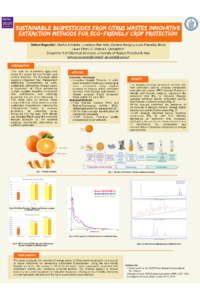
The increasing demand for sustainable agriculture underscores the need for eco-friendly alternatives to chemical pesticides. To address this issue, the European Union supports Integrated Pest Management (IPM), with a particular focus on biopesticides as safer, more sustainable options. Orange peels, a by-product of citrus processing, contain bioactive compounds with antimicrobial, antioxidant, and pesticidal properties [1]. However, these valuable compounds are often discarded, contributing to environmental pollution. Hence, this study investigates the recovery of active molecules (AMs) from citrus waste, specifically orange peels, to develop new biopesticides. A key aspect of this research is the development of an eco-friendly extraction method for AMs. Traditional methods like Soxhlet extraction are energy-intensive, use harmful chemicals, and generate waste. In contrast, the Naviglio extractor, a solid–liquid extraction technique, operates at room temperature and uses negative pressure to efficiently extract bioactive compounds while minimizing environmental and safety concerns, using different times of extraction (2 h, 22 h, 96 h) [2]. The results show that the extracts obtained with the Naviglio extraction method are endowed with higher antioxidant activity, as demonstrated by their greater total phenolic content (TPC) and radical-scavenging activity (RSA) compared to Soxhlet extraction [3]. UV-Vis and LC-MS analyses were performed to assess the chemical profiles of the extracts. The Naviglio extracts exhibited higher absorbance and distinctive peaks associated with carotenoids, confirming their presence. LC-MS analysis revealed that several compounds were present in the extracts, with their intensity decreasing as extraction time increased. Apigenin 7-O-glucoside, hexamethylquercetagetin, nobiletin, sinensetin, and tangeretin were identified as the main phenolic components. These findings suggest extraction time is a key factor influencing the composition and concentration of bioactive compounds in orange peel extracts. This research promotes a circular economy by utilising citrus waste, transforming waste into valuable resources.
References
- Cirrincione F. et al. (2024) Food Res, Int, 187, 114422
- Naviglio D. et al. (2003) Anal. Lett. 36,8, 1647–1659
- Famiglietti M. et al. (2022) Foods 11(14), 2078
Keywords
Citrus waste
active molecules
biopesticides
Poster
Poster Esposito S et al.pdf
Biocomposites for Regenerative Medicine Applications
Application of Biohydrogels Containing Adaptogens in Innovative Chronic Wound Therapy