Event submissions
Published
This submission belongs to the session S5. Natural and Synthetic Antioxidants and Antioxidant Enzyme Systems of the event The 2nd International Electronic Conference on Antioxidants
Published date
04 Apr, 2025
Academic Editor
'%3e%3cpath%20d='M12.6657%2010.9104C12.4185%2010.325%2012.0599%209.79327%2011.6097%209.34482C11.1609%208.89508%2010.6293%208.5365%2010.0442%208.28888C10.0389%208.28626%2010.0337%208.28495%2010.0285%208.28233C10.8446%207.69279%2011.3752%206.73249%2011.3752%205.64904C11.3752%203.8542%209.92103%202.39999%208.1262%202.39999C6.33136%202.39999%204.87715%203.8542%204.87715%205.64904C4.87715%206.73249%205.40774%207.69279%206.22393%208.28364C6.21869%208.28626%206.21345%208.28757%206.20821%208.29019C5.62129%208.5378%205.09463%208.89284%204.64265%209.34613C4.1929%209.79493%203.83432%2010.3266%203.58671%2010.9117C3.34345%2011.4845%203.21226%2012.0987%203.20023%2012.7209C3.19988%2012.7349%203.20233%2012.7488%203.20744%2012.7619C3.21255%2012.7749%203.22022%2012.7867%203.22998%2012.7968C3.23975%2012.8068%203.25142%2012.8147%203.26431%2012.8202C3.2772%2012.8256%203.29105%2012.8284%203.30504%2012.8284H4.09109C4.14874%2012.8284%204.19459%2012.7825%204.1959%2012.7262C4.2221%2011.7148%204.62823%2010.7676%205.34617%2010.0497C6.08899%209.30683%207.0755%208.89808%208.1262%208.89808C9.17689%208.89808%2010.1634%209.30683%2010.9062%2010.0497C11.6242%2010.7676%2012.0303%2011.7148%2012.0565%2012.7262C12.0578%2012.7838%2012.1037%2012.8284%2012.1613%2012.8284H12.9474C12.9613%2012.8284%2012.9752%2012.8256%2012.9881%2012.8202C13.001%2012.8147%2013.0126%2012.8068%2013.0224%2012.7968C13.0322%2012.7867%2013.0398%2012.7749%2013.0449%2012.7619C13.0501%2012.7488%2013.0525%2012.7349%2013.0522%2012.7209C13.0391%2012.0947%2012.9094%2011.4855%2012.6657%2010.9104ZM8.1262%207.9024C7.52486%207.9024%206.9589%207.6679%206.53312%207.24211C6.10733%206.81633%205.87283%206.25037%205.87283%205.64904C5.87283%205.0477%206.10733%204.48174%206.53312%204.05596C6.9589%203.63018%207.52486%203.39567%208.1262%203.39567C8.72753%203.39567%209.29349%203.63018%209.71927%204.05596C10.1451%204.48174%2010.3796%205.0477%2010.3796%205.64904C10.3796%206.25037%2010.1451%206.81633%209.71927%207.24211C9.29349%207.6679%208.72753%207.9024%208.1262%207.9024Z'%20fill='%235D1EE1'/%3e%3c/g%3e%3c/svg%3e) Mario Allegra
Mario AllegraCitation
Beatrice Sordini, Sonia Esposto, Arianna Bonucci, Ilenia Dottori, Luigi Daidone, Stefania Urbani, Gianluca Veneziani, Roberto Selvaggini, Maurizio Servili, Davide Nucciarelli, Agnese Taticchi, Role of a Natural Preservative in the Secondary Shelf-life of Ready-to-Use Meat Pâté, in Proceedings of The 2nd International Electronic Conference on Antioxidants, 7 April–9 April 2025, MDPI: Basel, Switzerland
Share
Email
Facebook
Twitter
LinkedIn
Role of a Natural Preservative in the Secondary Shelf-life of Ready-to-Use Meat Pâté
'%3e%3cpath%20d='M12.6647%2010.9104C12.4176%2010.325%2012.0589%209.7933%2011.6088%209.34485C11.16%208.89511%2010.6283%208.53653%2010.0432%208.28891C10.038%208.28629%2010.0327%208.28498%2010.0275%208.28236C10.8437%207.69282%2011.3743%206.73252%2011.3743%205.64907C11.3743%203.85423%209.92005%202.40002%208.12522%202.40002C6.33038%202.40002%204.87618%203.85423%204.87618%205.64907C4.87618%206.73252%205.40677%207.69282%206.22296%208.28367C6.21772%208.28629%206.21248%208.2876%206.20724%208.29022C5.62031%208.53783%205.09365%208.89287%204.64167%209.34616C4.19192%209.79496%203.83334%2010.3266%203.58573%2010.9117C3.34247%2011.4846%203.21128%2012.0987%203.19925%2012.721C3.1989%2012.735%203.20135%2012.7489%203.20646%2012.7619C3.21157%2012.7749%203.21924%2012.7868%203.22901%2012.7968C3.23877%2012.8068%203.25045%2012.8148%203.26334%2012.8202C3.27623%2012.8256%203.29007%2012.8284%203.30406%2012.8284H4.09012C4.14776%2012.8284%204.19362%2012.7825%204.19493%2012.7262C4.22113%2011.7148%204.62726%2010.7676%205.34519%2010.0497C6.08802%209.30686%207.07452%208.89811%208.12522%208.89811C9.17592%208.89811%2010.1624%209.30686%2010.9052%2010.0497C11.6232%2010.7676%2012.0293%2011.7148%2012.0555%2012.7262C12.0568%2012.7839%2012.1027%2012.8284%2012.1603%2012.8284H12.9464C12.9604%2012.8284%2012.9742%2012.8256%2012.9871%2012.8202C13%2012.8148%2013.0117%2012.8068%2013.0214%2012.7968C13.0312%2012.7868%2013.0389%2012.7749%2013.044%2012.7619C13.0491%2012.7489%2013.0515%2012.735%2013.0512%2012.721C13.0381%2012.0947%2012.9084%2011.4856%2012.6647%2010.9104ZM8.12522%207.90243C7.52388%207.90243%206.95792%207.66793%206.53214%207.24215C6.10636%206.81636%205.87185%206.2504%205.87185%205.64907C5.87185%205.04773%206.10636%204.48177%206.53214%204.05599C6.95792%203.63021%207.52388%203.3957%208.12522%203.3957C8.72655%203.3957%209.29252%203.63021%209.7183%204.05599C10.1441%204.48177%2010.3786%205.04773%2010.3786%205.64907C10.3786%206.2504%2010.1441%206.81636%209.7183%207.24215C9.29252%207.66793%208.72655%207.90243%208.12522%207.90243Z'%20fill='%235D1EE1'/%3e%3c/g%3e%3c/svg%3e)
Beatrice Sordini 1
Sonia Esposto 2
Arianna Bonucci 2
Ilenia Dottori 2
Luigi Daidone 2
Stefania Urbani 2
Gianluca Veneziani 2
Roberto Selvaggini 2
Maurizio Servili 2
Davide Nucciarelli 2
Agnese Taticchi 2
1. Department of Agriculture, Food and Environmental Sciences, University of Perugia, 06126 Perugia, Italy
2. Department of Agricultural, Food and Environmental Sciences, University of Perugia, Italy
Abstract
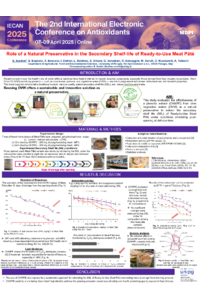
By-products from the agro-food industry can serve as innovative sources of natural ingredients in the reformulation of traditional foods, enhancing their overall quality, extending secondary shelf-life (SSL), and mitigating food loss and waste. This study aims to evaluate the effect of the addition in a ready-to-use meat pâté of an olive vegetation water phenolic extract (OWVE) at two concentrations (250 mg of phenols per kg of product (MP1) and 500 mg of phenols per kg of product (MP2)). Physicochemical and sensory properties and the antioxidant activity of OWVE-added pâté samples were evaluated and compared with a control sample (CTRL; without antioxidants), simulating the retail storage conditions typical for products sold loose in deli counters. The evolution of key quality parameters was monitored during the SSL at various intervals: 0, 1, 2, 3, 4, 7, 8, 9, 10, and 11 days after the packaging was opened. The addition of OWVE effectively reduced the formation of primary and secondary oxidation products, thereby enhancing the oxidative stability of the lipid fraction. The formation and accumulation of aldehydes C6–C9, which are responsible for the "rancid off-flavour", were significantly minimised in the OWVE-added pâté samples in a dose-dependent way. Additionally, the OWVE-added samples demonstrated significantly higher antioxidant activity and α-tocopherol content compared to the CTRL at every assessed time point. No sensory defects were detected in any of the samples; however, a more pronounced olive flavour was noted in the MP2 samples compared to MP1 and CTRL. The findings of this study suggest that OWVE could serve as a promising natural preservative for food formulations with complex compositions. This highlights its potential usefulness in countertop gastronomy products, allowing for the extension of SSL without the need for synthetic additives. This approach offers a sustainable solution for reducing food loss and waste in marketing and home preservation practices.
Keywords
Virgin olive oil by-product valorisation
polyphenols
antioxidant of natural origin
secondary shelf life.
Poster
Sordini et al.pdf
Application of Biohydrogels Containing Adaptogens in Innovative Chronic Wound Therapy
Exploring Natural Deep Eutectic Solvents (NADESs) for Extraction of Antioxidant Compounds from Aromatic Herbs used in Mediterranean Diet