Event submissions
Published
This submission belongs to the session S4. Antioxidants Intake and Gut Microbiome of the event The 2nd International Electronic Conference on Antioxidants
Published date
04 Apr, 2025
Academic Editor
'%3e%3cpath%20d='M12.6657%2010.9104C12.4185%2010.325%2012.0599%209.79327%2011.6097%209.34482C11.1609%208.89508%2010.6293%208.5365%2010.0442%208.28888C10.0389%208.28626%2010.0337%208.28495%2010.0285%208.28233C10.8446%207.69279%2011.3752%206.73249%2011.3752%205.64904C11.3752%203.8542%209.92103%202.39999%208.1262%202.39999C6.33136%202.39999%204.87715%203.8542%204.87715%205.64904C4.87715%206.73249%205.40774%207.69279%206.22393%208.28364C6.21869%208.28626%206.21345%208.28757%206.20821%208.29019C5.62129%208.5378%205.09463%208.89284%204.64265%209.34613C4.1929%209.79493%203.83432%2010.3266%203.58671%2010.9117C3.34345%2011.4845%203.21226%2012.0987%203.20023%2012.7209C3.19988%2012.7349%203.20233%2012.7488%203.20744%2012.7619C3.21255%2012.7749%203.22022%2012.7867%203.22998%2012.7968C3.23975%2012.8068%203.25142%2012.8147%203.26431%2012.8202C3.2772%2012.8256%203.29105%2012.8284%203.30504%2012.8284H4.09109C4.14874%2012.8284%204.19459%2012.7825%204.1959%2012.7262C4.2221%2011.7148%204.62823%2010.7676%205.34617%2010.0497C6.08899%209.30683%207.0755%208.89808%208.1262%208.89808C9.17689%208.89808%2010.1634%209.30683%2010.9062%2010.0497C11.6242%2010.7676%2012.0303%2011.7148%2012.0565%2012.7262C12.0578%2012.7838%2012.1037%2012.8284%2012.1613%2012.8284H12.9474C12.9613%2012.8284%2012.9752%2012.8256%2012.9881%2012.8202C13.001%2012.8147%2013.0126%2012.8068%2013.0224%2012.7968C13.0322%2012.7867%2013.0398%2012.7749%2013.0449%2012.7619C13.0501%2012.7488%2013.0525%2012.7349%2013.0522%2012.7209C13.0391%2012.0947%2012.9094%2011.4855%2012.6657%2010.9104ZM8.1262%207.9024C7.52486%207.9024%206.9589%207.6679%206.53312%207.24211C6.10733%206.81633%205.87283%206.25037%205.87283%205.64904C5.87283%205.0477%206.10733%204.48174%206.53312%204.05596C6.9589%203.63018%207.52486%203.39567%208.1262%203.39567C8.72753%203.39567%209.29349%203.63018%209.71927%204.05596C10.1451%204.48174%2010.3796%205.0477%2010.3796%205.64904C10.3796%206.25037%2010.1451%206.81633%209.71927%207.24211C9.29349%207.6679%208.72753%207.9024%208.1262%207.9024Z'%20fill='%235D1EE1'/%3e%3c/g%3e%3c/svg%3e) José A. Rufián-Henares
José A. Rufián-HenaresCitation
Michele Antonelli, Davide Donelli, Influence of probiotics on gut microbiota and their systemic antioxidant capacity: a narrative review, in Proceedings of The 2nd International Electronic Conference on Antioxidants, 7 April–9 April 2025, MDPI: Basel, Switzerland
Share
Email
Facebook
Twitter
LinkedIn
Influence of probiotics on gut microbiota and their systemic antioxidant capacity: a narrative review

Michele Antonelli 1

Davide Donelli 2
1. Private Practice for Evidence-Based Integrative and Preventive Medicine, Cavriago, Italy.
2. Cardiology Unit, University Hospital of Parma (Italy)
Abstract
Background:
Probiotics, live microorganisms known for their gut health benefits, are increasingly recognized for their potential to enhance antioxidant capacity and reduce oxidative stress and inflammation. This is particularly important in inflammaging, digestive problems, cardiometabolic conditions, and neurodegenerative diseases, where oxidative stress and gut dysbiosis are common. Compared to direct antioxidant supplementation, probiotics may offer more comprehensive benefits by simultaneously modulating the gut microbiota and promoting endogenous antioxidant defenses.
Objective:
This narrative review explores how probiotics influence antioxidant capacity and the gut microbiota, emphasizing their potential advantages over traditional antioxidant supplements.
Methods:
A review of the existing literature on the effects of probiotics on the gut microbiota, antioxidant biomarkers, and related health outcomes was conducted.
Results:
Probiotic supplementation consistently increased endogenous antioxidant enzymes, including catalase (CAT), glutathione peroxidase (GSH-Px), superoxide dismutase (SOD), and total antioxidant capacity (T-AOC). It also decreased oxidative stress markers such as malondialdehyde (MDA) and hydrogen peroxide (H₂O₂). Unlike direct antioxidants, probiotics act through multiple pathways: modulating the gut microbiota, enhancing the gut barrier, and stimulating the immune system. These effects were particularly notable in patients with disease-related oxidative stress. While all probiotics contribute to antioxidant capacity and gut health, Lactobacillus rhamnosus, Lactobacillus casei, and Bifidobacterium longum stand out for their pronounced effects on reducing oxidative stress and improving gut-related conditions. Their targeted actions make them ideal candidates for managing chronic diseases associated with inflammation and oxidative damage.
Conclusion:
Probiotics provide significant antioxidant benefits while restoring gut microbiota balance. This integrative approach makes probiotics potentially more effective than traditional antioxidants, particularly for patients with diseases characterized by oxidative stress and inflammation.
Keywords
Probiotics
Antioxidant Capacity
Gut Microbiota
Oxidative Stress
Inflammation
Health
Poster
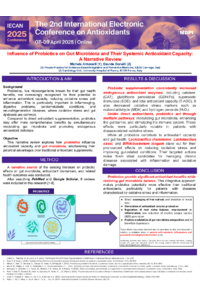
Probiotic Influence on Gut Microbiota and Antioxidant Capacity.pptx.pdf
Exploring Natural Deep Eutectic Solvents (NADESs) for Extraction of Antioxidant Compounds from Aromatic Herbs used in Mediterranean Diet
Achillea clypeolata: extraction, phenolic profile, cytotoxic and antioxidant activities, and pro-angiogenic potential in human keratinocytes