Event submissions
Published
This submission belongs to the session S6. Antioxidants Extraction, Assay and Industrial Applications of the event The 2nd International Electronic Conference on Antioxidants
Published date
04 Apr, 2025
Academic Editor
'%3e%3cpath%20d='M12.6657%2010.9104C12.4185%2010.325%2012.0599%209.79327%2011.6097%209.34482C11.1609%208.89508%2010.6293%208.5365%2010.0442%208.28888C10.0389%208.28626%2010.0337%208.28495%2010.0285%208.28233C10.8446%207.69279%2011.3752%206.73249%2011.3752%205.64904C11.3752%203.8542%209.92103%202.39999%208.1262%202.39999C6.33136%202.39999%204.87715%203.8542%204.87715%205.64904C4.87715%206.73249%205.40774%207.69279%206.22393%208.28364C6.21869%208.28626%206.21345%208.28757%206.20821%208.29019C5.62129%208.5378%205.09463%208.89284%204.64265%209.34613C4.1929%209.79493%203.83432%2010.3266%203.58671%2010.9117C3.34345%2011.4845%203.21226%2012.0987%203.20023%2012.7209C3.19988%2012.7349%203.20233%2012.7488%203.20744%2012.7619C3.21255%2012.7749%203.22022%2012.7867%203.22998%2012.7968C3.23975%2012.8068%203.25142%2012.8147%203.26431%2012.8202C3.2772%2012.8256%203.29105%2012.8284%203.30504%2012.8284H4.09109C4.14874%2012.8284%204.19459%2012.7825%204.1959%2012.7262C4.2221%2011.7148%204.62823%2010.7676%205.34617%2010.0497C6.08899%209.30683%207.0755%208.89808%208.1262%208.89808C9.17689%208.89808%2010.1634%209.30683%2010.9062%2010.0497C11.6242%2010.7676%2012.0303%2011.7148%2012.0565%2012.7262C12.0578%2012.7838%2012.1037%2012.8284%2012.1613%2012.8284H12.9474C12.9613%2012.8284%2012.9752%2012.8256%2012.9881%2012.8202C13.001%2012.8147%2013.0126%2012.8068%2013.0224%2012.7968C13.0322%2012.7867%2013.0398%2012.7749%2013.0449%2012.7619C13.0501%2012.7488%2013.0525%2012.7349%2013.0522%2012.7209C13.0391%2012.0947%2012.9094%2011.4855%2012.6657%2010.9104ZM8.1262%207.9024C7.52486%207.9024%206.9589%207.6679%206.53312%207.24211C6.10733%206.81633%205.87283%206.25037%205.87283%205.64904C5.87283%205.0477%206.10733%204.48174%206.53312%204.05596C6.9589%203.63018%207.52486%203.39567%208.1262%203.39567C8.72753%203.39567%209.29349%203.63018%209.71927%204.05596C10.1451%204.48174%2010.3796%205.0477%2010.3796%205.64904C10.3796%206.25037%2010.1451%206.81633%209.71927%207.24211C9.29349%207.6679%208.72753%207.9024%208.1262%207.9024Z'%20fill='%235D1EE1'/%3e%3c/g%3e%3c/svg%3e) Alessandra Napolitano
Alessandra NapolitanoCitation
Aleksandra A. Jovanović, Andrea Pirković, Nada Ćujić Nikolić, Jelena Živković, Katarina Šavikin, Cytotoxicity, antioxidant, anti-inflammatory, and sun protection potential of spray-dried Punica granatum peel extract, in Proceedings of The 2nd International Electronic Conference on Antioxidants, 7 April–9 April 2025, MDPI: Basel, Switzerland
Share
Email
Facebook
Twitter
LinkedIn
Cytotoxicity, antioxidant, anti-inflammatory, and sun protection potential of spray-dried Punica granatum peel extract

Aleksandra A. Jovanović 1
'%3e%3cpath%20d='M12.6647%2010.9104C12.4176%2010.325%2012.0589%209.7933%2011.6088%209.34485C11.16%208.89511%2010.6283%208.53653%2010.0432%208.28891C10.038%208.28629%2010.0327%208.28498%2010.0275%208.28236C10.8437%207.69282%2011.3743%206.73252%2011.3743%205.64907C11.3743%203.85423%209.92005%202.40002%208.12522%202.40002C6.33038%202.40002%204.87618%203.85423%204.87618%205.64907C4.87618%206.73252%205.40677%207.69282%206.22296%208.28367C6.21772%208.28629%206.21248%208.2876%206.20724%208.29022C5.62031%208.53783%205.09365%208.89287%204.64167%209.34616C4.19192%209.79496%203.83334%2010.3266%203.58573%2010.9117C3.34247%2011.4846%203.21128%2012.0987%203.19925%2012.721C3.1989%2012.735%203.20135%2012.7489%203.20646%2012.7619C3.21157%2012.7749%203.21924%2012.7868%203.22901%2012.7968C3.23877%2012.8068%203.25045%2012.8148%203.26334%2012.8202C3.27623%2012.8256%203.29007%2012.8284%203.30406%2012.8284H4.09012C4.14776%2012.8284%204.19362%2012.7825%204.19493%2012.7262C4.22113%2011.7148%204.62726%2010.7676%205.34519%2010.0497C6.08802%209.30686%207.07452%208.89811%208.12522%208.89811C9.17592%208.89811%2010.1624%209.30686%2010.9052%2010.0497C11.6232%2010.7676%2012.0293%2011.7148%2012.0555%2012.7262C12.0568%2012.7839%2012.1027%2012.8284%2012.1603%2012.8284H12.9464C12.9604%2012.8284%2012.9742%2012.8256%2012.9871%2012.8202C13%2012.8148%2013.0117%2012.8068%2013.0214%2012.7968C13.0312%2012.7868%2013.0389%2012.7749%2013.044%2012.7619C13.0491%2012.7489%2013.0515%2012.735%2013.0512%2012.721C13.0381%2012.0947%2012.9084%2011.4856%2012.6647%2010.9104ZM8.12522%207.90243C7.52388%207.90243%206.95792%207.66793%206.53214%207.24215C6.10636%206.81636%205.87185%206.2504%205.87185%205.64907C5.87185%205.04773%206.10636%204.48177%206.53214%204.05599C6.95792%203.63021%207.52388%203.3957%208.12522%203.3957C8.72655%203.3957%209.29252%203.63021%209.7183%204.05599C10.1441%204.48177%2010.3786%205.04773%2010.3786%205.64907C10.3786%206.2504%2010.1441%206.81636%209.7183%207.24215C9.29252%207.66793%208.72655%207.90243%208.12522%207.90243Z'%20fill='%235D1EE1'/%3e%3c/g%3e%3c/svg%3e)
Andrea Pirković 1

Nada Ćujić Nikolić 2

Jelena Živković 2

Katarina Šavikin 2
1. Institute for the Application of Nuclear Energy INEP, University of Belgrade, Banatska 31b, 11080 Belgrade, Serbia
2. Institute for Medicinal Plant Research “Dr Josif Pančić”, Tadeuša Košćuška 1, 11000 Belgrade, Serbia
Abstract
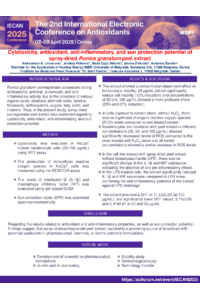
Punica granatum (pomegranate) possesses strong antibacterial, antiviral, antioxidant, and anti-inflammatory activity due to the presence of various organic acids, alkaloids, phenolic acids, tannins, flavonoids, anthocyanins, sugars, fatty acids, and vitamins. Thus, in the present study, spray-dried pomegranate peel extract was examined in terms of its cytotoxicity and antioxidant, anti-inflammatory, and sun protection potential. The extract showed a concentration-dependent effect on keratinocyte viability, producing a decrease in the viability of the HaCaT cells with rising concentrations. While 25 µg/mL did not significantly reduce cell viability (12% reduction), concentrations of 50 and 100 µg/mL showed a more profound effect (23% and 27% reductions, respectively). In cells exposed to the extract alone, without H2O2, there was no significant change in reactive oxygen species (ROS) levels compared to a non-treated control. Keratinocytes pre-incubated with three different concentrations of peel extract (25, 50, and 100 µg/mL) for 24 h before H2O2 exposure showed significantly decreased levels of ROS compared to ones treated with H2O2 alone. All three examined concentrations showed a similar decrease in ROS production. In the cell line treated with spray-dried peel extract without lipopolysaccharide (LPS), there was no significant change in the expression of interleukin 1β or macrophage inhibitory factor (MIF), indicating the absence of any pro-inflammatory effects from the extract. In the LPS-treated cells, the extract significantly reduced interleukin 1β and MIF expression when pre-incubated for 24 h compared to LPS alone, confirming the anti-inflammatory potential of the extract against an LPS challenge. Additionally, the extract provided a sun protection factor (SPF) of 11.33±0.33 (at a concentration of 100 µg/mL), and significantly lower SPF values, 3.11±0.05 and 5.97±0.21, at lower concentrations (25 and 50 µg/mL, respectively), while an SPF of 6 is generally considered the minimum degree of UVB protection required for sunscreen products.
Keywords
antioxidant activity
anti-inflammatory activity
cytotoxicity
Punica granatum
peel extract
sun protection factor
Poster
Antioxidants poster 110558.pdf
Achillea clypeolata: extraction, phenolic profile, cytotoxic and antioxidant activities, and pro-angiogenic potential in human keratinocytes
Antioxidant and Anti-inflammatory Properties of Urtica dioica: In Silico, In Vitro, and Phytochemical Analysis