Event submissions
Published
This submission belongs to the session S5. Natural and Synthetic Antioxidants and Antioxidant Enzyme Systems of the event The 2nd International Electronic Conference on Antioxidants
Published date
04 Apr, 2025
Academic Editor
'%3e%3cpath%20d='M12.6657%2010.9104C12.4185%2010.325%2012.0599%209.79327%2011.6097%209.34482C11.1609%208.89508%2010.6293%208.5365%2010.0442%208.28888C10.0389%208.28626%2010.0337%208.28495%2010.0285%208.28233C10.8446%207.69279%2011.3752%206.73249%2011.3752%205.64904C11.3752%203.8542%209.92103%202.39999%208.1262%202.39999C6.33136%202.39999%204.87715%203.8542%204.87715%205.64904C4.87715%206.73249%205.40774%207.69279%206.22393%208.28364C6.21869%208.28626%206.21345%208.28757%206.20821%208.29019C5.62129%208.5378%205.09463%208.89284%204.64265%209.34613C4.1929%209.79493%203.83432%2010.3266%203.58671%2010.9117C3.34345%2011.4845%203.21226%2012.0987%203.20023%2012.7209C3.19988%2012.7349%203.20233%2012.7488%203.20744%2012.7619C3.21255%2012.7749%203.22022%2012.7867%203.22998%2012.7968C3.23975%2012.8068%203.25142%2012.8147%203.26431%2012.8202C3.2772%2012.8256%203.29105%2012.8284%203.30504%2012.8284H4.09109C4.14874%2012.8284%204.19459%2012.7825%204.1959%2012.7262C4.2221%2011.7148%204.62823%2010.7676%205.34617%2010.0497C6.08899%209.30683%207.0755%208.89808%208.1262%208.89808C9.17689%208.89808%2010.1634%209.30683%2010.9062%2010.0497C11.6242%2010.7676%2012.0303%2011.7148%2012.0565%2012.7262C12.0578%2012.7838%2012.1037%2012.8284%2012.1613%2012.8284H12.9474C12.9613%2012.8284%2012.9752%2012.8256%2012.9881%2012.8202C13.001%2012.8147%2013.0126%2012.8068%2013.0224%2012.7968C13.0322%2012.7867%2013.0398%2012.7749%2013.0449%2012.7619C13.0501%2012.7488%2013.0525%2012.7349%2013.0522%2012.7209C13.0391%2012.0947%2012.9094%2011.4855%2012.6657%2010.9104ZM8.1262%207.9024C7.52486%207.9024%206.9589%207.6679%206.53312%207.24211C6.10733%206.81633%205.87283%206.25037%205.87283%205.64904C5.87283%205.0477%206.10733%204.48174%206.53312%204.05596C6.9589%203.63018%207.52486%203.39567%208.1262%203.39567C8.72753%203.39567%209.29349%203.63018%209.71927%204.05596C10.1451%204.48174%2010.3796%205.0477%2010.3796%205.64904C10.3796%206.25037%2010.1451%206.81633%209.71927%207.24211C9.29349%207.6679%208.72753%207.9024%208.1262%207.9024Z'%20fill='%235D1EE1'/%3e%3c/g%3e%3c/svg%3e) Mario Allegra
Mario AllegraCitation
Ahlem Ben chira, Yassine Kadmi, Badraoui Riadh, Mohd Saeed, Antioxidant and Anti-inflammatory Properties of Urtica dioica: In Silico, In Vitro, and Phytochemical Analysis, in Proceedings of The 2nd International Electronic Conference on Antioxidants, 7 April–9 April 2025, MDPI: Basel, Switzerland
Share
Email
Facebook
Twitter
LinkedIn
Antioxidant and Anti-inflammatory Properties of Urtica dioica: In Silico, In Vitro, and Phytochemical Analysis
'%3e%3cpath%20d='M12.6647%2010.9104C12.4176%2010.325%2012.0589%209.7933%2011.6088%209.34485C11.16%208.89511%2010.6283%208.53653%2010.0432%208.28891C10.038%208.28629%2010.0327%208.28498%2010.0275%208.28236C10.8437%207.69282%2011.3743%206.73252%2011.3743%205.64907C11.3743%203.85423%209.92005%202.40002%208.12522%202.40002C6.33038%202.40002%204.87618%203.85423%204.87618%205.64907C4.87618%206.73252%205.40677%207.69282%206.22296%208.28367C6.21772%208.28629%206.21248%208.2876%206.20724%208.29022C5.62031%208.53783%205.09365%208.89287%204.64167%209.34616C4.19192%209.79496%203.83334%2010.3266%203.58573%2010.9117C3.34247%2011.4846%203.21128%2012.0987%203.19925%2012.721C3.1989%2012.735%203.20135%2012.7489%203.20646%2012.7619C3.21157%2012.7749%203.21924%2012.7868%203.22901%2012.7968C3.23877%2012.8068%203.25045%2012.8148%203.26334%2012.8202C3.27623%2012.8256%203.29007%2012.8284%203.30406%2012.8284H4.09012C4.14776%2012.8284%204.19362%2012.7825%204.19493%2012.7262C4.22113%2011.7148%204.62726%2010.7676%205.34519%2010.0497C6.08802%209.30686%207.07452%208.89811%208.12522%208.89811C9.17592%208.89811%2010.1624%209.30686%2010.9052%2010.0497C11.6232%2010.7676%2012.0293%2011.7148%2012.0555%2012.7262C12.0568%2012.7839%2012.1027%2012.8284%2012.1603%2012.8284H12.9464C12.9604%2012.8284%2012.9742%2012.8256%2012.9871%2012.8202C13%2012.8148%2013.0117%2012.8068%2013.0214%2012.7968C13.0312%2012.7868%2013.0389%2012.7749%2013.044%2012.7619C13.0491%2012.7489%2013.0515%2012.735%2013.0512%2012.721C13.0381%2012.0947%2012.9084%2011.4856%2012.6647%2010.9104ZM8.12522%207.90243C7.52388%207.90243%206.95792%207.66793%206.53214%207.24215C6.10636%206.81636%205.87185%206.2504%205.87185%205.64907C5.87185%205.04773%206.10636%204.48177%206.53214%204.05599C6.95792%203.63021%207.52388%203.3957%208.12522%203.3957C8.72655%203.3957%209.29252%203.63021%209.7183%204.05599C10.1441%204.48177%2010.3786%205.04773%2010.3786%205.64907C10.3786%206.2504%2010.1441%206.81636%209.7183%207.24215C9.29252%207.66793%208.72655%207.90243%208.12522%207.90243Z'%20fill='%235D1EE1'/%3e%3c/g%3e%3c/svg%3e)
Ahlem Ben chira 1,2

Yassine Kadmi 2
Badraoui Riadh 3

Mohd Saeed 1
1. Laboratoire d’Ecophysiologie Animale, Faculté des Sciences de Sfax,3000, Sfax, TUNISIE.
2. Laboratoire de Spectrochimie Infrarouge et Raman (LASIR) UMR-CNRS 8516, 59655, Villeneuve d’Ascq.
3. Laboratory of General Biology, Department of Biology, University of Ha’il, Ha’il 81451, Saudi Arabia
Abstract
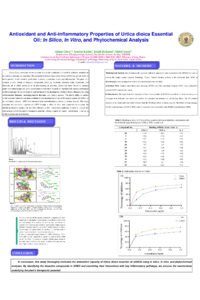
Oxidative stress and inflammation are key contributors to various chronic diseases, necessitating the discovery of natural compounds with therapeutic potential. Urtica dioica, commonly known as stinging nettle, has been traditionally used for its medicinal properties, but its essential oil remains underexplored. This study aimed to evaluate the antioxidant properties of Urtica dioica essential oil (UDEO) through an integrative approach involving in silico, in vitro, and in vivo analyses. The phytochemical composition of UDEO was investigated to identify bioactive compounds with significant biological roles. Gas chromatography combined with triple quadrupole mass spectrometry (GC-MS/MS) revealed 97 thermolabile compounds, highlighting the complex chemical profile of the essential oil. To enhance analytical precision, various injection methods using the multimode inlet (MMI) in chromatography were optimized, achieving lower instrumental detection limits. Standard antioxidant assays, including ABTS•+ radical scavenging and total antioxidant capacity (TAC), demonstrated UDEO’s strong antioxidative potential. In silico studies further indicated that several identified compounds may target inflammatory mediators such as cyclooxygenase-2 (COX-2), tumor necrosis factor-alpha (TNF-α), and interleukin-6 (IL-6). These findings suggest that UDEO may exert anti-inflammatory effects by modulating key pathways involved in oxidative stress and inflammation.
The study assessed the antioxidant properties of UDEO through a comprehensive approach, revealing its therapeutic potential in managing oxidative stress and inflammatory conditions. This work underscores the importance of exploring essential oils as a source of natural bioactive compounds for pharmacological applications.
Keywords
In vitro
in silico
Urtica dioica
inflammatory.
Poster
Poster Ahlem chira-1-1.pdf
Cytotoxicity, antioxidant, anti-inflammatory, and sun protection potential of spray-dried Punica granatum peel extract
PHYTOCHEMICAL COMPOSITION AND IN VITRO ANTIOXIDANT ACTIVITY OF Hibiscus sabdariffa.