Event submissions
Published
This submission belongs to the session S6. Antioxidants Extraction, Assay and Industrial Applications of the event The 2nd International Electronic Conference on Antioxidants
Published date
04 Apr, 2025
Academic Editor
'%3e%3cpath%20d='M12.6657%2010.9104C12.4185%2010.325%2012.0599%209.79327%2011.6097%209.34482C11.1609%208.89508%2010.6293%208.5365%2010.0442%208.28888C10.0389%208.28626%2010.0337%208.28495%2010.0285%208.28233C10.8446%207.69279%2011.3752%206.73249%2011.3752%205.64904C11.3752%203.8542%209.92103%202.39999%208.1262%202.39999C6.33136%202.39999%204.87715%203.8542%204.87715%205.64904C4.87715%206.73249%205.40774%207.69279%206.22393%208.28364C6.21869%208.28626%206.21345%208.28757%206.20821%208.29019C5.62129%208.5378%205.09463%208.89284%204.64265%209.34613C4.1929%209.79493%203.83432%2010.3266%203.58671%2010.9117C3.34345%2011.4845%203.21226%2012.0987%203.20023%2012.7209C3.19988%2012.7349%203.20233%2012.7488%203.20744%2012.7619C3.21255%2012.7749%203.22022%2012.7867%203.22998%2012.7968C3.23975%2012.8068%203.25142%2012.8147%203.26431%2012.8202C3.2772%2012.8256%203.29105%2012.8284%203.30504%2012.8284H4.09109C4.14874%2012.8284%204.19459%2012.7825%204.1959%2012.7262C4.2221%2011.7148%204.62823%2010.7676%205.34617%2010.0497C6.08899%209.30683%207.0755%208.89808%208.1262%208.89808C9.17689%208.89808%2010.1634%209.30683%2010.9062%2010.0497C11.6242%2010.7676%2012.0303%2011.7148%2012.0565%2012.7262C12.0578%2012.7838%2012.1037%2012.8284%2012.1613%2012.8284H12.9474C12.9613%2012.8284%2012.9752%2012.8256%2012.9881%2012.8202C13.001%2012.8147%2013.0126%2012.8068%2013.0224%2012.7968C13.0322%2012.7867%2013.0398%2012.7749%2013.0449%2012.7619C13.0501%2012.7488%2013.0525%2012.7349%2013.0522%2012.7209C13.0391%2012.0947%2012.9094%2011.4855%2012.6657%2010.9104ZM8.1262%207.9024C7.52486%207.9024%206.9589%207.6679%206.53312%207.24211C6.10733%206.81633%205.87283%206.25037%205.87283%205.64904C5.87283%205.0477%206.10733%204.48174%206.53312%204.05596C6.9589%203.63018%207.52486%203.39567%208.1262%203.39567C8.72753%203.39567%209.29349%203.63018%209.71927%204.05596C10.1451%204.48174%2010.3796%205.0477%2010.3796%205.64904C10.3796%206.25037%2010.1451%206.81633%209.71927%207.24211C9.29349%207.6679%208.72753%207.9024%208.1262%207.9024Z'%20fill='%235D1EE1'/%3e%3c/g%3e%3c/svg%3e) Ren-You Gan
Ren-You GanCitation
Branislava Teofilović, Kristina Stanišić, Zorana Nikić, Nevena Grujić-Letić, Snežena Papović, Emilia Gligorić, Milan Vraneš, Efficient Natural Deep Eutectic Solvent (NADES) Extraction of Gallic Acid as a Potent Antioxidant from Lamiaceae Plants, in Proceedings of The 2nd International Electronic Conference on Antioxidants, 7 April–9 April 2025, MDPI: Basel, Switzerland
Share
Email
Facebook
Twitter
LinkedIn
Efficient Natural Deep Eutectic Solvent (NADES) Extraction of Gallic Acid as a Potent Antioxidant from Lamiaceae Plants
'%3e%3cpath%20d='M12.6647%2010.9104C12.4176%2010.325%2012.0589%209.7933%2011.6088%209.34485C11.16%208.89511%2010.6283%208.53653%2010.0432%208.28891C10.038%208.28629%2010.0327%208.28498%2010.0275%208.28236C10.8437%207.69282%2011.3743%206.73252%2011.3743%205.64907C11.3743%203.85423%209.92005%202.40002%208.12522%202.40002C6.33038%202.40002%204.87618%203.85423%204.87618%205.64907C4.87618%206.73252%205.40677%207.69282%206.22296%208.28367C6.21772%208.28629%206.21248%208.2876%206.20724%208.29022C5.62031%208.53783%205.09365%208.89287%204.64167%209.34616C4.19192%209.79496%203.83334%2010.3266%203.58573%2010.9117C3.34247%2011.4846%203.21128%2012.0987%203.19925%2012.721C3.1989%2012.735%203.20135%2012.7489%203.20646%2012.7619C3.21157%2012.7749%203.21924%2012.7868%203.22901%2012.7968C3.23877%2012.8068%203.25045%2012.8148%203.26334%2012.8202C3.27623%2012.8256%203.29007%2012.8284%203.30406%2012.8284H4.09012C4.14776%2012.8284%204.19362%2012.7825%204.19493%2012.7262C4.22113%2011.7148%204.62726%2010.7676%205.34519%2010.0497C6.08802%209.30686%207.07452%208.89811%208.12522%208.89811C9.17592%208.89811%2010.1624%209.30686%2010.9052%2010.0497C11.6232%2010.7676%2012.0293%2011.7148%2012.0555%2012.7262C12.0568%2012.7839%2012.1027%2012.8284%2012.1603%2012.8284H12.9464C12.9604%2012.8284%2012.9742%2012.8256%2012.9871%2012.8202C13%2012.8148%2013.0117%2012.8068%2013.0214%2012.7968C13.0312%2012.7868%2013.0389%2012.7749%2013.044%2012.7619C13.0491%2012.7489%2013.0515%2012.735%2013.0512%2012.721C13.0381%2012.0947%2012.9084%2011.4856%2012.6647%2010.9104ZM8.12522%207.90243C7.52388%207.90243%206.95792%207.66793%206.53214%207.24215C6.10636%206.81636%205.87185%206.2504%205.87185%205.64907C5.87185%205.04773%206.10636%204.48177%206.53214%204.05599C6.95792%203.63021%207.52388%203.3957%208.12522%203.3957C8.72655%203.3957%209.29252%203.63021%209.7183%204.05599C10.1441%204.48177%2010.3786%205.04773%2010.3786%205.64907C10.3786%206.2504%2010.1441%206.81636%209.7183%207.24215C9.29252%207.66793%208.72655%207.90243%208.12522%207.90243Z'%20fill='%235D1EE1'/%3e%3c/g%3e%3c/svg%3e)
Branislava Teofilović 1
Kristina Stanišić 1
Zorana Nikić 1
Nevena Grujić-Letić 1
Snežena Papović 1
Emilia Gligorić 1
Milan Vraneš 1
1. Faculty of Medicine, University of Novi Sad, Novi Sad, 21000, Serbia
Abstract
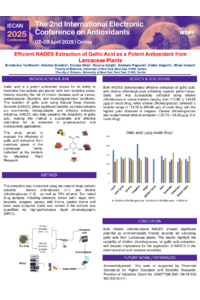
Gallic acid is a potent antioxidant known for its ability to neutralize free radicals and protect cells from oxidative stress, thereby reducing the risk of chronic diseases such as cancer, cardiovascular disorders, and neurodegenerative conditions. The isolation of gallic acid using Natural Deep Eutectic Solvents (NADESs) offers significant benefits, as these solvents are eco-friendly, biodegradable, and enhance extraction efficiency. NADESs also help preserve the bioactivity of gallic acid, making this method a sustainable and effective alternative for its extraction in pharmaceutical and nutraceutical applications. This study aimed to evaluate the efficiency of gallic acid extraction from medicinal plants of the Lamiaceae family, cultivated at the Institute for Medicinal Plant Research. The extraction was conducted using two natural deep eutectic solvents—choline chloride/urea (1:1) and choline chloride/glucose (1:2)—as well as 70% ethanol. Ten herbal drug samples, including rosemary, lemon balm, sage, mint, lavender, oregano, savory, wild thyme, garden thyme, and basil, were analyzed. Gallic acid content in the extracts was quantified via high-performance liquid chromatography (HPLC). Both NADESs demonstrated an effective extraction of gallic acid, with choline chloride/glucose exhibiting superior performance. Gallic acid was successfully extracted using choline chloride/urea in concentrations ranging from 113.80 to 134.05 µg/g of crude drug, while choline chloride/glucose achieved a broader range of 113.02 to 209.68 µg/g of crude drug, with the highest yield observed in oregano. Choline chloride/glucose also outperformed ethanol extraction (120.73–144.93 µg/g of of crude drug). Both choline chloride-based NADESs showed significant potential as environmentally friendly solvents for extracting gallic acid. The results highlight the suitability of choline chloride/glucose for gallic acid extraction, with broader implications for the application of NADESs in the pharmaceutical and cosmetic industries.
Acknowledgement: This work is supported by Provincial Secretariat for Higher Education and Scientific Research, Province of Vojvodina (Grant No. 142-451-3474/2023).
Keywords
NADES
green extraction
choline chloride/urea
choline chloride/glucose
Lamiaceae.
Poster
Teofilović et al..pdf
Polyphenols from Onion Skin Waste: A Natural Antioxidant Source with Beneficial Health Applications
Bioactive Potential of Cassia angustifolia Leaf Extract: Antioxidant and Antimicrobial Properties