Event submissions
Published
This submission belongs to the session S5. Natural and Synthetic Antioxidants and Antioxidant Enzyme Systems of the event The 2nd International Electronic Conference on Antioxidants
Published date
04 Apr, 2025
Academic Editor
'%3e%3cpath%20d='M12.6657%2010.9104C12.4185%2010.325%2012.0599%209.79327%2011.6097%209.34482C11.1609%208.89508%2010.6293%208.5365%2010.0442%208.28888C10.0389%208.28626%2010.0337%208.28495%2010.0285%208.28233C10.8446%207.69279%2011.3752%206.73249%2011.3752%205.64904C11.3752%203.8542%209.92103%202.39999%208.1262%202.39999C6.33136%202.39999%204.87715%203.8542%204.87715%205.64904C4.87715%206.73249%205.40774%207.69279%206.22393%208.28364C6.21869%208.28626%206.21345%208.28757%206.20821%208.29019C5.62129%208.5378%205.09463%208.89284%204.64265%209.34613C4.1929%209.79493%203.83432%2010.3266%203.58671%2010.9117C3.34345%2011.4845%203.21226%2012.0987%203.20023%2012.7209C3.19988%2012.7349%203.20233%2012.7488%203.20744%2012.7619C3.21255%2012.7749%203.22022%2012.7867%203.22998%2012.7968C3.23975%2012.8068%203.25142%2012.8147%203.26431%2012.8202C3.2772%2012.8256%203.29105%2012.8284%203.30504%2012.8284H4.09109C4.14874%2012.8284%204.19459%2012.7825%204.1959%2012.7262C4.2221%2011.7148%204.62823%2010.7676%205.34617%2010.0497C6.08899%209.30683%207.0755%208.89808%208.1262%208.89808C9.17689%208.89808%2010.1634%209.30683%2010.9062%2010.0497C11.6242%2010.7676%2012.0303%2011.7148%2012.0565%2012.7262C12.0578%2012.7838%2012.1037%2012.8284%2012.1613%2012.8284H12.9474C12.9613%2012.8284%2012.9752%2012.8256%2012.9881%2012.8202C13.001%2012.8147%2013.0126%2012.8068%2013.0224%2012.7968C13.0322%2012.7867%2013.0398%2012.7749%2013.0449%2012.7619C13.0501%2012.7488%2013.0525%2012.7349%2013.0522%2012.7209C13.0391%2012.0947%2012.9094%2011.4855%2012.6657%2010.9104ZM8.1262%207.9024C7.52486%207.9024%206.9589%207.6679%206.53312%207.24211C6.10733%206.81633%205.87283%206.25037%205.87283%205.64904C5.87283%205.0477%206.10733%204.48174%206.53312%204.05596C6.9589%203.63018%207.52486%203.39567%208.1262%203.39567C8.72753%203.39567%209.29349%203.63018%209.71927%204.05596C10.1451%204.48174%2010.3796%205.0477%2010.3796%205.64904C10.3796%206.25037%2010.1451%206.81633%209.71927%207.24211C9.29349%207.6679%208.72753%207.9024%208.1262%207.9024Z'%20fill='%235D1EE1'/%3e%3c/g%3e%3c/svg%3e) Mario Allegra
Mario AllegraCitation
Dmitry Filimonov, Alexander Eresko, Nadezhda Trubnikova, Irina Kisilenko, Margarita Belotserkovskaya, Elena Raksha, Dorota Marta Chudoba, Structural descriptors and antioxidant activity markers of 4-[4-(2-aminoetoxy)benzyl]aniline, in Proceedings of The 2nd International Electronic Conference on Antioxidants, 7 April–9 April 2025, MDPI: Basel, Switzerland
Share
Email
Facebook
Twitter
LinkedIn
Structural descriptors and antioxidant activity markers of 4-[4-(2-aminoetoxy)benzyl]aniline

Dmitry Filimonov 1
'%3e%3cpath%20d='M12.6647%2010.9104C12.4176%2010.325%2012.0589%209.7933%2011.6088%209.34485C11.16%208.89511%2010.6283%208.53653%2010.0432%208.28891C10.038%208.28629%2010.0327%208.28498%2010.0275%208.28236C10.8437%207.69282%2011.3743%206.73252%2011.3743%205.64907C11.3743%203.85423%209.92005%202.40002%208.12522%202.40002C6.33038%202.40002%204.87618%203.85423%204.87618%205.64907C4.87618%206.73252%205.40677%207.69282%206.22296%208.28367C6.21772%208.28629%206.21248%208.2876%206.20724%208.29022C5.62031%208.53783%205.09365%208.89287%204.64167%209.34616C4.19192%209.79496%203.83334%2010.3266%203.58573%2010.9117C3.34247%2011.4846%203.21128%2012.0987%203.19925%2012.721C3.1989%2012.735%203.20135%2012.7489%203.20646%2012.7619C3.21157%2012.7749%203.21924%2012.7868%203.22901%2012.7968C3.23877%2012.8068%203.25045%2012.8148%203.26334%2012.8202C3.27623%2012.8256%203.29007%2012.8284%203.30406%2012.8284H4.09012C4.14776%2012.8284%204.19362%2012.7825%204.19493%2012.7262C4.22113%2011.7148%204.62726%2010.7676%205.34519%2010.0497C6.08802%209.30686%207.07452%208.89811%208.12522%208.89811C9.17592%208.89811%2010.1624%209.30686%2010.9052%2010.0497C11.6232%2010.7676%2012.0293%2011.7148%2012.0555%2012.7262C12.0568%2012.7839%2012.1027%2012.8284%2012.1603%2012.8284H12.9464C12.9604%2012.8284%2012.9742%2012.8256%2012.9871%2012.8202C13%2012.8148%2013.0117%2012.8068%2013.0214%2012.7968C13.0312%2012.7868%2013.0389%2012.7749%2013.044%2012.7619C13.0491%2012.7489%2013.0515%2012.735%2013.0512%2012.721C13.0381%2012.0947%2012.9084%2011.4856%2012.6647%2010.9104ZM8.12522%207.90243C7.52388%207.90243%206.95792%207.66793%206.53214%207.24215C6.10636%206.81636%205.87185%206.2504%205.87185%205.64907C5.87185%205.04773%206.10636%204.48177%206.53214%204.05599C6.95792%203.63021%207.52388%203.3957%208.12522%203.3957C8.72655%203.3957%209.29252%203.63021%209.7183%204.05599C10.1441%204.48177%2010.3786%205.04773%2010.3786%205.64907C10.3786%206.2504%2010.1441%206.81636%209.7183%207.24215C9.29252%207.66793%208.72655%207.90243%208.12522%207.90243Z'%20fill='%235D1EE1'/%3e%3c/g%3e%3c/svg%3e)
Alexander Eresko 2
Nadezhda Trubnikova 1
Irina Kisilenko 1
Margarita Belotserkovskaya 1
Elena Raksha 2
Dorota Marta Chudoba 2
1. Federal State Budgetary Institution "V.K. Gusak Institute of Emergency and Reconstructive Surgery" of the Ministry of Health of the Russian Federation, Donetsk, 283045, Russia
2. Frank Laboratory of Neutron Physics, Joint Institute for Nuclear Research, Dubna, 141980 Russia
Abstract
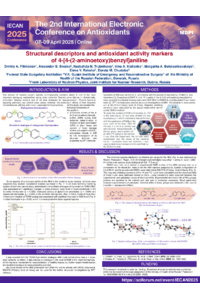
The release of reactive oxygen species accompanying oxidative stress is one of the most important damaging mechanisms during brain ischemia. Despite some failures in clinical trials, antioxidant therapy remains one of the best strategies for neuroprotection. Thyroid hormone signaling pathways can control redox status; however,the antioxidant effects of their bioactive metabolites are still less well known, especially for thyronamines.
The chemical species distribution at different pH values for 4-[4-(2-aminoethoxy)benzyl]aniline (Т0АМ thyronamine synthetic analogue) was estimated with the Marvin Protonation Plugin. The 2-{4-[(4-Aminophenyl)methyl]phenoxy}ethan-1-aminium cation is the main species in the pH 6.6-7.4 range. Molecular modeling of the structure and an evaluation of some structural descriptors were performed for the 2-{4-[(4-aminophenyl)methyl]phenoxy}ethan-1-aminium cation. A combination of the PM6-DH2 and B3LYP/6-31G(d,p) levels of theory was used to investigate the intramolecular dynamics of the considered protonated thyronamine.
Some aspects of the antioxidant activity of 4-[4-(2-aminoethoxy)benzyl]aniline in the model of acute cerebral ischemia were experimentally studied and discussed. In a rat brain hemisphere ischemia model, ligation of the internal carotid artery through the administration of a synthetic analogue of the thyronamine T0AM was associated with significant changes in redox markers: a lower level of malondialdehyde in the ischemic hemisphere (p = 0.022) and increased activity of glutathione peroxidase (p = 0.004) and superoxide dismutase levels (p = 0.042) in the ischemic hemisphere. Also, in an FeCl3 model of local brain infarction, the administration of a T0AM analog was associated with a significant increase in neuroglobin level in the intact hemisphere (p = 0.02), which is a cytoprotective factor. It was revealed that the Т0АМ thyronamine analogue could control redox status in acute brain ischemia. Further experimental studies are needed to evaluate its neuroprotective potential.
Keywords: thyronamines; protonation; intramolecular dynamics; DFT calculations; ischemic stroke; oxidative stress; lipid peroxidation.
Keywords
thyronamines
protonation
intramolecular dynamics
DFT calculations
ischemic stroke
oxidative stress
lipid peroxidation
Poster
Filimonov_Eresko_poster.pdf
Circular economy and valorization of pomegranate peel: Innovation for multifunctional applications
Bioactive Potential of Chardonnay White Wines: Evaluation of Phenolic Compounds and Antioxidant Capacity Before and After In Vitro Digestion