Event submissions
Published
This submission belongs to the session S5. Natural and Synthetic Antioxidants and Antioxidant Enzyme Systems of the event The 2nd International Electronic Conference on Antioxidants
Published date
04 Apr, 2025
Academic Editor
'%3e%3cpath%20d='M12.6657%2010.9104C12.4185%2010.325%2012.0599%209.79327%2011.6097%209.34482C11.1609%208.89508%2010.6293%208.5365%2010.0442%208.28888C10.0389%208.28626%2010.0337%208.28495%2010.0285%208.28233C10.8446%207.69279%2011.3752%206.73249%2011.3752%205.64904C11.3752%203.8542%209.92103%202.39999%208.1262%202.39999C6.33136%202.39999%204.87715%203.8542%204.87715%205.64904C4.87715%206.73249%205.40774%207.69279%206.22393%208.28364C6.21869%208.28626%206.21345%208.28757%206.20821%208.29019C5.62129%208.5378%205.09463%208.89284%204.64265%209.34613C4.1929%209.79493%203.83432%2010.3266%203.58671%2010.9117C3.34345%2011.4845%203.21226%2012.0987%203.20023%2012.7209C3.19988%2012.7349%203.20233%2012.7488%203.20744%2012.7619C3.21255%2012.7749%203.22022%2012.7867%203.22998%2012.7968C3.23975%2012.8068%203.25142%2012.8147%203.26431%2012.8202C3.2772%2012.8256%203.29105%2012.8284%203.30504%2012.8284H4.09109C4.14874%2012.8284%204.19459%2012.7825%204.1959%2012.7262C4.2221%2011.7148%204.62823%2010.7676%205.34617%2010.0497C6.08899%209.30683%207.0755%208.89808%208.1262%208.89808C9.17689%208.89808%2010.1634%209.30683%2010.9062%2010.0497C11.6242%2010.7676%2012.0303%2011.7148%2012.0565%2012.7262C12.0578%2012.7838%2012.1037%2012.8284%2012.1613%2012.8284H12.9474C12.9613%2012.8284%2012.9752%2012.8256%2012.9881%2012.8202C13.001%2012.8147%2013.0126%2012.8068%2013.0224%2012.7968C13.0322%2012.7867%2013.0398%2012.7749%2013.0449%2012.7619C13.0501%2012.7488%2013.0525%2012.7349%2013.0522%2012.7209C13.0391%2012.0947%2012.9094%2011.4855%2012.6657%2010.9104ZM8.1262%207.9024C7.52486%207.9024%206.9589%207.6679%206.53312%207.24211C6.10733%206.81633%205.87283%206.25037%205.87283%205.64904C5.87283%205.0477%206.10733%204.48174%206.53312%204.05596C6.9589%203.63018%207.52486%203.39567%208.1262%203.39567C8.72753%203.39567%209.29349%203.63018%209.71927%204.05596C10.1451%204.48174%2010.3796%205.0477%2010.3796%205.64904C10.3796%206.25037%2010.1451%206.81633%209.71927%207.24211C9.29349%207.6679%208.72753%207.9024%208.1262%207.9024Z'%20fill='%235D1EE1'/%3e%3c/g%3e%3c/svg%3e) Alessandra Napolitano
Alessandra NapolitanoCitation
Roberta Pino, Rosa Tundis, Monica Rosa Loizzo, Maurizio Bruno, natale Badalamenti, Vincenzo Ilardi, Chemical profile and Antioxidant activity of Allium chamaemoly L. subsp. chamaemoly from Sicily (Italy), in Proceedings of The 2nd International Electronic Conference on Antioxidants, 7 April–9 April 2025, MDPI: Basel, Switzerland
Share
Email
Facebook
Twitter
LinkedIn
Chemical profile and Antioxidant activity of Allium chamaemoly L. subsp. chamaemoly from Sicily (Italy)
'%3e%3cpath%20d='M12.6647%2010.9104C12.4176%2010.325%2012.0589%209.7933%2011.6088%209.34485C11.16%208.89511%2010.6283%208.53653%2010.0432%208.28891C10.038%208.28629%2010.0327%208.28498%2010.0275%208.28236C10.8437%207.69282%2011.3743%206.73252%2011.3743%205.64907C11.3743%203.85423%209.92005%202.40002%208.12522%202.40002C6.33038%202.40002%204.87618%203.85423%204.87618%205.64907C4.87618%206.73252%205.40677%207.69282%206.22296%208.28367C6.21772%208.28629%206.21248%208.2876%206.20724%208.29022C5.62031%208.53783%205.09365%208.89287%204.64167%209.34616C4.19192%209.79496%203.83334%2010.3266%203.58573%2010.9117C3.34247%2011.4846%203.21128%2012.0987%203.19925%2012.721C3.1989%2012.735%203.20135%2012.7489%203.20646%2012.7619C3.21157%2012.7749%203.21924%2012.7868%203.22901%2012.7968C3.23877%2012.8068%203.25045%2012.8148%203.26334%2012.8202C3.27623%2012.8256%203.29007%2012.8284%203.30406%2012.8284H4.09012C4.14776%2012.8284%204.19362%2012.7825%204.19493%2012.7262C4.22113%2011.7148%204.62726%2010.7676%205.34519%2010.0497C6.08802%209.30686%207.07452%208.89811%208.12522%208.89811C9.17592%208.89811%2010.1624%209.30686%2010.9052%2010.0497C11.6232%2010.7676%2012.0293%2011.7148%2012.0555%2012.7262C12.0568%2012.7839%2012.1027%2012.8284%2012.1603%2012.8284H12.9464C12.9604%2012.8284%2012.9742%2012.8256%2012.9871%2012.8202C13%2012.8148%2013.0117%2012.8068%2013.0214%2012.7968C13.0312%2012.7868%2013.0389%2012.7749%2013.044%2012.7619C13.0491%2012.7489%2013.0515%2012.735%2013.0512%2012.721C13.0381%2012.0947%2012.9084%2011.4856%2012.6647%2010.9104ZM8.12522%207.90243C7.52388%207.90243%206.95792%207.66793%206.53214%207.24215C6.10636%206.81636%205.87185%206.2504%205.87185%205.64907C5.87185%205.04773%206.10636%204.48177%206.53214%204.05599C6.95792%203.63021%207.52388%203.3957%208.12522%203.3957C8.72655%203.3957%209.29252%203.63021%209.7183%204.05599C10.1441%204.48177%2010.3786%205.04773%2010.3786%205.64907C10.3786%206.2504%2010.1441%206.81636%209.7183%207.24215C9.29252%207.66793%208.72655%207.90243%208.12522%207.90243Z'%20fill='%235D1EE1'/%3e%3c/g%3e%3c/svg%3e)
Roberta Pino 1

Rosa Tundis 2

Monica Rosa Loizzo 2

Maurizio Bruno 3

natale Badalamenti 3
Vincenzo Ilardi 4
1. Department of Pharmacy, Health and Nutritional Sciences, University of Calabria, 87036 Arcavacata di Rende (CS), Italy
2. Department of Pharmacy, Health and Nutritional Sciences, University of Calabria, 87036 Arcavacata di Rende (CS),
3. Department of Biological, Chemical and Pharmaceutical Sciences and Technologies, University of Palermo, Viale delle Scienze, Parco d’Orleans II, IT-90128 Palermo, Italy
4. Department of Earth and Marine Sciences, University of Palermo, Via Archirafi, 26 Palermo, Italy
Abstract
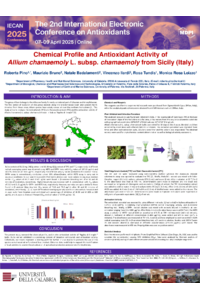
This study aimed to evaluate the total phenol content (TPC) and total flavonoid content (TFC) involved the composition and antioxidant activity of Allium chamaemoly L. subsp. chamaemoly (Amaryllidaceae), known in Italy as “Agghiu di li maghi” [1]. Bulbs were dried for 10 days in the shade, blended, and then extracted with ethanol EtOH, giving us an extraction yield of 1.17%. The TPC and TFC were measured using the Folin–Ciocalteu method, whereas the aluminium chloride colorimetric assay was applied to evaluate just the TFC [2]. The antioxidant activity was assessed by using 2,2′-azinobis-(3-ethylbenzothiazoline-6-sulfonic acid) (ABTS), and 2,2-diphenyl-1-picrylhydrazyl (DPPH), and β-carotene bleaching tests) [2]. Bulbs contained 56.22 and 18.88 mg/g extract of TPC and TFC, respectively. Different radical scavenging power was observed using ABTS and DPPH tests with IC50 of 287.13 mg/mL and 44,32% inhibition at 1000 mg/mL, respectively. In fact, the differences between these activities can be ascribed to the reaction media. The DPPH assay is conventionally conducted under a concentration of 50% ethanol /water, while the ABTS assay is carried out in aqueous conditions. In our case, it was possible to observe that thebulb’s phenols are more soluble in aqueous reaction media. IC50 values of 66.23 and 62.47 μg/mL were found in the β-carotene bleaching test after 30 and 60 minutes of incubation, respectively. In conclusion, our investigation revealed that Allium chamaemoly L. subsp. chamaemoly is a healthy spice with a promising content of bioactive compounds and antioxidant activity.
[1] Pignatti, S.; Guarino, R.; La Rosa, M. - Flora d’Italia; Edagricole, Bologna, II edizione, 2017, vol. 1, pp. 248-249; [2] Loizzo, M.R.; Tundis, R.; Sut, S.; Dall'Acqua, S.; Ilardi, V.; Leporini, M.; Falco, T.; Sicari, V.; Bruno, M. High-Performance Liquid Chromatography/Electrospray Ionization Tandem Mass Spectrometry (HPLC-ESI-MSn) Analysis and Bioactivity Useful for Prevention of "Diabesity" of Allium commutatum Guss. Plant Foods Hum Nutr. 2020, 75, 124-130.
Keywords
garlic
antioxidant
biodiversity
Poster
Poster Allium FINALE.pdf
Bioactive Potential of Chardonnay White Wines: Evaluation of Phenolic Compounds and Antioxidant Capacity Before and After In Vitro Digestion
Harnessing Antioxidant Potential: Optimized Extraction of Bioactive Compounds from Yellow Kiwi Peels (Actinidia chinensis)