Event submissions
Published
This submission belongs to the session S6. Antioxidants Extraction, Assay and Industrial Applications of the event The 2nd International Electronic Conference on Antioxidants
Published date
04 Apr, 2025
Academic Editor
'%3e%3cpath%20d='M12.6657%2010.9104C12.4185%2010.325%2012.0599%209.79327%2011.6097%209.34482C11.1609%208.89508%2010.6293%208.5365%2010.0442%208.28888C10.0389%208.28626%2010.0337%208.28495%2010.0285%208.28233C10.8446%207.69279%2011.3752%206.73249%2011.3752%205.64904C11.3752%203.8542%209.92103%202.39999%208.1262%202.39999C6.33136%202.39999%204.87715%203.8542%204.87715%205.64904C4.87715%206.73249%205.40774%207.69279%206.22393%208.28364C6.21869%208.28626%206.21345%208.28757%206.20821%208.29019C5.62129%208.5378%205.09463%208.89284%204.64265%209.34613C4.1929%209.79493%203.83432%2010.3266%203.58671%2010.9117C3.34345%2011.4845%203.21226%2012.0987%203.20023%2012.7209C3.19988%2012.7349%203.20233%2012.7488%203.20744%2012.7619C3.21255%2012.7749%203.22022%2012.7867%203.22998%2012.7968C3.23975%2012.8068%203.25142%2012.8147%203.26431%2012.8202C3.2772%2012.8256%203.29105%2012.8284%203.30504%2012.8284H4.09109C4.14874%2012.8284%204.19459%2012.7825%204.1959%2012.7262C4.2221%2011.7148%204.62823%2010.7676%205.34617%2010.0497C6.08899%209.30683%207.0755%208.89808%208.1262%208.89808C9.17689%208.89808%2010.1634%209.30683%2010.9062%2010.0497C11.6242%2010.7676%2012.0303%2011.7148%2012.0565%2012.7262C12.0578%2012.7838%2012.1037%2012.8284%2012.1613%2012.8284H12.9474C12.9613%2012.8284%2012.9752%2012.8256%2012.9881%2012.8202C13.001%2012.8147%2013.0126%2012.8068%2013.0224%2012.7968C13.0322%2012.7867%2013.0398%2012.7749%2013.0449%2012.7619C13.0501%2012.7488%2013.0525%2012.7349%2013.0522%2012.7209C13.0391%2012.0947%2012.9094%2011.4855%2012.6657%2010.9104ZM8.1262%207.9024C7.52486%207.9024%206.9589%207.6679%206.53312%207.24211C6.10733%206.81633%205.87283%206.25037%205.87283%205.64904C5.87283%205.0477%206.10733%204.48174%206.53312%204.05596C6.9589%203.63018%207.52486%203.39567%208.1262%203.39567C8.72753%203.39567%209.29349%203.63018%209.71927%204.05596C10.1451%204.48174%2010.3796%205.0477%2010.3796%205.64904C10.3796%206.25037%2010.1451%206.81633%209.71927%207.24211C9.29349%207.6679%208.72753%207.9024%208.1262%207.9024Z'%20fill='%235D1EE1'/%3e%3c/g%3e%3c/svg%3e) Ren-You Gan
Ren-You GanCitation
Rafael Nogueira-Marques, F. Chamorro, A. Perez-Vazquez, A.O.S. Jorge, Aurora Silva, M.A. Prieto, Harnessing Antioxidant Potential: Optimized Extraction of Bioactive Compounds from Yellow Kiwi Peels (Actinidia chinensis) , in Proceedings of The 2nd International Electronic Conference on Antioxidants, 7 April–9 April 2025, MDPI: Basel, Switzerland
Share
Email
Facebook
Twitter
LinkedIn
Harnessing Antioxidant Potential: Optimized Extraction of Bioactive Compounds from Yellow Kiwi Peels (Actinidia chinensis)
'%3e%3cpath%20d='M12.6647%2010.9104C12.4176%2010.325%2012.0589%209.7933%2011.6088%209.34485C11.16%208.89511%2010.6283%208.53653%2010.0432%208.28891C10.038%208.28629%2010.0327%208.28498%2010.0275%208.28236C10.8437%207.69282%2011.3743%206.73252%2011.3743%205.64907C11.3743%203.85423%209.92005%202.40002%208.12522%202.40002C6.33038%202.40002%204.87618%203.85423%204.87618%205.64907C4.87618%206.73252%205.40677%207.69282%206.22296%208.28367C6.21772%208.28629%206.21248%208.2876%206.20724%208.29022C5.62031%208.53783%205.09365%208.89287%204.64167%209.34616C4.19192%209.79496%203.83334%2010.3266%203.58573%2010.9117C3.34247%2011.4846%203.21128%2012.0987%203.19925%2012.721C3.1989%2012.735%203.20135%2012.7489%203.20646%2012.7619C3.21157%2012.7749%203.21924%2012.7868%203.22901%2012.7968C3.23877%2012.8068%203.25045%2012.8148%203.26334%2012.8202C3.27623%2012.8256%203.29007%2012.8284%203.30406%2012.8284H4.09012C4.14776%2012.8284%204.19362%2012.7825%204.19493%2012.7262C4.22113%2011.7148%204.62726%2010.7676%205.34519%2010.0497C6.08802%209.30686%207.07452%208.89811%208.12522%208.89811C9.17592%208.89811%2010.1624%209.30686%2010.9052%2010.0497C11.6232%2010.7676%2012.0293%2011.7148%2012.0555%2012.7262C12.0568%2012.7839%2012.1027%2012.8284%2012.1603%2012.8284H12.9464C12.9604%2012.8284%2012.9742%2012.8256%2012.9871%2012.8202C13%2012.8148%2013.0117%2012.8068%2013.0214%2012.7968C13.0312%2012.7868%2013.0389%2012.7749%2013.044%2012.7619C13.0491%2012.7489%2013.0515%2012.735%2013.0512%2012.721C13.0381%2012.0947%2012.9084%2011.4856%2012.6647%2010.9104ZM8.12522%207.90243C7.52388%207.90243%206.95792%207.66793%206.53214%207.24215C6.10636%206.81636%205.87185%206.2504%205.87185%205.64907C5.87185%205.04773%206.10636%204.48177%206.53214%204.05599C6.95792%203.63021%207.52388%203.3957%208.12522%203.3957C8.72655%203.3957%209.29252%203.63021%209.7183%204.05599C10.1441%204.48177%2010.3786%205.04773%2010.3786%205.64907C10.3786%206.2504%2010.1441%206.81636%209.7183%207.24215C9.29252%207.66793%208.72655%207.90243%208.12522%207.90243Z'%20fill='%235D1EE1'/%3e%3c/g%3e%3c/svg%3e)
Rafael Nogueira-Marques 1

F. Chamorro 1
A. Perez-Vazquez 1
A.O.S. Jorge 1,2

Aurora Silva 1,3

M.A. Prieto 1
1. Universidade de Vigo, Nutrition and Bromatology Group, Department of Analytical Chemistry and Food Science, Instituto de Agroecoloxía e Alimentación (IAA) – CITEXVI, 36310 Vigo, Spain.
2. REQUIMTE/LAQV, Department of Chemical Sciences, Faculty of Pharmacy, University of Porto, R. Jorge Viterbo Ferreira 228, 4050-313 Porto, Portugal
3. REQUIMTE/LAQV, Instituto Superior de Engenharia do Porto, Instituto Politécnico do Porto, Rua Dr. António Bernardino de Almeida 431, 4249-015 Porto, Portugal.
Abstract
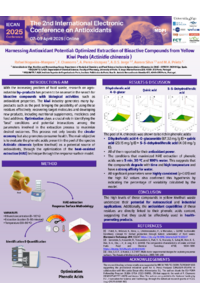
With the increasing problem of food waste, research on agro-industrial by-products has proven to be an asset in the search for bioactive compounds with biological activities, such as antioxidant properties. The kiwi industry generates many by-products such as the peel, bringing the possibility of using these residues effectively, recovering target molecules and developing new products, including nutritional supplements, medicines and food additives. Optimization plays a crucial role in identifying the "best" conditions and potential interactions among the parameters involved in the extraction process to maximize desired outcomes. This process not only boosts the circular economy but also promotes consumer health. The main objective is to evaluate the phenolic acids present in the peel of the species Actinidia chinensis (yellow kiwifruit) as a potential source of antioxidants, through the optimization of the heat-assisted extraction (HAE) technique through the response surface model. In this study, the peel of A. chinensis was shown to be rich in phenolic acids, of which the predominant is dihydroferulic acid 4-O-glucuronide, with a content of 67.32 mg/g E, accompanied by significant amounts of quinic acid (23.15 mg/g E) and 5-5-dehydrodiferulic acid (4.08 mg/g E), all of them reported for their antioxidant power. The conditions that maximized HAE extraction of phenolic acids were 5 min, 30 ºC and 100% water. This suggests that the compounds degrade with time and high temperature and have a strong affinity for water. All significant parameters were highly consistent (p<0.01) and the high R2 values also confirmed this hypothesis by indicating the percentage of variability calculated by the model. The high levels of these compounds in yellow kiwifruit waste underscore their potential for nutraceutical and industrial applications. Additionally, the antioxidant capabilities of these residues are directly linked to their phenolic acids content, suggesting that they could be effectively used in health-promoting products.
Keywords
Kiwifruit
antioxidant compounds
phenolic acids
optimization extraction
Poster
IECAN_2025_Rafa&Frank.pdf
Chemical profile and Antioxidant activity of Allium chamaemoly L. subsp. chamaemoly from Sicily (Italy)
Preserving Heritage, Promoting Health: A Review of Antioxidants in Indian Women’s Nutrition