Event submissions
Published
This submission belongs to the session S6. Antioxidants Extraction, Assay and Industrial Applications of the event The 2nd International Electronic Conference on Antioxidants
Published date
04 Apr, 2025
Academic Editor
'%3e%3cpath%20d='M12.6657%2010.9104C12.4185%2010.325%2012.0599%209.79327%2011.6097%209.34482C11.1609%208.89508%2010.6293%208.5365%2010.0442%208.28888C10.0389%208.28626%2010.0337%208.28495%2010.0285%208.28233C10.8446%207.69279%2011.3752%206.73249%2011.3752%205.64904C11.3752%203.8542%209.92103%202.39999%208.1262%202.39999C6.33136%202.39999%204.87715%203.8542%204.87715%205.64904C4.87715%206.73249%205.40774%207.69279%206.22393%208.28364C6.21869%208.28626%206.21345%208.28757%206.20821%208.29019C5.62129%208.5378%205.09463%208.89284%204.64265%209.34613C4.1929%209.79493%203.83432%2010.3266%203.58671%2010.9117C3.34345%2011.4845%203.21226%2012.0987%203.20023%2012.7209C3.19988%2012.7349%203.20233%2012.7488%203.20744%2012.7619C3.21255%2012.7749%203.22022%2012.7867%203.22998%2012.7968C3.23975%2012.8068%203.25142%2012.8147%203.26431%2012.8202C3.2772%2012.8256%203.29105%2012.8284%203.30504%2012.8284H4.09109C4.14874%2012.8284%204.19459%2012.7825%204.1959%2012.7262C4.2221%2011.7148%204.62823%2010.7676%205.34617%2010.0497C6.08899%209.30683%207.0755%208.89808%208.1262%208.89808C9.17689%208.89808%2010.1634%209.30683%2010.9062%2010.0497C11.6242%2010.7676%2012.0303%2011.7148%2012.0565%2012.7262C12.0578%2012.7838%2012.1037%2012.8284%2012.1613%2012.8284H12.9474C12.9613%2012.8284%2012.9752%2012.8256%2012.9881%2012.8202C13.001%2012.8147%2013.0126%2012.8068%2013.0224%2012.7968C13.0322%2012.7867%2013.0398%2012.7749%2013.0449%2012.7619C13.0501%2012.7488%2013.0525%2012.7349%2013.0522%2012.7209C13.0391%2012.0947%2012.9094%2011.4855%2012.6657%2010.9104ZM8.1262%207.9024C7.52486%207.9024%206.9589%207.6679%206.53312%207.24211C6.10733%206.81633%205.87283%206.25037%205.87283%205.64904C5.87283%205.0477%206.10733%204.48174%206.53312%204.05596C6.9589%203.63018%207.52486%203.39567%208.1262%203.39567C8.72753%203.39567%209.29349%203.63018%209.71927%204.05596C10.1451%204.48174%2010.3796%205.0477%2010.3796%205.64904C10.3796%206.25037%2010.1451%206.81633%209.71927%207.24211C9.29349%207.6679%208.72753%207.9024%208.1262%207.9024Z'%20fill='%235D1EE1'/%3e%3c/g%3e%3c/svg%3e) Ren-You Gan
Ren-You GanCitation
Aleksandra A. Jovanović, Amjed Abdullah Karkad, Andrea Pirković, Dragana Dekanski, Diana Lupulović, Miroslav Novaković, Aleksandar Marinković, Stability of Cotinus coggygria Scop. extract-loaded liposomes: the impact of storage on their physical and antioxidant properties, in Proceedings of The 2nd International Electronic Conference on Antioxidants, 7 April–9 April 2025, MDPI: Basel, Switzerland
Share
Email
Facebook
Twitter
LinkedIn
Stability of Cotinus coggygria Scop. extract-loaded liposomes: the impact of storage on their physical and antioxidant properties

Aleksandra A. Jovanović 1
'%3e%3cpath%20d='M12.6647%2010.9104C12.4176%2010.325%2012.0589%209.7933%2011.6088%209.34485C11.16%208.89511%2010.6283%208.53653%2010.0432%208.28891C10.038%208.28629%2010.0327%208.28498%2010.0275%208.28236C10.8437%207.69282%2011.3743%206.73252%2011.3743%205.64907C11.3743%203.85423%209.92005%202.40002%208.12522%202.40002C6.33038%202.40002%204.87618%203.85423%204.87618%205.64907C4.87618%206.73252%205.40677%207.69282%206.22296%208.28367C6.21772%208.28629%206.21248%208.2876%206.20724%208.29022C5.62031%208.53783%205.09365%208.89287%204.64167%209.34616C4.19192%209.79496%203.83334%2010.3266%203.58573%2010.9117C3.34247%2011.4846%203.21128%2012.0987%203.19925%2012.721C3.1989%2012.735%203.20135%2012.7489%203.20646%2012.7619C3.21157%2012.7749%203.21924%2012.7868%203.22901%2012.7968C3.23877%2012.8068%203.25045%2012.8148%203.26334%2012.8202C3.27623%2012.8256%203.29007%2012.8284%203.30406%2012.8284H4.09012C4.14776%2012.8284%204.19362%2012.7825%204.19493%2012.7262C4.22113%2011.7148%204.62726%2010.7676%205.34519%2010.0497C6.08802%209.30686%207.07452%208.89811%208.12522%208.89811C9.17592%208.89811%2010.1624%209.30686%2010.9052%2010.0497C11.6232%2010.7676%2012.0293%2011.7148%2012.0555%2012.7262C12.0568%2012.7839%2012.1027%2012.8284%2012.1603%2012.8284H12.9464C12.9604%2012.8284%2012.9742%2012.8256%2012.9871%2012.8202C13%2012.8148%2013.0117%2012.8068%2013.0214%2012.7968C13.0312%2012.7868%2013.0389%2012.7749%2013.044%2012.7619C13.0491%2012.7489%2013.0515%2012.735%2013.0512%2012.721C13.0381%2012.0947%2012.9084%2011.4856%2012.6647%2010.9104ZM8.12522%207.90243C7.52388%207.90243%206.95792%207.66793%206.53214%207.24215C6.10636%206.81636%205.87185%206.2504%205.87185%205.64907C5.87185%205.04773%206.10636%204.48177%206.53214%204.05599C6.95792%203.63021%207.52388%203.3957%208.12522%203.3957C8.72655%203.3957%209.29252%203.63021%209.7183%204.05599C10.1441%204.48177%2010.3786%205.04773%2010.3786%205.64907C10.3786%206.2504%2010.1441%206.81636%209.7183%207.24215C9.29252%207.66793%208.72655%207.90243%208.12522%207.90243Z'%20fill='%235D1EE1'/%3e%3c/g%3e%3c/svg%3e)
Amjed Abdullah Karkad 2,3
Andrea Pirković 1

Dragana Dekanski 1
Diana Lupulović 1

Miroslav Novaković 4
Aleksandar Marinković 5
1. Institute for the Application of Nuclear Energy INEP, University of Belgrade, Banatska 31b, 11080 Belgrade, Serbia
2. Faculty of Technology and Metallurgy, University of Belgrade, 11000 Belgrade, Serbia
3. Faculty of Medical Technology, Elmergib University, Msallata, Libya
4. Institute of Chemistry, Technology and Metallurgy, National Institute of the Republic of Serbia, University of Belgrade, Njegoševa 12, 11000 Belgrade, Serbia
5. Faculty of Technology and Metallurgy, University of Belgrade, Karnegijeva 4, 11000 Belgrade, Serbia
Abstract
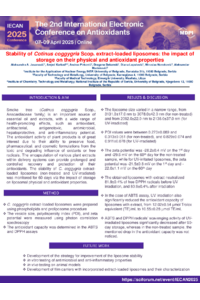
Smoke tree (Cotinus coggygria Scop., Anacardiaceae family) is an important source of essential oils and extracts, with a wide range of health-promoting effects, such as antioxidant, antibacterial, antigenotoxic, antimicrobial, hepatoprotective, and anti-inflammatory potential. The antioxidant activity of plant products is of great interest due to their ability to preserve food, pharmaceutical, and cosmetic formulations from the toxic and degrading influence of oxidants or free radicals. The encapsulation of various plant extracts within delivery systems can provide prolonged and controlled recovery and protection of their antioxidants. Hence, in the current research, the stability of C. coggygria extract-loaded liposomes (non-treated and UV-irradiated) was monitored for 60 days via the impact of storage on their physical and antioxidant properties. The vesicle size, polydispersity index (PDI), and zeta potential were determined using photon correlation spectroscopy in a 60-day storage study at 4 °C. The liposome size varied over a narrow range for the 60 days, from 3131.0±17.0 nm to 3078.0±42.0 nm (for non-treated) and from 2092.0±22.0 nm to 2136.0±37.0 nm (for UV-irradiated). The PDI values obtained were between 0.273±0.089 and 0.313±0.051 (for non-treated) and 0.829±0.074 and 0.911±0.078 (for UV-irradiated). The zeta potential was -28.2±0.4 mV on the 1st day and -29.6 mV on the 60th day for the non-treated sample, while for the UV-irritated liposomes, the zeta potential was -21.5±0.8 mV on the 1st day and -22.0±1.1 mV on the 60th day. The obtained extract-loaded liposomes neutralized 81.9±0.4% of the free DPPH radicals before UV irradiation and 80.9±0.4% after irradiation. In the case of the ABTS assay, UV irradiation also significantly reduced the antioxidant capacity of the extract-loaded liposomes, from 12.02±0.54 µmol Trolox equivalent (TE)/mL to 10.55±0.28 µmol TE/mL. Furthermore, the ABTS and DPPH radicals’ scavenging activity of the UV-irradiated liposomes significantly decreased after 60 days of storage (75.4±0.7% and 8.93±0.45 µmol TE/mL, respectively), whereas in the non-treated sample, this drop in antioxidant capacity was not observed.
Keywords
liposomes
storage stability
antioxidant capacity
Cotinus coggygria
extract
Poster
Antioxidants poster 110559.pdf
ANTIOXIDANTS AND COFFEE OIL FROM SPENT COFFEE GROUNDS AS POTENTIAL COSMETIC INGREDIENTS
Comparative analysis and antioxidant potential of hydroalcoholic extracts and infusions of cultivated ironwort