Event submissions
Published
This submission belongs to the session S6. Antioxidants Extraction, Assay and Industrial Applications of the event The 2nd International Electronic Conference on Antioxidants
Published date
04 Apr, 2025
Academic Editor
'%3e%3cpath%20d='M12.6657%2010.9104C12.4185%2010.325%2012.0599%209.79327%2011.6097%209.34482C11.1609%208.89508%2010.6293%208.5365%2010.0442%208.28888C10.0389%208.28626%2010.0337%208.28495%2010.0285%208.28233C10.8446%207.69279%2011.3752%206.73249%2011.3752%205.64904C11.3752%203.8542%209.92103%202.39999%208.1262%202.39999C6.33136%202.39999%204.87715%203.8542%204.87715%205.64904C4.87715%206.73249%205.40774%207.69279%206.22393%208.28364C6.21869%208.28626%206.21345%208.28757%206.20821%208.29019C5.62129%208.5378%205.09463%208.89284%204.64265%209.34613C4.1929%209.79493%203.83432%2010.3266%203.58671%2010.9117C3.34345%2011.4845%203.21226%2012.0987%203.20023%2012.7209C3.19988%2012.7349%203.20233%2012.7488%203.20744%2012.7619C3.21255%2012.7749%203.22022%2012.7867%203.22998%2012.7968C3.23975%2012.8068%203.25142%2012.8147%203.26431%2012.8202C3.2772%2012.8256%203.29105%2012.8284%203.30504%2012.8284H4.09109C4.14874%2012.8284%204.19459%2012.7825%204.1959%2012.7262C4.2221%2011.7148%204.62823%2010.7676%205.34617%2010.0497C6.08899%209.30683%207.0755%208.89808%208.1262%208.89808C9.17689%208.89808%2010.1634%209.30683%2010.9062%2010.0497C11.6242%2010.7676%2012.0303%2011.7148%2012.0565%2012.7262C12.0578%2012.7838%2012.1037%2012.8284%2012.1613%2012.8284H12.9474C12.9613%2012.8284%2012.9752%2012.8256%2012.9881%2012.8202C13.001%2012.8147%2013.0126%2012.8068%2013.0224%2012.7968C13.0322%2012.7867%2013.0398%2012.7749%2013.0449%2012.7619C13.0501%2012.7488%2013.0525%2012.7349%2013.0522%2012.7209C13.0391%2012.0947%2012.9094%2011.4855%2012.6657%2010.9104ZM8.1262%207.9024C7.52486%207.9024%206.9589%207.6679%206.53312%207.24211C6.10733%206.81633%205.87283%206.25037%205.87283%205.64904C5.87283%205.0477%206.10733%204.48174%206.53312%204.05596C6.9589%203.63018%207.52486%203.39567%208.1262%203.39567C8.72753%203.39567%209.29349%203.63018%209.71927%204.05596C10.1451%204.48174%2010.3796%205.0477%2010.3796%205.64904C10.3796%206.25037%2010.1451%206.81633%209.71927%207.24211C9.29349%207.6679%208.72753%207.9024%208.1262%207.9024Z'%20fill='%235D1EE1'/%3e%3c/g%3e%3c/svg%3e) Alessandra Napolitano
Alessandra NapolitanoCitation
Paraskevi S. Sinou, Vassiliki S. Birba, Vasilios A. Ioannidis, Fotini N. Lamari, Comparative analysis and antioxidant potential of hydroalcoholic extracts and infusions of cultivated ironwort, in Proceedings of The 2nd International Electronic Conference on Antioxidants, 7 April–9 April 2025, MDPI: Basel, Switzerland
Share
Email
Facebook
Twitter
LinkedIn
Comparative analysis and antioxidant potential of hydroalcoholic extracts and infusions of cultivated ironwort
'%3e%3cpath%20d='M12.6647%2010.9104C12.4176%2010.325%2012.0589%209.7933%2011.6088%209.34485C11.16%208.89511%2010.6283%208.53653%2010.0432%208.28891C10.038%208.28629%2010.0327%208.28498%2010.0275%208.28236C10.8437%207.69282%2011.3743%206.73252%2011.3743%205.64907C11.3743%203.85423%209.92005%202.40002%208.12522%202.40002C6.33038%202.40002%204.87618%203.85423%204.87618%205.64907C4.87618%206.73252%205.40677%207.69282%206.22296%208.28367C6.21772%208.28629%206.21248%208.2876%206.20724%208.29022C5.62031%208.53783%205.09365%208.89287%204.64167%209.34616C4.19192%209.79496%203.83334%2010.3266%203.58573%2010.9117C3.34247%2011.4846%203.21128%2012.0987%203.19925%2012.721C3.1989%2012.735%203.20135%2012.7489%203.20646%2012.7619C3.21157%2012.7749%203.21924%2012.7868%203.22901%2012.7968C3.23877%2012.8068%203.25045%2012.8148%203.26334%2012.8202C3.27623%2012.8256%203.29007%2012.8284%203.30406%2012.8284H4.09012C4.14776%2012.8284%204.19362%2012.7825%204.19493%2012.7262C4.22113%2011.7148%204.62726%2010.7676%205.34519%2010.0497C6.08802%209.30686%207.07452%208.89811%208.12522%208.89811C9.17592%208.89811%2010.1624%209.30686%2010.9052%2010.0497C11.6232%2010.7676%2012.0293%2011.7148%2012.0555%2012.7262C12.0568%2012.7839%2012.1027%2012.8284%2012.1603%2012.8284H12.9464C12.9604%2012.8284%2012.9742%2012.8256%2012.9871%2012.8202C13%2012.8148%2013.0117%2012.8068%2013.0214%2012.7968C13.0312%2012.7868%2013.0389%2012.7749%2013.044%2012.7619C13.0491%2012.7489%2013.0515%2012.735%2013.0512%2012.721C13.0381%2012.0947%2012.9084%2011.4856%2012.6647%2010.9104ZM8.12522%207.90243C7.52388%207.90243%206.95792%207.66793%206.53214%207.24215C6.10636%206.81636%205.87185%206.2504%205.87185%205.64907C5.87185%205.04773%206.10636%204.48177%206.53214%204.05599C6.95792%203.63021%207.52388%203.3957%208.12522%203.3957C8.72655%203.3957%209.29252%203.63021%209.7183%204.05599C10.1441%204.48177%2010.3786%205.04773%2010.3786%205.64907C10.3786%206.2504%2010.1441%206.81636%209.7183%207.24215C9.29252%207.66793%208.72655%207.90243%208.12522%207.90243Z'%20fill='%235D1EE1'/%3e%3c/g%3e%3c/svg%3e)
Paraskevi S. Sinou 1
Vassiliki S. Birba 1
Vasilios A. Ioannidis 1

Fotini N. Lamari 1
1. Laboratory of Pharmacognosy and Natural Products Chemistry, Department of Pharmacy, University of Patras, Greece
Abstract
Introduction:
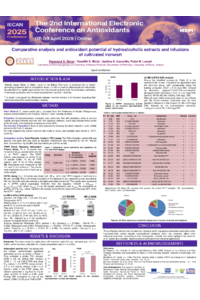
Sideritis raeseri Boiss. & Heldr., native to the Balkan Peninsula, is renowned for its composition, which is rich in diterpenoids and flavonoids. Its cultivation is rapidly expanding to meet the increasing demand for its aerial parts, particularly in beverage production and the pharmaceutical and cosmetic industries.
Methods:
S. raeseri cultivated in the Prefecture of Achaia (Peloponnese, Greece) was harvested in June 2024 and the aerial parts were air-dried. Ultrasound-assisted extraction was performed, first with petroleum ether to remove volatile and lipid contents and then with 50% aqueous methanol. Additionally, infusions were prepared by steeping the plant material in water initially heated to 95°C for 10 minutes. The hydromethanolic extract and the infusion were analyzed using Liquid Chromatography coupled with Mass Spectrometry and UV/Vis spectroscopy. Antioxidant capacity was evaluated through Total Phenolic Content (TPC), Ferric Reducing Antioxidant Power (FRAP), and 2,2-diphenyl-1-picrylhydrazyl radical activity (DPPH•) assays.
Results:
The primary constituents in the extract were verbascoside (19.22 mg/g dry extract weight), 4′-O-methyl-isoscutellarein 7-O-[6′″-O-acetyl-β-D-allopyranosyl-(1→2)]-β-D-glucopyranoside (15.93 mg/g), echinacin (14.26 mg/g), and chlorogenic acid (11.82 mg/g). The infusion contained fewer compounds but was rich in melittoside (31.39 mg/g dry infusion weight), with chlorogenic acid (4.29 mg/g) as the second most abundant compound. Despite differences in their quantitative profiles, the polar extract (TPC: 22.69 mg GAE/g; FRAP: 66.46 mg Fe(II)/g; DPPH scavenging: IC50 2.17 mg/mL) and the infusion (19 mg GAE/g, 73.75 mg Fe(II)/g, and IC50 2.58 mg/mL, respectively) exhibited comparable antioxidant activities across all assays.
Conclusion:
These findings indicate that mountain tea infusions confer equipotent antioxidant protection to the hydromethanolic extract despite compositional variations, which can, however, affect other biological properties, warranting further investigation. Overall, this study highlights the potential of S. raeseri as a valuable natural source of antioxidants for industrial applications.
Keywords
Sideritis raeseri
infusions
LC- MS
HPLC-DAD
antioxidant activity
Poster
IECAN 2025 Sideritis raeseri Poster (sciforum-113142).pdf
Stability of Cotinus coggygria Scop. extract-loaded liposomes: the impact of storage on their physical and antioxidant properties
Nano-Antioxidants: A New Frontier In Antioxidant Delivery Systems