Event submissions
Published
This submission belongs to the session S6. Antioxidants Extraction, Assay and Industrial Applications of the event The 2nd International Electronic Conference on Antioxidants
Published date
04 Apr, 2025
Academic Editor
'%3e%3cpath%20d='M12.6657%2010.9104C12.4185%2010.325%2012.0599%209.79327%2011.6097%209.34482C11.1609%208.89508%2010.6293%208.5365%2010.0442%208.28888C10.0389%208.28626%2010.0337%208.28495%2010.0285%208.28233C10.8446%207.69279%2011.3752%206.73249%2011.3752%205.64904C11.3752%203.8542%209.92103%202.39999%208.1262%202.39999C6.33136%202.39999%204.87715%203.8542%204.87715%205.64904C4.87715%206.73249%205.40774%207.69279%206.22393%208.28364C6.21869%208.28626%206.21345%208.28757%206.20821%208.29019C5.62129%208.5378%205.09463%208.89284%204.64265%209.34613C4.1929%209.79493%203.83432%2010.3266%203.58671%2010.9117C3.34345%2011.4845%203.21226%2012.0987%203.20023%2012.7209C3.19988%2012.7349%203.20233%2012.7488%203.20744%2012.7619C3.21255%2012.7749%203.22022%2012.7867%203.22998%2012.7968C3.23975%2012.8068%203.25142%2012.8147%203.26431%2012.8202C3.2772%2012.8256%203.29105%2012.8284%203.30504%2012.8284H4.09109C4.14874%2012.8284%204.19459%2012.7825%204.1959%2012.7262C4.2221%2011.7148%204.62823%2010.7676%205.34617%2010.0497C6.08899%209.30683%207.0755%208.89808%208.1262%208.89808C9.17689%208.89808%2010.1634%209.30683%2010.9062%2010.0497C11.6242%2010.7676%2012.0303%2011.7148%2012.0565%2012.7262C12.0578%2012.7838%2012.1037%2012.8284%2012.1613%2012.8284H12.9474C12.9613%2012.8284%2012.9752%2012.8256%2012.9881%2012.8202C13.001%2012.8147%2013.0126%2012.8068%2013.0224%2012.7968C13.0322%2012.7867%2013.0398%2012.7749%2013.0449%2012.7619C13.0501%2012.7488%2013.0525%2012.7349%2013.0522%2012.7209C13.0391%2012.0947%2012.9094%2011.4855%2012.6657%2010.9104ZM8.1262%207.9024C7.52486%207.9024%206.9589%207.6679%206.53312%207.24211C6.10733%206.81633%205.87283%206.25037%205.87283%205.64904C5.87283%205.0477%206.10733%204.48174%206.53312%204.05596C6.9589%203.63018%207.52486%203.39567%208.1262%203.39567C8.72753%203.39567%209.29349%203.63018%209.71927%204.05596C10.1451%204.48174%2010.3796%205.0477%2010.3796%205.64904C10.3796%206.25037%2010.1451%206.81633%209.71927%207.24211C9.29349%207.6679%208.72753%207.9024%208.1262%207.9024Z'%20fill='%235D1EE1'/%3e%3c/g%3e%3c/svg%3e) Alessandra Napolitano
Alessandra NapolitanoCitation
Filip Balaz, Ana Bojic, Katarina Arapovic, Ana Tomas Petrovic, Emilia Gligoric, Nevena Grujic-Letic, Branislava Teofilovic, ECO-FRIENDLY ULTRASOUND-ASSISTED EXTRACTION OF QUERCETINE FROM CICHORIUM INTYBUS USING NADESs AND COMMERCIAL SOLVENTS, in Proceedings of The 2nd International Electronic Conference on Antioxidants, 7 April–9 April 2025, MDPI: Basel, Switzerland
Share
Email
Facebook
Twitter
LinkedIn
ECO-FRIENDLY ULTRASOUND-ASSISTED EXTRACTION OF QUERCETINE FROM CICHORIUM INTYBUS USING NADESs AND COMMERCIAL SOLVENTS
'%3e%3cpath%20d='M12.6647%2010.9104C12.4176%2010.325%2012.0589%209.7933%2011.6088%209.34485C11.16%208.89511%2010.6283%208.53653%2010.0432%208.28891C10.038%208.28629%2010.0327%208.28498%2010.0275%208.28236C10.8437%207.69282%2011.3743%206.73252%2011.3743%205.64907C11.3743%203.85423%209.92005%202.40002%208.12522%202.40002C6.33038%202.40002%204.87618%203.85423%204.87618%205.64907C4.87618%206.73252%205.40677%207.69282%206.22296%208.28367C6.21772%208.28629%206.21248%208.2876%206.20724%208.29022C5.62031%208.53783%205.09365%208.89287%204.64167%209.34616C4.19192%209.79496%203.83334%2010.3266%203.58573%2010.9117C3.34247%2011.4846%203.21128%2012.0987%203.19925%2012.721C3.1989%2012.735%203.20135%2012.7489%203.20646%2012.7619C3.21157%2012.7749%203.21924%2012.7868%203.22901%2012.7968C3.23877%2012.8068%203.25045%2012.8148%203.26334%2012.8202C3.27623%2012.8256%203.29007%2012.8284%203.30406%2012.8284H4.09012C4.14776%2012.8284%204.19362%2012.7825%204.19493%2012.7262C4.22113%2011.7148%204.62726%2010.7676%205.34519%2010.0497C6.08802%209.30686%207.07452%208.89811%208.12522%208.89811C9.17592%208.89811%2010.1624%209.30686%2010.9052%2010.0497C11.6232%2010.7676%2012.0293%2011.7148%2012.0555%2012.7262C12.0568%2012.7839%2012.1027%2012.8284%2012.1603%2012.8284H12.9464C12.9604%2012.8284%2012.9742%2012.8256%2012.9871%2012.8202C13%2012.8148%2013.0117%2012.8068%2013.0214%2012.7968C13.0312%2012.7868%2013.0389%2012.7749%2013.044%2012.7619C13.0491%2012.7489%2013.0515%2012.735%2013.0512%2012.721C13.0381%2012.0947%2012.9084%2011.4856%2012.6647%2010.9104ZM8.12522%207.90243C7.52388%207.90243%206.95792%207.66793%206.53214%207.24215C6.10636%206.81636%205.87185%206.2504%205.87185%205.64907C5.87185%205.04773%206.10636%204.48177%206.53214%204.05599C6.95792%203.63021%207.52388%203.3957%208.12522%203.3957C8.72655%203.3957%209.29252%203.63021%209.7183%204.05599C10.1441%204.48177%2010.3786%205.04773%2010.3786%205.64907C10.3786%206.2504%2010.1441%206.81636%209.7183%207.24215C9.29252%207.66793%208.72655%207.90243%208.12522%207.90243Z'%20fill='%235D1EE1'/%3e%3c/g%3e%3c/svg%3e)
Filip Balaz 1
Ana Bojic 1
Katarina Arapovic 1
Ana Tomas Petrovic 1
Emilia Gligoric 1
Nevena Grujic-Letic 1
Branislava Teofilovic 1
1. University of Novi Sad, Faculty of Medicine, Hajduk Veljkova 3, 21000 Novi Sad, Serbia
Abstract
Cichorium intybus, a medicinal plant, is valued for its bioactive compounds, such as flavonoids, phenolic acids, and other phytochemicals. In particular, quercetin is a flavonoid with potent antioxidant properties that combat oxidative stress and aid in preventing chronic diseases. Additionally, quercetin exhibits anti-inflammatory, antihistaminic, and immunomodulatory effects, making it a popular choice for promoting overall health. The objective of this study was to compare the extraction efficiency of quercetin using natural deep eutectic solvents (NADESs) based on glucose and glycerol with commercial solvents from the aerial parts of Cichorium intybus cultivated at the Institute “Dr. Josif Pančić.” Extraction was performed using eight solvents: five NADES formulations (glycerol–citric acid 1:1, glycerol–urea 1:1, glucose–lactic acid 1:1, glucose–urea 1:2, and glucose–glycerol 1:2) and three commercial solvents (water, ethanol, and methanol). Quercetin content was quantified using ultrasonic-assisted extraction. All NADESs outperformed the commercial solvents in extracting quercetin. The quercetin content extracted using NADESs ranged from 1.52 to 2.69 mg/g of crude extract, with the glucose–lactic acid NADES yielding the highest quercetin content at 2.69 mg/g of crude extract. In contrast, the quercetin levels obtained with commercial solvents ranged from 0.40 to 1.37 mg/g of crude extract. The NADESs demonstrated remarkable efficiency in extracting bioactive compounds such as quercetin due to their tunable physicochemical properties, including high polarity and hydrogen bonding capacity, which enhance solubility and selectivity. Additionally, NADESs are environmentally friendly, biodegradable, and non-toxic, making them a sustainable alternative to conventional organic solvents while improving extraction efficiency. Their unique ability to mimic natural cellular environments stabilizes sensitive bioactive compounds during extraction, preserving their antioxidant potential and functional properties.
Acknowledgement:
This work is supported by Provincial Secretariat for Higher Education and Scientific Research, Province of Vojvodina (Grant No. 142-451-3474/2023).
Keywords
Cichorium intybus
Quercetin
NADES
Antioxidant properties
Poster
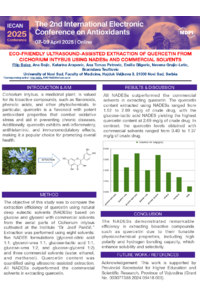
ECO-FRIENDLY ULTRASOUND-ASSISTED EXTRACTION OF QUERCETINE FROM CICHORIUM INTYBUS USING NADESs AND COMMERCIAL SOLVENTS .pdf
Anticancer potential of antioxidant extract from spent coffee grounds.
Exploring Limonia acidissima: The Nutritional and Medicinal Secrets of Wood Apple