Event submissions
Published
This submission belongs to the session S6. Antioxidants Extraction, Assay and Industrial Applications of the event The 2nd International Electronic Conference on Antioxidants
Published date
04 Apr, 2025
Academic Editor
'%3e%3cpath%20d='M12.6657%2010.9104C12.4185%2010.325%2012.0599%209.79327%2011.6097%209.34482C11.1609%208.89508%2010.6293%208.5365%2010.0442%208.28888C10.0389%208.28626%2010.0337%208.28495%2010.0285%208.28233C10.8446%207.69279%2011.3752%206.73249%2011.3752%205.64904C11.3752%203.8542%209.92103%202.39999%208.1262%202.39999C6.33136%202.39999%204.87715%203.8542%204.87715%205.64904C4.87715%206.73249%205.40774%207.69279%206.22393%208.28364C6.21869%208.28626%206.21345%208.28757%206.20821%208.29019C5.62129%208.5378%205.09463%208.89284%204.64265%209.34613C4.1929%209.79493%203.83432%2010.3266%203.58671%2010.9117C3.34345%2011.4845%203.21226%2012.0987%203.20023%2012.7209C3.19988%2012.7349%203.20233%2012.7488%203.20744%2012.7619C3.21255%2012.7749%203.22022%2012.7867%203.22998%2012.7968C3.23975%2012.8068%203.25142%2012.8147%203.26431%2012.8202C3.2772%2012.8256%203.29105%2012.8284%203.30504%2012.8284H4.09109C4.14874%2012.8284%204.19459%2012.7825%204.1959%2012.7262C4.2221%2011.7148%204.62823%2010.7676%205.34617%2010.0497C6.08899%209.30683%207.0755%208.89808%208.1262%208.89808C9.17689%208.89808%2010.1634%209.30683%2010.9062%2010.0497C11.6242%2010.7676%2012.0303%2011.7148%2012.0565%2012.7262C12.0578%2012.7838%2012.1037%2012.8284%2012.1613%2012.8284H12.9474C12.9613%2012.8284%2012.9752%2012.8256%2012.9881%2012.8202C13.001%2012.8147%2013.0126%2012.8068%2013.0224%2012.7968C13.0322%2012.7867%2013.0398%2012.7749%2013.0449%2012.7619C13.0501%2012.7488%2013.0525%2012.7349%2013.0522%2012.7209C13.0391%2012.0947%2012.9094%2011.4855%2012.6657%2010.9104ZM8.1262%207.9024C7.52486%207.9024%206.9589%207.6679%206.53312%207.24211C6.10733%206.81633%205.87283%206.25037%205.87283%205.64904C5.87283%205.0477%206.10733%204.48174%206.53312%204.05596C6.9589%203.63018%207.52486%203.39567%208.1262%203.39567C8.72753%203.39567%209.29349%203.63018%209.71927%204.05596C10.1451%204.48174%2010.3796%205.0477%2010.3796%205.64904C10.3796%206.25037%2010.1451%206.81633%209.71927%207.24211C9.29349%207.6679%208.72753%207.9024%208.1262%207.9024Z'%20fill='%235D1EE1'/%3e%3c/g%3e%3c/svg%3e) Alessandra Napolitano
Alessandra NapolitanoCitation
Aurora Silva, Maria Carpena, Javier Echave, Clara Grosso, M.Fátima Barroso, Miguel A Prieto, Exploring the Role of Brown Algae as Scavengers of Reactive Oxygen and Nitrogen Species, in Proceedings of The 2nd International Electronic Conference on Antioxidants, 7 April–9 April 2025, MDPI: Basel, Switzerland
Share
Email
Facebook
Twitter
LinkedIn
Exploring the Role of Brown Algae as Scavengers of Reactive Oxygen and Nitrogen Species

Aurora Silva 1,2

Maria Carpena 2

Javier Echave 2

Clara Grosso 1

M.Fátima Barroso 1

Miguel A Prieto 2,3
1. REQUIMTE/LAQV, Instituto Superior de Engenharia do Porto, Instituto Politécnico do Porto, Rua Dr António Bernardino de Almeida 431, 4200-072 Porto, Portugal.
2. Universidade de Vigo, Nutrition and Bromatology Group, Department of Analytical Chemistry and Food Science, Instituto de Agroecoloxía e Alimentación (IAA) – CITEXVI, 36310 Vigo, Spain.
3. Centro de Investigação de Montanha (CIMO), Instituto Politécnico de Bragança, Campus de Santa Apolonia, 5300-253 Bragança, Portugal.
Abstract
Oxidative stress, an imbalance between reactive oxygen species (ROS) and/or reactive nitrogen species (RNS) and the antioxidants present in the organism, has a significant role in the pathogenesis of various illnesses. Moreover, this process contributes to cellular damage, affecting DNA, proteins, and lipids, inducing cellular aging and age-related diseases such as cancer, cardiovascular diseases, and neurodegenerative disorders [1]. Brown macroalgae have been demonstrated to be significant potential ROS and RNS scavengers, primarily due to their rich antioxidant properties. Various studies have highlighted the ability of brown algae extracts to neutralize ROS and RNS, including superoxide (O2●-) and hydroxyl (●OH) radicals, hydrogen peroxide (H2O2), and nitric oxide (●NO), which are known to contribute to oxidative stress. This antioxidant capability of these extracts is attributed to the presence of bioactive compounds such as polyphenols, specifically phlorotannins, among other secondary metabolites found in these marine species. In this work, six brown algae species, i.e., Himanthalia elongata, Undaria pinnatifida, Sargassum muticum, Bifurcaria bifurcata, Fucus spiralis, and Ascophylum nodosum, were studied, aiming to assess their ability to promote ROS and RNS scavenging. The bioactive compounds were extracted by microwave-assisted extraction [2–5], and the scavenging activity was tested by in vitro spectrophotometric methods [6]. The results showed that concerning the ●NO scavenging activity, the EC50 varied from 74 µg/mL to 2000 µg/mL for Fucus spiralis and Himanthalia elongata, respectively. The EC50 regarding the O2●- scavenging activity ranged from 16 µg/mL (Sargassum muticum) to 279 µg/mL (Undaria pinnatifida), while for H2O2 scavenging, the best result was achieved by Fucus spiralis (EC50 =39 µg/mL). The radical ●OH was the reactive species that required the highest quantity of algae extract to achieve the 50% depletion, averaging 1240 µg/mL. These results highlight the activity of the algae extracts as antioxidants, showing their potential to reduce oxidative stress.
Keywords
Brown algae
Reactive oxygen and nitrogem species
Scavanging activity
Poster
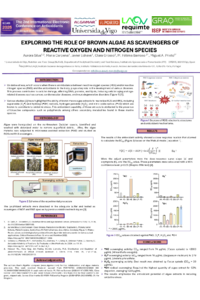
2025_antioxidants_poster.pdf
Exploring antioxidant potential of green kiwifruit: Nutritional and phytochemical characterization of peel and pomace
Lichens of the genus Parmelia: a promising source of antioxidant compounds with pharmacological applications