Event submissions
Published
This submission belongs to the session S3. Antioxidants in Chronic Disease: From Dietary Prevention to Therapeutic Intervention of the event The 2nd International Electronic Conference on Antioxidants
Published date
09 Apr, 2025
Academic Editor
'%3e%3cpath%20d='M12.6657%2010.9104C12.4185%2010.325%2012.0599%209.79327%2011.6097%209.34482C11.1609%208.89508%2010.6293%208.5365%2010.0442%208.28888C10.0389%208.28626%2010.0337%208.28495%2010.0285%208.28233C10.8446%207.69279%2011.3752%206.73249%2011.3752%205.64904C11.3752%203.8542%209.92103%202.39999%208.1262%202.39999C6.33136%202.39999%204.87715%203.8542%204.87715%205.64904C4.87715%206.73249%205.40774%207.69279%206.22393%208.28364C6.21869%208.28626%206.21345%208.28757%206.20821%208.29019C5.62129%208.5378%205.09463%208.89284%204.64265%209.34613C4.1929%209.79493%203.83432%2010.3266%203.58671%2010.9117C3.34345%2011.4845%203.21226%2012.0987%203.20023%2012.7209C3.19988%2012.7349%203.20233%2012.7488%203.20744%2012.7619C3.21255%2012.7749%203.22022%2012.7867%203.22998%2012.7968C3.23975%2012.8068%203.25142%2012.8147%203.26431%2012.8202C3.2772%2012.8256%203.29105%2012.8284%203.30504%2012.8284H4.09109C4.14874%2012.8284%204.19459%2012.7825%204.1959%2012.7262C4.2221%2011.7148%204.62823%2010.7676%205.34617%2010.0497C6.08899%209.30683%207.0755%208.89808%208.1262%208.89808C9.17689%208.89808%2010.1634%209.30683%2010.9062%2010.0497C11.6242%2010.7676%2012.0303%2011.7148%2012.0565%2012.7262C12.0578%2012.7838%2012.1037%2012.8284%2012.1613%2012.8284H12.9474C12.9613%2012.8284%2012.9752%2012.8256%2012.9881%2012.8202C13.001%2012.8147%2013.0126%2012.8068%2013.0224%2012.7968C13.0322%2012.7867%2013.0398%2012.7749%2013.0449%2012.7619C13.0501%2012.7488%2013.0525%2012.7349%2013.0522%2012.7209C13.0391%2012.0947%2012.9094%2011.4855%2012.6657%2010.9104ZM8.1262%207.9024C7.52486%207.9024%206.9589%207.6679%206.53312%207.24211C6.10733%206.81633%205.87283%206.25037%205.87283%205.64904C5.87283%205.0477%206.10733%204.48174%206.53312%204.05596C6.9589%203.63018%207.52486%203.39567%208.1262%203.39567C8.72753%203.39567%209.29349%203.63018%209.71927%204.05596C10.1451%204.48174%2010.3796%205.0477%2010.3796%205.64904C10.3796%206.25037%2010.1451%206.81633%209.71927%207.24211C9.29349%207.6679%208.72753%207.9024%208.1262%207.9024Z'%20fill='%235D1EE1'/%3e%3c/g%3e%3c/svg%3e) Alessandra Napolitano
Alessandra NapolitanoCitation
LOUBENKY SURFIN, Rodrigo Gester, Neidy Samara S. dos Santos, Computational Analysis of the Antioxidant Potential of Organic Compounds Using the Density Functional Theory Method, in Proceedings of The 2nd International Electronic Conference on Antioxidants, 7 April–9 April 2025, MDPI: Basel, Switzerland
Share
Email
Facebook
Twitter
LinkedIn
Computational Analysis of the Antioxidant Potential of Organic Compounds Using the Density Functional Theory Method
'%3e%3cpath%20d='M12.6647%2010.9104C12.4176%2010.325%2012.0589%209.7933%2011.6088%209.34485C11.16%208.89511%2010.6283%208.53653%2010.0432%208.28891C10.038%208.28629%2010.0327%208.28498%2010.0275%208.28236C10.8437%207.69282%2011.3743%206.73252%2011.3743%205.64907C11.3743%203.85423%209.92005%202.40002%208.12522%202.40002C6.33038%202.40002%204.87618%203.85423%204.87618%205.64907C4.87618%206.73252%205.40677%207.69282%206.22296%208.28367C6.21772%208.28629%206.21248%208.2876%206.20724%208.29022C5.62031%208.53783%205.09365%208.89287%204.64167%209.34616C4.19192%209.79496%203.83334%2010.3266%203.58573%2010.9117C3.34247%2011.4846%203.21128%2012.0987%203.19925%2012.721C3.1989%2012.735%203.20135%2012.7489%203.20646%2012.7619C3.21157%2012.7749%203.21924%2012.7868%203.22901%2012.7968C3.23877%2012.8068%203.25045%2012.8148%203.26334%2012.8202C3.27623%2012.8256%203.29007%2012.8284%203.30406%2012.8284H4.09012C4.14776%2012.8284%204.19362%2012.7825%204.19493%2012.7262C4.22113%2011.7148%204.62726%2010.7676%205.34519%2010.0497C6.08802%209.30686%207.07452%208.89811%208.12522%208.89811C9.17592%208.89811%2010.1624%209.30686%2010.9052%2010.0497C11.6232%2010.7676%2012.0293%2011.7148%2012.0555%2012.7262C12.0568%2012.7839%2012.1027%2012.8284%2012.1603%2012.8284H12.9464C12.9604%2012.8284%2012.9742%2012.8256%2012.9871%2012.8202C13%2012.8148%2013.0117%2012.8068%2013.0214%2012.7968C13.0312%2012.7868%2013.0389%2012.7749%2013.044%2012.7619C13.0491%2012.7489%2013.0515%2012.735%2013.0512%2012.721C13.0381%2012.0947%2012.9084%2011.4856%2012.6647%2010.9104ZM8.12522%207.90243C7.52388%207.90243%206.95792%207.66793%206.53214%207.24215C6.10636%206.81636%205.87185%206.2504%205.87185%205.64907C5.87185%205.04773%206.10636%204.48177%206.53214%204.05599C6.95792%203.63021%207.52388%203.3957%208.12522%203.3957C8.72655%203.3957%209.29252%203.63021%209.7183%204.05599C10.1441%204.48177%2010.3786%205.04773%2010.3786%205.64907C10.3786%206.2504%2010.1441%206.81636%209.7183%207.24215C9.29252%207.66793%208.72655%207.90243%208.12522%207.90243Z'%20fill='%235D1EE1'/%3e%3c/g%3e%3c/svg%3e)
LOUBENKY SURFIN 1
Rodrigo Gester 2
Neidy Samara S. dos Santos 1
1. UNIVERSIDADE FEDERAL DO SUL E SUDESTE DO PARÁ (UNIFESSPA), PROGRAMA DE PÓS-GRADUAÇÃO EM QUÍMICA (PPGQ) , MARABÁ /PA
2. UNIVERSIDADE FEDERAL DO SUL E SUDESTE DO PARÁ (UNIFESSPA), PROGRAMA DE PÓS-GRADUAÇÃO
EM QUÍMICA (PPGQ), MARABÁ/PA
Abstract
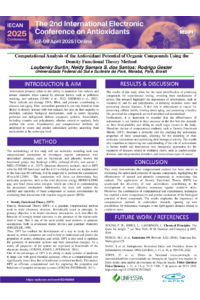
This work presents a computational analysis of the antioxidant potential of organic molecular compounds using the DFT (Density Functional Theory) method, a technique that involves using advanced theoretical tools to predict and analyze the antioxidant activity of various organic molecules. This method also allows for the determination of key parameters influencing the antioxidant efficiency of compounds, such as ionization energy, electron affinity, and radical dissociation energy. These properties are essential for predicting the antioxidant behavior of molecules under various biological conditions and help identify which compound is most effective at capturing free radicals and thus preventing oxidative damage. We also demonstrate how these compounds can combat oxidative damage caused by free radicals in the body by using computational simulations and molecular modeling tools to assess the antioxidant potential of these molecular compounds. These compounds are crucial as they can prevent or repair damage caused by free radicals, a process that can lead to chronic diseases, cellular aging, and other serious health issues. In our research, we also studied the three main antioxidant mechanisms—HAT (Hydrogen Atom Transfer), SEP-PT (Sequential Proton Transfer), and SPLET (Single-Electron Transfer Proton Transfer)—in order to evaluate their effectiveness against free radicals. The results of this study highlight the significant impact of free radicals on our health and identify promising compounds for experimental testing, thus contributing to the development of new antioxidants with therapeutic, cosmetic, and nutritional applications. These findings also open new perspectives for future research and the potential application of computational methods in drug design and antioxidant development.
Keywords
KEYWORDS: Antioxidant
Free Radicals
Organic Molecular Compounds
DFT
Poster
The 2nd International Electronic Conference on Antioxidants.pdf
Antioxidant capacity of Colombian tropical fruits with dietary potential to reduce the risk of cardiovascular diseases
Undertaking a Literature Review: Quercetin, A Flavonoid with Therapeutic Promise in Chronic Illness