Event submissions
Published
This submission belongs to the session S3. Antioxidants in Chronic Disease: From Dietary Prevention to Therapeutic Intervention of the event The 2nd International Electronic Conference on Antioxidants
Published date
09 Apr, 2025
Academic Editor
'%3e%3cpath%20d='M12.6657%2010.9104C12.4185%2010.325%2012.0599%209.79327%2011.6097%209.34482C11.1609%208.89508%2010.6293%208.5365%2010.0442%208.28888C10.0389%208.28626%2010.0337%208.28495%2010.0285%208.28233C10.8446%207.69279%2011.3752%206.73249%2011.3752%205.64904C11.3752%203.8542%209.92103%202.39999%208.1262%202.39999C6.33136%202.39999%204.87715%203.8542%204.87715%205.64904C4.87715%206.73249%205.40774%207.69279%206.22393%208.28364C6.21869%208.28626%206.21345%208.28757%206.20821%208.29019C5.62129%208.5378%205.09463%208.89284%204.64265%209.34613C4.1929%209.79493%203.83432%2010.3266%203.58671%2010.9117C3.34345%2011.4845%203.21226%2012.0987%203.20023%2012.7209C3.19988%2012.7349%203.20233%2012.7488%203.20744%2012.7619C3.21255%2012.7749%203.22022%2012.7867%203.22998%2012.7968C3.23975%2012.8068%203.25142%2012.8147%203.26431%2012.8202C3.2772%2012.8256%203.29105%2012.8284%203.30504%2012.8284H4.09109C4.14874%2012.8284%204.19459%2012.7825%204.1959%2012.7262C4.2221%2011.7148%204.62823%2010.7676%205.34617%2010.0497C6.08899%209.30683%207.0755%208.89808%208.1262%208.89808C9.17689%208.89808%2010.1634%209.30683%2010.9062%2010.0497C11.6242%2010.7676%2012.0303%2011.7148%2012.0565%2012.7262C12.0578%2012.7838%2012.1037%2012.8284%2012.1613%2012.8284H12.9474C12.9613%2012.8284%2012.9752%2012.8256%2012.9881%2012.8202C13.001%2012.8147%2013.0126%2012.8068%2013.0224%2012.7968C13.0322%2012.7867%2013.0398%2012.7749%2013.0449%2012.7619C13.0501%2012.7488%2013.0525%2012.7349%2013.0522%2012.7209C13.0391%2012.0947%2012.9094%2011.4855%2012.6657%2010.9104ZM8.1262%207.9024C7.52486%207.9024%206.9589%207.6679%206.53312%207.24211C6.10733%206.81633%205.87283%206.25037%205.87283%205.64904C5.87283%205.0477%206.10733%204.48174%206.53312%204.05596C6.9589%203.63018%207.52486%203.39567%208.1262%203.39567C8.72753%203.39567%209.29349%203.63018%209.71927%204.05596C10.1451%204.48174%2010.3796%205.0477%2010.3796%205.64904C10.3796%206.25037%2010.1451%206.81633%209.71927%207.24211C9.29349%207.6679%208.72753%207.9024%208.1262%207.9024Z'%20fill='%235D1EE1'/%3e%3c/g%3e%3c/svg%3e) Jiankang Liu
Jiankang LiuCitation
Joshua Abelgas, Nesteve John Agosto, Total Phenolic and Flavonoid Contents, Antioxidant and Anti-Inflammatory Activities of Different Solvent Fractions from the Ethanolic Extract of Allium ampeloprasum (“Sibujing”), in Proceedings of The 2nd International Electronic Conference on Antioxidants, 7 April–9 April 2025, MDPI: Basel, Switzerland
Share
Email
Facebook
Twitter
LinkedIn
Total Phenolic and Flavonoid Contents, Antioxidant and Anti-Inflammatory Activities of Different Solvent Fractions from the Ethanolic Extract of Allium ampeloprasum (“Sibujing”)

Joshua Abelgas 1

Nesteve John Agosto 1,2
1. Department of Chemistry, University of Science and Technology of Southern Philippines, Cagayan de Oro City, 9000, Philippines
2. Center for Natural Products Research, University of Science and Technology of Southern Philippines, Cagayan de Oro City, 9000, Philippines
Abstract
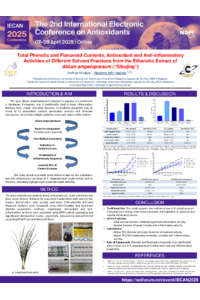
The spice Allium ampeloprasum, commonly known as “sibujing,” is a key ingredient in the "palapa" condiment, popular in Maranao dishes, and is traditionally used by the Maranao people in the Lanao regions of Mindanao, Philippines, to treat inflammatory diseases, fever, and cough. This study investigates the total phenolic content (TPC), total flavonoid content (TFC), and the antioxidant and anti-inflammatory activities of the crude ethanolic extract of A. ampeloprasum and its solvent fractions. TPC was determined using the Folin–Ciocalteu method, while TFC was assessed using the aluminum chloride colorimetric method. Anti-inflammatory activity and antioxidant activity were measured using the egg albumin denaturation assay and the DPPH radical scavenging assay, respectively. The results showed that the ethyl acetate fraction had the highest TPC (68.54 ± 1.44 mg GAE/g) and a moderately strong antioxidant capacity (EC50 = 221.40 ± 2.97 μg/mL). On the other hand, the hexane fraction had the highest TFC (169.88 ± 0.64 mg QE/g) and showed promising anti-inflammatory activity (IC50 = 205.83 ± 6.73 μg/mL). Interestingly, a very strong inverse correlation was observed between TPC and antioxidant EC50, while a moderate inverse correlation was noted between the TFC and anti-inflammatory IC50 of the plant’s extract and fractions. These correlations suggest that the phenolic and flavonoid compounds in the plant’s extract and fractions may significantly contribute to A. ampeloprasum’s antioxidant and anti-inflammatory effects. These findings support the traditional medicinal use of A. ampeloprasum for treating inflammatory diseases, highlight its natural antioxidant properties, and underscore its potential as a valuable source of bioactive compounds. This study recommends further research to identify the specific active compounds responsible for the observed biological activities.
Keywords
Allium ampeloprasum
anti-inflammation
antioxidant
total flavonoid content
total phenolic content
Poster
sciforum-111728-Agosto(revised version).pdf
A new era in plant extract antioxidant capacity optimization
Antioxidant activity of casein hydrolysates produced using Bromelia serra leaf extract