Event submissions
Published
This submission belongs to the session S6. Antioxidants Extraction, Assay and Industrial Applications of the event The 2nd International Electronic Conference on Antioxidants
Published date
09 Apr, 2025
Academic Editor
'%3e%3cpath%20d='M12.6657%2010.9104C12.4185%2010.325%2012.0599%209.79327%2011.6097%209.34482C11.1609%208.89508%2010.6293%208.5365%2010.0442%208.28888C10.0389%208.28626%2010.0337%208.28495%2010.0285%208.28233C10.8446%207.69279%2011.3752%206.73249%2011.3752%205.64904C11.3752%203.8542%209.92103%202.39999%208.1262%202.39999C6.33136%202.39999%204.87715%203.8542%204.87715%205.64904C4.87715%206.73249%205.40774%207.69279%206.22393%208.28364C6.21869%208.28626%206.21345%208.28757%206.20821%208.29019C5.62129%208.5378%205.09463%208.89284%204.64265%209.34613C4.1929%209.79493%203.83432%2010.3266%203.58671%2010.9117C3.34345%2011.4845%203.21226%2012.0987%203.20023%2012.7209C3.19988%2012.7349%203.20233%2012.7488%203.20744%2012.7619C3.21255%2012.7749%203.22022%2012.7867%203.22998%2012.7968C3.23975%2012.8068%203.25142%2012.8147%203.26431%2012.8202C3.2772%2012.8256%203.29105%2012.8284%203.30504%2012.8284H4.09109C4.14874%2012.8284%204.19459%2012.7825%204.1959%2012.7262C4.2221%2011.7148%204.62823%2010.7676%205.34617%2010.0497C6.08899%209.30683%207.0755%208.89808%208.1262%208.89808C9.17689%208.89808%2010.1634%209.30683%2010.9062%2010.0497C11.6242%2010.7676%2012.0303%2011.7148%2012.0565%2012.7262C12.0578%2012.7838%2012.1037%2012.8284%2012.1613%2012.8284H12.9474C12.9613%2012.8284%2012.9752%2012.8256%2012.9881%2012.8202C13.001%2012.8147%2013.0126%2012.8068%2013.0224%2012.7968C13.0322%2012.7867%2013.0398%2012.7749%2013.0449%2012.7619C13.0501%2012.7488%2013.0525%2012.7349%2013.0522%2012.7209C13.0391%2012.0947%2012.9094%2011.4855%2012.6657%2010.9104ZM8.1262%207.9024C7.52486%207.9024%206.9589%207.6679%206.53312%207.24211C6.10733%206.81633%205.87283%206.25037%205.87283%205.64904C5.87283%205.0477%206.10733%204.48174%206.53312%204.05596C6.9589%203.63018%207.52486%203.39567%208.1262%203.39567C8.72753%203.39567%209.29349%203.63018%209.71927%204.05596C10.1451%204.48174%2010.3796%205.0477%2010.3796%205.64904C10.3796%206.25037%2010.1451%206.81633%209.71927%207.24211C9.29349%207.6679%208.72753%207.9024%208.1262%207.9024Z'%20fill='%235D1EE1'/%3e%3c/g%3e%3c/svg%3e) Alessandra Napolitano
Alessandra NapolitanoCitation
Melanie Desirée Gomez Herrera, Paula Alayón Luaces, Maria VIctoria Avanza, Antioxidant activity of casein hydrolysates produced using Bromelia serra leaf extract, in Proceedings of The 2nd International Electronic Conference on Antioxidants, 7 April–9 April 2025, MDPI: Basel, Switzerland
Share
Email
Facebook
Twitter
LinkedIn
Antioxidant activity of casein hydrolysates produced using Bromelia serra leaf extract
'%3e%3cpath%20d='M12.6647%2010.9104C12.4176%2010.325%2012.0589%209.7933%2011.6088%209.34485C11.16%208.89511%2010.6283%208.53653%2010.0432%208.28891C10.038%208.28629%2010.0327%208.28498%2010.0275%208.28236C10.8437%207.69282%2011.3743%206.73252%2011.3743%205.64907C11.3743%203.85423%209.92005%202.40002%208.12522%202.40002C6.33038%202.40002%204.87618%203.85423%204.87618%205.64907C4.87618%206.73252%205.40677%207.69282%206.22296%208.28367C6.21772%208.28629%206.21248%208.2876%206.20724%208.29022C5.62031%208.53783%205.09365%208.89287%204.64167%209.34616C4.19192%209.79496%203.83334%2010.3266%203.58573%2010.9117C3.34247%2011.4846%203.21128%2012.0987%203.19925%2012.721C3.1989%2012.735%203.20135%2012.7489%203.20646%2012.7619C3.21157%2012.7749%203.21924%2012.7868%203.22901%2012.7968C3.23877%2012.8068%203.25045%2012.8148%203.26334%2012.8202C3.27623%2012.8256%203.29007%2012.8284%203.30406%2012.8284H4.09012C4.14776%2012.8284%204.19362%2012.7825%204.19493%2012.7262C4.22113%2011.7148%204.62726%2010.7676%205.34519%2010.0497C6.08802%209.30686%207.07452%208.89811%208.12522%208.89811C9.17592%208.89811%2010.1624%209.30686%2010.9052%2010.0497C11.6232%2010.7676%2012.0293%2011.7148%2012.0555%2012.7262C12.0568%2012.7839%2012.1027%2012.8284%2012.1603%2012.8284H12.9464C12.9604%2012.8284%2012.9742%2012.8256%2012.9871%2012.8202C13%2012.8148%2013.0117%2012.8068%2013.0214%2012.7968C13.0312%2012.7868%2013.0389%2012.7749%2013.044%2012.7619C13.0491%2012.7489%2013.0515%2012.735%2013.0512%2012.721C13.0381%2012.0947%2012.9084%2011.4856%2012.6647%2010.9104ZM8.12522%207.90243C7.52388%207.90243%206.95792%207.66793%206.53214%207.24215C6.10636%206.81636%205.87185%206.2504%205.87185%205.64907C5.87185%205.04773%206.10636%204.48177%206.53214%204.05599C6.95792%203.63021%207.52388%203.3957%208.12522%203.3957C8.72655%203.3957%209.29252%203.63021%209.7183%204.05599C10.1441%204.48177%2010.3786%205.04773%2010.3786%205.64907C10.3786%206.2504%2010.1441%206.81636%209.7183%207.24215C9.29252%207.66793%208.72655%207.90243%208.12522%207.90243Z'%20fill='%235D1EE1'/%3e%3c/g%3e%3c/svg%3e)
Melanie Desirée Gomez Herrera 1
Paula Alayón Luaces 2
Maria VIctoria Avanza 3
1. Faculty of Agricultural Engineering, National University of the Northeast (UNNE), National Scientific and Technical Research Council (CONICET), Corrientes 3400, Argentina
2. Department of Plant Production, National University of the Northeast (UNNE), Corrientes, 3400, Argentina.
3. Roca Campus, Institute of basic and applied chemistry (IQUIBA NEA UNNE CONICET), National University of the Northeast (UNNE), Corrientes, 3400, Argentina.
Abstract
In this study, hydrolysis tests were conducted on casein at different incubation times to assess the antioxidant activity of hydrolysates produced by Bromelia serra leaf extracts (BLEs). The hydrolysis reaction was carried out at 90, 120, and 240 minutes (treatments) at 55°C in an incubator with constant agitation at 300 rpm. The reaction was stopped by thermal shock (boiling above 100°C) for 15 minutes. The degree of hydrolysis (%DH) was determined using the Adler-Nissen TNBS method. The antioxidant capacity of a sample was measured based on its ability to neutralize the ABTS cation radical. The progression of the percentage of %DH over digestion time showed no significant differences between 90 and 180 minutes, with 5.68% and 6.91% DH, respectively. At 240 minutes of incubation, the highest DH value was obtained, at 12%. The antioxidant activity of the hydrolysates obtained from each treatment was measured. Dilutions of the hydrolysates from each treatment were also prepared to determine the percentage of inhibition as a function of protein concentration and to calculate the IC50 values. Antioxidant activity, expressed as TEAC (Trolox Equivalent Antioxidant Capacity), showed that casein exhibits antioxidant activity even without hydrolysis. Additionally, it was observed that the antioxidant activity of casein significantly decreased when exposed to hydrolysis at 55°C for 90 and 180 minutes with BLE. After 240 minutes of hydrolysis with BLE, its antioxidant activity significantly increased by approximately 18%. Regarding IC50, a similar trend was observed. The lowest IC50 value was obtained for the 240-minute hydrolysate, followed by unhydrolyzed casein. This indicates that 1.68 mg/mL of hydrolyzed casein (55°C for 240 minutes) is required to achieve 50% inhibition of the ABTS cation radical, compared to 1.98 mg/mL for unhydrolyzed casein.
Keywords
Bromeliaceae
ABTS
peptides
Poster
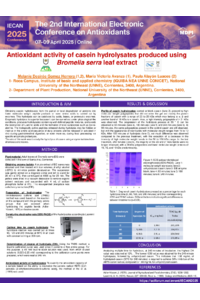
GOMEZ HERRERA ANTIOXIDANTS.pdf
Total Phenolic and Flavonoid Contents, Antioxidant and Anti-Inflammatory Activities of Different Solvent Fractions from the Ethanolic Extract of Allium ampeloprasum (“Sibujing”)
Valorization of rice straw through aqueous polyphenol extraction: Optimization, scale-up and potential industrial applications.