Event submissions
Published
This submission belongs to the session S5. Natural and Synthetic Antioxidants and Antioxidant Enzyme Systems of the event The 2nd International Electronic Conference on Antioxidants
Published date
09 Apr, 2025
Academic Editor
'%3e%3cpath%20d='M12.6657%2010.9104C12.4185%2010.325%2012.0599%209.79327%2011.6097%209.34482C11.1609%208.89508%2010.6293%208.5365%2010.0442%208.28888C10.0389%208.28626%2010.0337%208.28495%2010.0285%208.28233C10.8446%207.69279%2011.3752%206.73249%2011.3752%205.64904C11.3752%203.8542%209.92103%202.39999%208.1262%202.39999C6.33136%202.39999%204.87715%203.8542%204.87715%205.64904C4.87715%206.73249%205.40774%207.69279%206.22393%208.28364C6.21869%208.28626%206.21345%208.28757%206.20821%208.29019C5.62129%208.5378%205.09463%208.89284%204.64265%209.34613C4.1929%209.79493%203.83432%2010.3266%203.58671%2010.9117C3.34345%2011.4845%203.21226%2012.0987%203.20023%2012.7209C3.19988%2012.7349%203.20233%2012.7488%203.20744%2012.7619C3.21255%2012.7749%203.22022%2012.7867%203.22998%2012.7968C3.23975%2012.8068%203.25142%2012.8147%203.26431%2012.8202C3.2772%2012.8256%203.29105%2012.8284%203.30504%2012.8284H4.09109C4.14874%2012.8284%204.19459%2012.7825%204.1959%2012.7262C4.2221%2011.7148%204.62823%2010.7676%205.34617%2010.0497C6.08899%209.30683%207.0755%208.89808%208.1262%208.89808C9.17689%208.89808%2010.1634%209.30683%2010.9062%2010.0497C11.6242%2010.7676%2012.0303%2011.7148%2012.0565%2012.7262C12.0578%2012.7838%2012.1037%2012.8284%2012.1613%2012.8284H12.9474C12.9613%2012.8284%2012.9752%2012.8256%2012.9881%2012.8202C13.001%2012.8147%2013.0126%2012.8068%2013.0224%2012.7968C13.0322%2012.7867%2013.0398%2012.7749%2013.0449%2012.7619C13.0501%2012.7488%2013.0525%2012.7349%2013.0522%2012.7209C13.0391%2012.0947%2012.9094%2011.4855%2012.6657%2010.9104ZM8.1262%207.9024C7.52486%207.9024%206.9589%207.6679%206.53312%207.24211C6.10733%206.81633%205.87283%206.25037%205.87283%205.64904C5.87283%205.0477%206.10733%204.48174%206.53312%204.05596C6.9589%203.63018%207.52486%203.39567%208.1262%203.39567C8.72753%203.39567%209.29349%203.63018%209.71927%204.05596C10.1451%204.48174%2010.3796%205.0477%2010.3796%205.64904C10.3796%206.25037%2010.1451%206.81633%209.71927%207.24211C9.29349%207.6679%208.72753%207.9024%208.1262%207.9024Z'%20fill='%235D1EE1'/%3e%3c/g%3e%3c/svg%3e) Mario Allegra
Mario AllegraCitation
Ibrahim Gidado, Idris Yunusa Abdullahi, Hamza Nasiru Asma'u, Abdullahi Maryam, Lukman Ali Hassan, Jimoh Yusuf, Benzimidazole-Based Antioxidants: A Computational Study on Lipoxygenase Inhibition, in Proceedings of The 2nd International Electronic Conference on Antioxidants, 7 April–9 April 2025, MDPI: Basel, Switzerland
Share
Email
Facebook
Twitter
LinkedIn
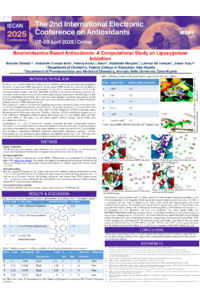
Benzimidazole-Based Antioxidants: A Computational Study on Lipoxygenase Inhibition

Ibrahim Gidado 1,2
'%3e%3cpath%20d='M12.6647%2010.9104C12.4176%2010.325%2012.0589%209.7933%2011.6088%209.34485C11.16%208.89511%2010.6283%208.53653%2010.0432%208.28891C10.038%208.28629%2010.0327%208.28498%2010.0275%208.28236C10.8437%207.69282%2011.3743%206.73252%2011.3743%205.64907C11.3743%203.85423%209.92005%202.40002%208.12522%202.40002C6.33038%202.40002%204.87618%203.85423%204.87618%205.64907C4.87618%206.73252%205.40677%207.69282%206.22296%208.28367C6.21772%208.28629%206.21248%208.2876%206.20724%208.29022C5.62031%208.53783%205.09365%208.89287%204.64167%209.34616C4.19192%209.79496%203.83334%2010.3266%203.58573%2010.9117C3.34247%2011.4846%203.21128%2012.0987%203.19925%2012.721C3.1989%2012.735%203.20135%2012.7489%203.20646%2012.7619C3.21157%2012.7749%203.21924%2012.7868%203.22901%2012.7968C3.23877%2012.8068%203.25045%2012.8148%203.26334%2012.8202C3.27623%2012.8256%203.29007%2012.8284%203.30406%2012.8284H4.09012C4.14776%2012.8284%204.19362%2012.7825%204.19493%2012.7262C4.22113%2011.7148%204.62726%2010.7676%205.34519%2010.0497C6.08802%209.30686%207.07452%208.89811%208.12522%208.89811C9.17592%208.89811%2010.1624%209.30686%2010.9052%2010.0497C11.6232%2010.7676%2012.0293%2011.7148%2012.0555%2012.7262C12.0568%2012.7839%2012.1027%2012.8284%2012.1603%2012.8284H12.9464C12.9604%2012.8284%2012.9742%2012.8256%2012.9871%2012.8202C13%2012.8148%2013.0117%2012.8068%2013.0214%2012.7968C13.0312%2012.7868%2013.0389%2012.7749%2013.044%2012.7619C13.0491%2012.7489%2013.0515%2012.735%2013.0512%2012.721C13.0381%2012.0947%2012.9084%2011.4856%2012.6647%2010.9104ZM8.12522%207.90243C7.52388%207.90243%206.95792%207.66793%206.53214%207.24215C6.10636%206.81636%205.87185%206.2504%205.87185%205.64907C5.87185%205.04773%206.10636%204.48177%206.53214%204.05599C6.95792%203.63021%207.52388%203.3957%208.12522%203.3957C8.72655%203.3957%209.29252%203.63021%209.7183%204.05599C10.1441%204.48177%2010.3786%205.04773%2010.3786%205.64907C10.3786%206.2504%2010.1441%206.81636%209.7183%207.24215C9.29252%207.66793%208.72655%207.90243%208.12522%207.90243Z'%20fill='%235D1EE1'/%3e%3c/g%3e%3c/svg%3e)
Idris Yunusa Abdullahi 2
Hamza Nasiru Asma'u 2
Abdullahi Maryam 2
Lukman Ali Hassan 2
Jimoh Yusuf 2
1. Department of Chemistry, Federal College of Education, Yola, Nigeria
2. Department of Pharmaceutical and Medicinal Chemistry, Ahmadu Bello University, Zaria, Nigeria
Abstract
Oxidative stress is an imbalance between the reactive oxygen species (ROS) and the endogenous antioxidant defense system in the body. Oxidative stress can injure cells in several ways, contributing to various diseases, such as atherosclerosis, cardiovascular disease, Alzheimer’s disease, and cancer. Lipoxygenase (LOX) is a family of non-heme iron-containing enzymes known for their catalysis of lipid peroxidation via the oxidation of polyunsaturated fatty acids (PUFAa). Oxidative stress can lead to the peroxidation of lipids, which can alter the substrate specificity and activity of LOX enzymes. This study aims to design benzimidazole derivatives and evaluate their antioxidant activity using an in silico approach. An oral bioavailability prediction was carried out using an online web server (ADMETlab 2.0). The compounds were designed, optimized, and prepared using ChemDraw 12.0, Spartan14, and UCFS Chimera. The molecular docking of the compounds in the LOX enzyme was carried out using AutoDock Vina. All the designed ligands passed Lipinski’s rule of five, which means that they are all druggable. All the ligands have a good synthetic accessibility score (< 6). The docking results showed that the ligands have a good binding affinity to the target, the LOX enzyme (1N8Q), with L20 having the best binding affinity (-6.0 Kcal/mol). The native ligand (DHB: 3,4-DIHYDROXYBENZOIC ACID) has a binding score of -5.7 Kcal/mol. Ascorbic acid was used as a reference drug and had a binding score of -5.4 Kcal/mol. The results indicated that ligands interacted with the binding pockets of the enzyme’s active site through conventional hydrogen bond, hydrogen bond, Van der Waals, Pi-Pi, Pi-alkyl, pi-anion, and alkyl interactions. The interacting amino acid residues responsible for the scavenging activity are HIS518, GLN514, LEU515, HIS523, ALA561, TRP519, and ILE572. This study suggested that designed benzimidazole ligands have the potential to scavenge free radicals.
Keywords
Benzimidazole
Oxidative stress
Lipoxygenase
Antioxidants
Poster
Antioxidant Poster.pdf
Antioxidant Effect of Pinene in Biological Systems
The impact of 6-hydroxy-L-nicotine on inflammation in a 5xFAD mouse model of Alzheimer’s disease