Event submissions
Published
This submission belongs to the session S5. Natural and Synthetic Antioxidants and Antioxidant Enzyme Systems of the event The 2nd International Electronic Conference on Antioxidants
Published date
09 Apr, 2025
Academic Editor
'%3e%3cpath%20d='M12.6657%2010.9104C12.4185%2010.325%2012.0599%209.79327%2011.6097%209.34482C11.1609%208.89508%2010.6293%208.5365%2010.0442%208.28888C10.0389%208.28626%2010.0337%208.28495%2010.0285%208.28233C10.8446%207.69279%2011.3752%206.73249%2011.3752%205.64904C11.3752%203.8542%209.92103%202.39999%208.1262%202.39999C6.33136%202.39999%204.87715%203.8542%204.87715%205.64904C4.87715%206.73249%205.40774%207.69279%206.22393%208.28364C6.21869%208.28626%206.21345%208.28757%206.20821%208.29019C5.62129%208.5378%205.09463%208.89284%204.64265%209.34613C4.1929%209.79493%203.83432%2010.3266%203.58671%2010.9117C3.34345%2011.4845%203.21226%2012.0987%203.20023%2012.7209C3.19988%2012.7349%203.20233%2012.7488%203.20744%2012.7619C3.21255%2012.7749%203.22022%2012.7867%203.22998%2012.7968C3.23975%2012.8068%203.25142%2012.8147%203.26431%2012.8202C3.2772%2012.8256%203.29105%2012.8284%203.30504%2012.8284H4.09109C4.14874%2012.8284%204.19459%2012.7825%204.1959%2012.7262C4.2221%2011.7148%204.62823%2010.7676%205.34617%2010.0497C6.08899%209.30683%207.0755%208.89808%208.1262%208.89808C9.17689%208.89808%2010.1634%209.30683%2010.9062%2010.0497C11.6242%2010.7676%2012.0303%2011.7148%2012.0565%2012.7262C12.0578%2012.7838%2012.1037%2012.8284%2012.1613%2012.8284H12.9474C12.9613%2012.8284%2012.9752%2012.8256%2012.9881%2012.8202C13.001%2012.8147%2013.0126%2012.8068%2013.0224%2012.7968C13.0322%2012.7867%2013.0398%2012.7749%2013.0449%2012.7619C13.0501%2012.7488%2013.0525%2012.7349%2013.0522%2012.7209C13.0391%2012.0947%2012.9094%2011.4855%2012.6657%2010.9104ZM8.1262%207.9024C7.52486%207.9024%206.9589%207.6679%206.53312%207.24211C6.10733%206.81633%205.87283%206.25037%205.87283%205.64904C5.87283%205.0477%206.10733%204.48174%206.53312%204.05596C6.9589%203.63018%207.52486%203.39567%208.1262%203.39567C8.72753%203.39567%209.29349%203.63018%209.71927%204.05596C10.1451%204.48174%2010.3796%205.0477%2010.3796%205.64904C10.3796%206.25037%2010.1451%206.81633%209.71927%207.24211C9.29349%207.6679%208.72753%207.9024%208.1262%207.9024Z'%20fill='%235D1EE1'/%3e%3c/g%3e%3c/svg%3e) Mario Allegra
Mario AllegraCitation
Yusuf Jimoh, Asmau Nasir Hamza, Maryam Abdullahi, Abdullahi Yunusa Idris, Amina Busola Olorukooba, Lukman Ali Hassan, Ibrahim Gidado, In silico design and discovery of novel 2-pyrazoline methanone derivatives as antioxidant agents for cosmetic applications: A bioinformatics analysis and molecular docking study, in Proceedings of The 2nd International Electronic Conference on Antioxidants, 7 April–9 April 2025, MDPI: Basel, Switzerland
Share
Email
Facebook
Twitter
LinkedIn
In silico design and discovery of novel 2-pyrazoline methanone derivatives as antioxidant agents for cosmetic applications: A bioinformatics analysis and molecular docking study
'%3e%3cpath%20d='M12.6647%2010.9104C12.4176%2010.325%2012.0589%209.7933%2011.6088%209.34485C11.16%208.89511%2010.6283%208.53653%2010.0432%208.28891C10.038%208.28629%2010.0327%208.28498%2010.0275%208.28236C10.8437%207.69282%2011.3743%206.73252%2011.3743%205.64907C11.3743%203.85423%209.92005%202.40002%208.12522%202.40002C6.33038%202.40002%204.87618%203.85423%204.87618%205.64907C4.87618%206.73252%205.40677%207.69282%206.22296%208.28367C6.21772%208.28629%206.21248%208.2876%206.20724%208.29022C5.62031%208.53783%205.09365%208.89287%204.64167%209.34616C4.19192%209.79496%203.83334%2010.3266%203.58573%2010.9117C3.34247%2011.4846%203.21128%2012.0987%203.19925%2012.721C3.1989%2012.735%203.20135%2012.7489%203.20646%2012.7619C3.21157%2012.7749%203.21924%2012.7868%203.22901%2012.7968C3.23877%2012.8068%203.25045%2012.8148%203.26334%2012.8202C3.27623%2012.8256%203.29007%2012.8284%203.30406%2012.8284H4.09012C4.14776%2012.8284%204.19362%2012.7825%204.19493%2012.7262C4.22113%2011.7148%204.62726%2010.7676%205.34519%2010.0497C6.08802%209.30686%207.07452%208.89811%208.12522%208.89811C9.17592%208.89811%2010.1624%209.30686%2010.9052%2010.0497C11.6232%2010.7676%2012.0293%2011.7148%2012.0555%2012.7262C12.0568%2012.7839%2012.1027%2012.8284%2012.1603%2012.8284H12.9464C12.9604%2012.8284%2012.9742%2012.8256%2012.9871%2012.8202C13%2012.8148%2013.0117%2012.8068%2013.0214%2012.7968C13.0312%2012.7868%2013.0389%2012.7749%2013.044%2012.7619C13.0491%2012.7489%2013.0515%2012.735%2013.0512%2012.721C13.0381%2012.0947%2012.9084%2011.4856%2012.6647%2010.9104ZM8.12522%207.90243C7.52388%207.90243%206.95792%207.66793%206.53214%207.24215C6.10636%206.81636%205.87185%206.2504%205.87185%205.64907C5.87185%205.04773%206.10636%204.48177%206.53214%204.05599C6.95792%203.63021%207.52388%203.3957%208.12522%203.3957C8.72655%203.3957%209.29252%203.63021%209.7183%204.05599C10.1441%204.48177%2010.3786%205.04773%2010.3786%205.64907C10.3786%206.2504%2010.1441%206.81636%209.7183%207.24215C9.29252%207.66793%208.72655%207.90243%208.12522%207.90243Z'%20fill='%235D1EE1'/%3e%3c/g%3e%3c/svg%3e)
Yusuf Jimoh 1
Asmau Nasir Hamza 1
Maryam Abdullahi 1
Abdullahi Yunusa Idris 1
Amina Busola Olorukooba 2
Lukman Ali Hassan 1

Ibrahim Gidado 3
1. Department of Pharmaceutical and Medicinal Chemistry, Ahmadu Bello University, Zaria, Nigeria
2. Department of Pharmacology and Toxicology, Faculty of Pharmaceutical Sciences, University of Abuja, Gwagwalada-Nigeria
3. Department of Chemistry, Federal College of Education, Yola, Nigeria
Abstract
The cosmetic industry's growing demand for effective antioxidants has spurred extensive research into novel compounds. This study explores the potential of 2-pyrazoline methanone derivatives as antioxidant agents for cosmetic applications using advanced computational methods. The designed 2D structures of 2-pyrazoline methanone derivatives were created using ChemDraw and optimized in 3D using Spartan14 software. Human erythrocyte catalase (PDB ID: 1DGB) was prepared for molecular docking simulations conducted with AutoDock Vina. Theoretical oral bioavailability was assessed using Lipinski's rule of five, which indicated that all designed compounds adhered to the criteria for good bioavailability. Post-docking analysis was performed using Biovia Discovery Studio to evaluate binding affinities and interactions. The designed compounds demonstrated favorable theoretical oral bioavailability, adhering to Lipinski's rule of five. Molecular docking simulations revealed significant binding affinities between the novel compounds and Human erythrocyte catalase, with binding energies comparable to the co-crystallized ligand (HEM). Specific interaction types, including hydrogen bonds and hydrophobic interactions, were identified through post-docking analysis, highlighting the stability of these interactions. The promising binding affinities and interactions observed suggest that these 2-pyrazoline methanone derivatives could effectively target the antioxidant defense system, potentially enhancing catalase activity and overall skin protection. The computational approach employed aligns with current trends in cosmetic science, demonstrating the power of in silico methods in accelerating the discovery of new cosmetic ingredients. This study highlights the potential of novel 2-pyrazoline methanone derivatives as effective antioxidant agents for cosmetic applications. While the in silico results are encouraging, further experimental validation is necessary to confirm the efficacy and safety of these compounds in biological systems, paving the way for future research in this area.
Keywords
2-pyrazoline methanone
antioxidant agents
bioinformatics
cosmetic applications
molecular docking
Human erythrocyte catalase
in silico design
Poster
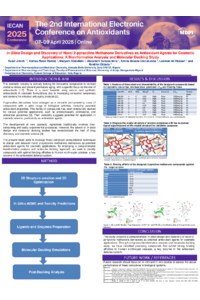
poster.pdf
Evaluation of Antioxidant Activity and Phenolic Content in Camellia Japonica Leaves: A Step Towards Applications in Functional Foods and Cosmetics