Event submissions
Published
This submission belongs to the session A. Catalytic Materials of the event The 3rd International Electronic Conference on Catalysis Sciences
Published date
21 Apr, 2025
Academic Editor
'%3e%3cpath%20d='M12.6657%2010.9104C12.4185%2010.325%2012.0599%209.79327%2011.6097%209.34482C11.1609%208.89508%2010.6293%208.5365%2010.0442%208.28888C10.0389%208.28626%2010.0337%208.28495%2010.0285%208.28233C10.8446%207.69279%2011.3752%206.73249%2011.3752%205.64904C11.3752%203.8542%209.92103%202.39999%208.1262%202.39999C6.33136%202.39999%204.87715%203.8542%204.87715%205.64904C4.87715%206.73249%205.40774%207.69279%206.22393%208.28364C6.21869%208.28626%206.21345%208.28757%206.20821%208.29019C5.62129%208.5378%205.09463%208.89284%204.64265%209.34613C4.1929%209.79493%203.83432%2010.3266%203.58671%2010.9117C3.34345%2011.4845%203.21226%2012.0987%203.20023%2012.7209C3.19988%2012.7349%203.20233%2012.7488%203.20744%2012.7619C3.21255%2012.7749%203.22022%2012.7867%203.22998%2012.7968C3.23975%2012.8068%203.25142%2012.8147%203.26431%2012.8202C3.2772%2012.8256%203.29105%2012.8284%203.30504%2012.8284H4.09109C4.14874%2012.8284%204.19459%2012.7825%204.1959%2012.7262C4.2221%2011.7148%204.62823%2010.7676%205.34617%2010.0497C6.08899%209.30683%207.0755%208.89808%208.1262%208.89808C9.17689%208.89808%2010.1634%209.30683%2010.9062%2010.0497C11.6242%2010.7676%2012.0303%2011.7148%2012.0565%2012.7262C12.0578%2012.7838%2012.1037%2012.8284%2012.1613%2012.8284H12.9474C12.9613%2012.8284%2012.9752%2012.8256%2012.9881%2012.8202C13.001%2012.8147%2013.0126%2012.8068%2013.0224%2012.7968C13.0322%2012.7867%2013.0398%2012.7749%2013.0449%2012.7619C13.0501%2012.7488%2013.0525%2012.7349%2013.0522%2012.7209C13.0391%2012.0947%2012.9094%2011.4855%2012.6657%2010.9104ZM8.1262%207.9024C7.52486%207.9024%206.9589%207.6679%206.53312%207.24211C6.10733%206.81633%205.87283%206.25037%205.87283%205.64904C5.87283%205.0477%206.10733%204.48174%206.53312%204.05596C6.9589%203.63018%207.52486%203.39567%208.1262%203.39567C8.72753%203.39567%209.29349%203.63018%209.71927%204.05596C10.1451%204.48174%2010.3796%205.0477%2010.3796%205.64904C10.3796%206.25037%2010.1451%206.81633%209.71927%207.24211C9.29349%207.6679%208.72753%207.9024%208.1262%207.9024Z'%20fill='%235D1EE1'/%3e%3c/g%3e%3c/svg%3e) Narendra Kumar
Narendra KumarCitation
Paulo Brito, Heloísa Diniz, Ana Queiroz, António E. Ribeiro, Valorisation of waste cooking oils through [HMIM][HSO4] ionic liquid-catalysed biodiesel conversion, in Proceedings of The 3rd International Electronic Conference on Catalysis Sciences, 23 April–25 April 2025, MDPI: Basel, Switzerland
Share
Email
Facebook
Twitter
LinkedIn
Valorisation of waste cooking oils through [HMIM][HSO4] ionic liquid-catalysed biodiesel conversion
'%3e%3cpath%20d='M12.6647%2010.9104C12.4176%2010.325%2012.0589%209.7933%2011.6088%209.34485C11.16%208.89511%2010.6283%208.53653%2010.0432%208.28891C10.038%208.28629%2010.0327%208.28498%2010.0275%208.28236C10.8437%207.69282%2011.3743%206.73252%2011.3743%205.64907C11.3743%203.85423%209.92005%202.40002%208.12522%202.40002C6.33038%202.40002%204.87618%203.85423%204.87618%205.64907C4.87618%206.73252%205.40677%207.69282%206.22296%208.28367C6.21772%208.28629%206.21248%208.2876%206.20724%208.29022C5.62031%208.53783%205.09365%208.89287%204.64167%209.34616C4.19192%209.79496%203.83334%2010.3266%203.58573%2010.9117C3.34247%2011.4846%203.21128%2012.0987%203.19925%2012.721C3.1989%2012.735%203.20135%2012.7489%203.20646%2012.7619C3.21157%2012.7749%203.21924%2012.7868%203.22901%2012.7968C3.23877%2012.8068%203.25045%2012.8148%203.26334%2012.8202C3.27623%2012.8256%203.29007%2012.8284%203.30406%2012.8284H4.09012C4.14776%2012.8284%204.19362%2012.7825%204.19493%2012.7262C4.22113%2011.7148%204.62726%2010.7676%205.34519%2010.0497C6.08802%209.30686%207.07452%208.89811%208.12522%208.89811C9.17592%208.89811%2010.1624%209.30686%2010.9052%2010.0497C11.6232%2010.7676%2012.0293%2011.7148%2012.0555%2012.7262C12.0568%2012.7839%2012.1027%2012.8284%2012.1603%2012.8284H12.9464C12.9604%2012.8284%2012.9742%2012.8256%2012.9871%2012.8202C13%2012.8148%2013.0117%2012.8068%2013.0214%2012.7968C13.0312%2012.7868%2013.0389%2012.7749%2013.044%2012.7619C13.0491%2012.7489%2013.0515%2012.735%2013.0512%2012.721C13.0381%2012.0947%2012.9084%2011.4856%2012.6647%2010.9104ZM8.12522%207.90243C7.52388%207.90243%206.95792%207.66793%206.53214%207.24215C6.10636%206.81636%205.87185%206.2504%205.87185%205.64907C5.87185%205.04773%206.10636%204.48177%206.53214%204.05599C6.95792%203.63021%207.52388%203.3957%208.12522%203.3957C8.72655%203.3957%209.29252%203.63021%209.7183%204.05599C10.1441%204.48177%2010.3786%205.04773%2010.3786%205.64907C10.3786%206.2504%2010.1441%206.81636%209.7183%207.24215C9.29252%207.66793%208.72655%207.90243%208.12522%207.90243Z'%20fill='%235D1EE1'/%3e%3c/g%3e%3c/svg%3e)
Paulo Brito 1
Heloísa Diniz 1
Ana Queiroz 1
António E. Ribeiro 1
1. CIMO, LA SusTEC, Instituto Politécnico de Bragança, Campus de Santa Apolónia, 5300-253 Bragança, Portugal
Abstract
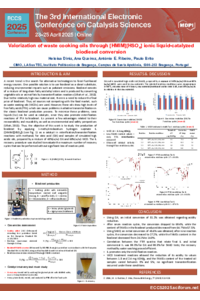
Biodiesel consists of a mixture of fatty acid methyl esters (FAMEs) and is produced by processing vegetable oils or animal fats. Oil sources, not competing with the food market, such as waste cooking oils (WCOs), can be used, and ionic liquids (ILs) are promising catalysts, since they promote esterification/transesterification reactions to biodiesel. The objective was to study biodiesel production using 1-methylimidazolium hydrogen sulphate IL ([HMIM][HSO4]) as a catalyst in esterification/transesterification reactions with methanol, for oleic acid (OA) and simulated high acidic oils, in mixtures of 40%(w/w) OA to 60%(w/w) WCO. The IL recovery procedure was also assessed using water as solvent. Biodiesel production was carried out on two heating plates with automatic temperature control and magnetic stirring (IKA, digital C-MAG HS4 model, and VWR, VMS-C4 model). A centrifuge (SIGMA, model 2-4) was used for phase separation. Samples were dried in an oven (CIENTIFIC, series 9000) and all masses were measured on an analytical balance (accuracy: ±0.0002g and maximum: 210g; AE, ADA 210/C). FAME content was determined by GC (SHIMADZU, Nexis GC 2030), with FID, an AOC-20i autoinjector and an Optima BioDiesel F capillary column (30mx0.25mm). Analyses were carried out by FTIR with a Perkin Elmer equipment, Spectrum Two, and an ATR universal accessory. Reaction conditions were as follows: 65°C, 4 hr, raw-material/methanol molar ratio 1:10, and 10%(w/w) IL load. Using OA as the raw material, an acidity drop conversion of 81.2% was obtained. After seven reaction cycles, the conversion dropped to 69.4%, while the FAME content decreased from 64.7% to 57.5%. For WCO, a conversion of 45.6% was obtained and after nine reaction cycles it decreased to 27.2%, while the biodiesel FAME content decreased from 24.1% to 14.0%. The FTIR correlation between initial and final IL samples was 99.3% for OA and 90.0% for WCO, showing that the recovery method is efficient. For these operating conditions, IL only promotes esterification reactions.
Keywords
Biodiesel
Ionic liquids
Recovery
[HMIM][HSO4]
Waste cooking oils
Poster
Diniz et al_115646.pdf
Biodiesel production by transesterification using choline hydroxide as catalyst
High-Performance Gd1-xAxFeO3 (A = Ca, Sr, Ba) perovskite catalysts produced via simulated bio-syngas hydrogenation