Event submissions
Published
This submission belongs to the session A. Catalytic Materials of the event The 3rd International Electronic Conference on Catalysis Sciences
Published date
21 Apr, 2025
Academic Editor
'%3e%3cpath%20d='M12.6657%2010.9104C12.4185%2010.325%2012.0599%209.79327%2011.6097%209.34482C11.1609%208.89508%2010.6293%208.5365%2010.0442%208.28888C10.0389%208.28626%2010.0337%208.28495%2010.0285%208.28233C10.8446%207.69279%2011.3752%206.73249%2011.3752%205.64904C11.3752%203.8542%209.92103%202.39999%208.1262%202.39999C6.33136%202.39999%204.87715%203.8542%204.87715%205.64904C4.87715%206.73249%205.40774%207.69279%206.22393%208.28364C6.21869%208.28626%206.21345%208.28757%206.20821%208.29019C5.62129%208.5378%205.09463%208.89284%204.64265%209.34613C4.1929%209.79493%203.83432%2010.3266%203.58671%2010.9117C3.34345%2011.4845%203.21226%2012.0987%203.20023%2012.7209C3.19988%2012.7349%203.20233%2012.7488%203.20744%2012.7619C3.21255%2012.7749%203.22022%2012.7867%203.22998%2012.7968C3.23975%2012.8068%203.25142%2012.8147%203.26431%2012.8202C3.2772%2012.8256%203.29105%2012.8284%203.30504%2012.8284H4.09109C4.14874%2012.8284%204.19459%2012.7825%204.1959%2012.7262C4.2221%2011.7148%204.62823%2010.7676%205.34617%2010.0497C6.08899%209.30683%207.0755%208.89808%208.1262%208.89808C9.17689%208.89808%2010.1634%209.30683%2010.9062%2010.0497C11.6242%2010.7676%2012.0303%2011.7148%2012.0565%2012.7262C12.0578%2012.7838%2012.1037%2012.8284%2012.1613%2012.8284H12.9474C12.9613%2012.8284%2012.9752%2012.8256%2012.9881%2012.8202C13.001%2012.8147%2013.0126%2012.8068%2013.0224%2012.7968C13.0322%2012.7867%2013.0398%2012.7749%2013.0449%2012.7619C13.0501%2012.7488%2013.0525%2012.7349%2013.0522%2012.7209C13.0391%2012.0947%2012.9094%2011.4855%2012.6657%2010.9104ZM8.1262%207.9024C7.52486%207.9024%206.9589%207.6679%206.53312%207.24211C6.10733%206.81633%205.87283%206.25037%205.87283%205.64904C5.87283%205.0477%206.10733%204.48174%206.53312%204.05596C6.9589%203.63018%207.52486%203.39567%208.1262%203.39567C8.72753%203.39567%209.29349%203.63018%209.71927%204.05596C10.1451%204.48174%2010.3796%205.0477%2010.3796%205.64904C10.3796%206.25037%2010.1451%206.81633%209.71927%207.24211C9.29349%207.6679%208.72753%207.9024%208.1262%207.9024Z'%20fill='%235D1EE1'/%3e%3c/g%3e%3c/svg%3e) Narendra Kumar
Narendra KumarCitation
María Gabriela Egusquiza, Ingrid Medina Mojica, Mercedes Muñoz, Vicente Barone, Gustavo Pablo Romanelli, Preparation and characterisation of diatomaceous earth/MnMo₉O₃₂ system and its potential application in clean oxidation, in Proceedings of The 3rd International Electronic Conference on Catalysis Sciences, 23 April–25 April 2025, MDPI: Basel, Switzerland
Share
Email
Facebook
Twitter
LinkedIn
Preparation and characterisation of diatomaceous earth/MnMo9O32 system and its potential application in clean oxidation
'%3e%3cpath%20d='M12.6647%2010.9104C12.4176%2010.325%2012.0589%209.7933%2011.6088%209.34485C11.16%208.89511%2010.6283%208.53653%2010.0432%208.28891C10.038%208.28629%2010.0327%208.28498%2010.0275%208.28236C10.8437%207.69282%2011.3743%206.73252%2011.3743%205.64907C11.3743%203.85423%209.92005%202.40002%208.12522%202.40002C6.33038%202.40002%204.87618%203.85423%204.87618%205.64907C4.87618%206.73252%205.40677%207.69282%206.22296%208.28367C6.21772%208.28629%206.21248%208.2876%206.20724%208.29022C5.62031%208.53783%205.09365%208.89287%204.64167%209.34616C4.19192%209.79496%203.83334%2010.3266%203.58573%2010.9117C3.34247%2011.4846%203.21128%2012.0987%203.19925%2012.721C3.1989%2012.735%203.20135%2012.7489%203.20646%2012.7619C3.21157%2012.7749%203.21924%2012.7868%203.22901%2012.7968C3.23877%2012.8068%203.25045%2012.8148%203.26334%2012.8202C3.27623%2012.8256%203.29007%2012.8284%203.30406%2012.8284H4.09012C4.14776%2012.8284%204.19362%2012.7825%204.19493%2012.7262C4.22113%2011.7148%204.62726%2010.7676%205.34519%2010.0497C6.08802%209.30686%207.07452%208.89811%208.12522%208.89811C9.17592%208.89811%2010.1624%209.30686%2010.9052%2010.0497C11.6232%2010.7676%2012.0293%2011.7148%2012.0555%2012.7262C12.0568%2012.7839%2012.1027%2012.8284%2012.1603%2012.8284H12.9464C12.9604%2012.8284%2012.9742%2012.8256%2012.9871%2012.8202C13%2012.8148%2013.0117%2012.8068%2013.0214%2012.7968C13.0312%2012.7868%2013.0389%2012.7749%2013.044%2012.7619C13.0491%2012.7489%2013.0515%2012.735%2013.0512%2012.721C13.0381%2012.0947%2012.9084%2011.4856%2012.6647%2010.9104ZM8.12522%207.90243C7.52388%207.90243%206.95792%207.66793%206.53214%207.24215C6.10636%206.81636%205.87185%206.2504%205.87185%205.64907C5.87185%205.04773%206.10636%204.48177%206.53214%204.05599C6.95792%203.63021%207.52388%203.3957%208.12522%203.3957C8.72655%203.3957%209.29252%203.63021%209.7183%204.05599C10.1441%204.48177%2010.3786%205.04773%2010.3786%205.64907C10.3786%206.2504%2010.1441%206.81636%209.7183%207.24215C9.29252%207.66793%208.72655%207.90243%208.12522%207.90243Z'%20fill='%235D1EE1'/%3e%3c/g%3e%3c/svg%3e)
María Gabriela Egusquiza 1
Ingrid Medina Mojica 2
Mercedes Muñoz 3
Vicente Barone 4
Gustavo Pablo Romanelli 1
1. Centro de Investigación y Desarrollo en Cs. Aplicadas, Dr. J. J. Ronco” (CINDECA), CCT-CONICET La Plata - CIC - UNLP, Calle 47 N° 257, 1900, La Plata, Bs. As., Argentina.
2. Centro de Investigaciones Ópticas (CIOp) CCT CONICET La Plata - CIC - UNLP, Gonnet, La Plata Bs. As. Argentina
3. Centro de Investigación y Desarrollo en Cs. Aplicadas, Dr. J. J. Ronco” (CINDECA), CCT-CONICET La Plata - CIC - UNLP, Calle 47 N° 257, 1900, La Plata, Bs. As., Argentina
4. Centro de Química Inorgánica (CEQUINOR), Facultad de Ciencias Exactas, Universidad Nacional de La Plata, CONICET, La Plata, Argentina
Abstract
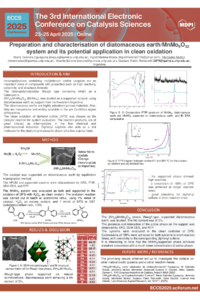
Heteropolyanions containing molybdenum and/or tungsten are an important class of compounds with properties such as high reactivity, selectivity, and structural diversity. In the present study, the heteropolymolybdate Waugh type containing Mn(II) as a heteroatom, (NH4)6MnMo9O32 (MnMo9), was studied as a supported catalyst, using diatomaceous earth from northwestern Argentina as the support. The diatomaceous earths are highly adsorbent porous materials. Also, they are inexpensive and widely available in the pre-Cordillera region of Argentina. The HPOM and supported systems were characterised by DRX, FTIR, SEM-EDS, and RTP, among other physicochemical techniques. Given the chemical and structural properties of this phase, the clean oxidation of diphenyl sulfide (DFS) was chosen as the catalytic reaction for system evaluation. The reaction products, diphenyl sulfoxides (DPSOs) and diphenyl sulfones (DPSO2), are of great interest as intermediates in the fine chemical and pharmaceutical industries. Diphenyl dulphide also acts as a test molecule for the study of processes to obtain ultra-low-sulphur fuels.
The MnMo9 system was evaluated as a bulk and a support in the oxidation of DPS with H2O2, as a clean oxidant, at 80 °C. The results for the supported phase showed high reactivity, and a conversion of 100% of DPS was achieved at longer reaction times, with good selectivity for diphenyl sulfone at short reaction times.
Keywords
Diatomaceous earths
Heteropolyanions
Diphenyl sulphide
Heterogeneous catalysis
Poster
Poster ECCS 25 -Muñoz.pdf
Catalytic Activity of Metal Oxide Nanoparticles Derived from Electronic Waste through Green Synthesis
Niobium-doped heteropolyacid included in silica--titania support as catalyst for selective sulfoxidation