Event submissions
Published
This submission belongs to the session A. Catalytic Materials of the event The 3rd International Electronic Conference on Catalysis Sciences
Published date
21 Apr, 2025
Academic Editor
'%3e%3cpath%20d='M12.6657%2010.9104C12.4185%2010.325%2012.0599%209.79327%2011.6097%209.34482C11.1609%208.89508%2010.6293%208.5365%2010.0442%208.28888C10.0389%208.28626%2010.0337%208.28495%2010.0285%208.28233C10.8446%207.69279%2011.3752%206.73249%2011.3752%205.64904C11.3752%203.8542%209.92103%202.39999%208.1262%202.39999C6.33136%202.39999%204.87715%203.8542%204.87715%205.64904C4.87715%206.73249%205.40774%207.69279%206.22393%208.28364C6.21869%208.28626%206.21345%208.28757%206.20821%208.29019C5.62129%208.5378%205.09463%208.89284%204.64265%209.34613C4.1929%209.79493%203.83432%2010.3266%203.58671%2010.9117C3.34345%2011.4845%203.21226%2012.0987%203.20023%2012.7209C3.19988%2012.7349%203.20233%2012.7488%203.20744%2012.7619C3.21255%2012.7749%203.22022%2012.7867%203.22998%2012.7968C3.23975%2012.8068%203.25142%2012.8147%203.26431%2012.8202C3.2772%2012.8256%203.29105%2012.8284%203.30504%2012.8284H4.09109C4.14874%2012.8284%204.19459%2012.7825%204.1959%2012.7262C4.2221%2011.7148%204.62823%2010.7676%205.34617%2010.0497C6.08899%209.30683%207.0755%208.89808%208.1262%208.89808C9.17689%208.89808%2010.1634%209.30683%2010.9062%2010.0497C11.6242%2010.7676%2012.0303%2011.7148%2012.0565%2012.7262C12.0578%2012.7838%2012.1037%2012.8284%2012.1613%2012.8284H12.9474C12.9613%2012.8284%2012.9752%2012.8256%2012.9881%2012.8202C13.001%2012.8147%2013.0126%2012.8068%2013.0224%2012.7968C13.0322%2012.7867%2013.0398%2012.7749%2013.0449%2012.7619C13.0501%2012.7488%2013.0525%2012.7349%2013.0522%2012.7209C13.0391%2012.0947%2012.9094%2011.4855%2012.6657%2010.9104ZM8.1262%207.9024C7.52486%207.9024%206.9589%207.6679%206.53312%207.24211C6.10733%206.81633%205.87283%206.25037%205.87283%205.64904C5.87283%205.0477%206.10733%204.48174%206.53312%204.05596C6.9589%203.63018%207.52486%203.39567%208.1262%203.39567C8.72753%203.39567%209.29349%203.63018%209.71927%204.05596C10.1451%204.48174%2010.3796%205.0477%2010.3796%205.64904C10.3796%206.25037%2010.1451%206.81633%209.71927%207.24211C9.29349%207.6679%208.72753%207.9024%208.1262%207.9024Z'%20fill='%235D1EE1'/%3e%3c/g%3e%3c/svg%3e) Narendra Kumar
Narendra KumarCitation
María Belén Colombo Migliorero, Martina Pometto, Agustín Ponzinibbio, Gustavo Pablo Romanelli, Valeria Palermo, José Manuel López Nieto, Patricia Graciela Vázquez, Niobium-doped heteropolyacid included in silica--titania support as catalyst for selective sulfoxidation, in Proceedings of The 3rd International Electronic Conference on Catalysis Sciences, 23 April–25 April 2025, MDPI: Basel, Switzerland
Share
Email
Facebook
Twitter
LinkedIn
Niobium-doped heteropolyacid included in silica--titania support as catalyst for selective sulfoxidation
'%3e%3cpath%20d='M12.6647%2010.9104C12.4176%2010.325%2012.0589%209.7933%2011.6088%209.34485C11.16%208.89511%2010.6283%208.53653%2010.0432%208.28891C10.038%208.28629%2010.0327%208.28498%2010.0275%208.28236C10.8437%207.69282%2011.3743%206.73252%2011.3743%205.64907C11.3743%203.85423%209.92005%202.40002%208.12522%202.40002C6.33038%202.40002%204.87618%203.85423%204.87618%205.64907C4.87618%206.73252%205.40677%207.69282%206.22296%208.28367C6.21772%208.28629%206.21248%208.2876%206.20724%208.29022C5.62031%208.53783%205.09365%208.89287%204.64167%209.34616C4.19192%209.79496%203.83334%2010.3266%203.58573%2010.9117C3.34247%2011.4846%203.21128%2012.0987%203.19925%2012.721C3.1989%2012.735%203.20135%2012.7489%203.20646%2012.7619C3.21157%2012.7749%203.21924%2012.7868%203.22901%2012.7968C3.23877%2012.8068%203.25045%2012.8148%203.26334%2012.8202C3.27623%2012.8256%203.29007%2012.8284%203.30406%2012.8284H4.09012C4.14776%2012.8284%204.19362%2012.7825%204.19493%2012.7262C4.22113%2011.7148%204.62726%2010.7676%205.34519%2010.0497C6.08802%209.30686%207.07452%208.89811%208.12522%208.89811C9.17592%208.89811%2010.1624%209.30686%2010.9052%2010.0497C11.6232%2010.7676%2012.0293%2011.7148%2012.0555%2012.7262C12.0568%2012.7839%2012.1027%2012.8284%2012.1603%2012.8284H12.9464C12.9604%2012.8284%2012.9742%2012.8256%2012.9871%2012.8202C13%2012.8148%2013.0117%2012.8068%2013.0214%2012.7968C13.0312%2012.7868%2013.0389%2012.7749%2013.044%2012.7619C13.0491%2012.7489%2013.0515%2012.735%2013.0512%2012.721C13.0381%2012.0947%2012.9084%2011.4856%2012.6647%2010.9104ZM8.12522%207.90243C7.52388%207.90243%206.95792%207.66793%206.53214%207.24215C6.10636%206.81636%205.87185%206.2504%205.87185%205.64907C5.87185%205.04773%206.10636%204.48177%206.53214%204.05599C6.95792%203.63021%207.52388%203.3957%208.12522%203.3957C8.72655%203.3957%209.29252%203.63021%209.7183%204.05599C10.1441%204.48177%2010.3786%205.04773%2010.3786%205.64907C10.3786%206.2504%2010.1441%206.81636%209.7183%207.24215C9.29252%207.66793%208.72655%207.90243%208.12522%207.90243Z'%20fill='%235D1EE1'/%3e%3c/g%3e%3c/svg%3e)
María Belén Colombo Migliorero 1
Martina Pometto 1

Agustín Ponzinibbio 1
Gustavo Pablo Romanelli 2
Valeria Palermo 2
José Manuel López Nieto 3

Patricia Graciela Vázquez 2
1. CEDECOR (UNLP-CIC), Departamento de Química, Facultad de Ciencias Exactas, Universidad Nacional de La Plata, La Plata, Argentina
2. CINDECA, (CONICET-CIC-UNLP), Facultad de Ciencias Exactas, Universidad Nacional de La Plata, La Plata, Argentina
3. ITQ (CSIC-UPV), Instituto de Tecnología Química, Universitat Politècnica de València, Valencia, España
Abstract
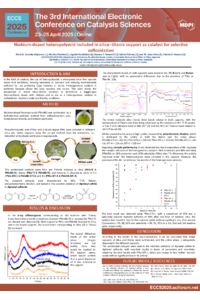
In the field of catalysis, the use of heteropolyacids is widespread, since they operate under mild conditions, favoring selectivity in reactions and reducing environmental pollution by not producing large volumes of waste. Heterogeneous catalysis is preferred because allows for easy recovery and re-use. This work shows the preparation of mixed silica--titania materials to immobilize a Keggin-type heteropolyacid doped with niobium and to use as a heterogeneous catalysts in sulfoxidation reactions under eco-friendly conditions.
Niobium-doped heteropolyacid (PMoNb) was synthesized by way of a hydrothermal synthesis method from orthophosphoric acid, molybdenum trioxide, and niobium pentoxide. Subsequently, PMoNb was included in different silica and titania supports using the sol--gel method from the precursors, i.e., tetraethyl orthosilicate and titanium isopropoxide. The prepared catalysts were characterized by XRD, FT-IR, Raman, and potentiometric titration, and tested in the selective oxidation of diphenyl sulfide to diphenyl sulfoxide.
The characteristic bands of both supports were found in the FT-IR and Raman spectra, with no appreciable differences due to the presence of PMoNb. Similar results were observed from XRD patterns. All the solids obtained present high acidity.
Regarding catalytic performance, bulk PMo and PMoNb catalysts were tested in the reaction, and it was observed that the incorporation of Nb improved the catalytic behaviour: 94% conversion and 94% selectivity (PMoNb) vs. 36% conversion and 100% selectivity (PMo) after 7 h. Moreover, the activity improved when the heteropolyacids were included in the support. However, the presence of Nb did not enhance the activity of the heterogeneous catalysts.
On the other hand, the high activity of TiO2, undesired since it reduces selectivity, could be controlled when silica is incorporated into the structure. In this way, the best result was obtained using PMo, which was included in a support of silica--titania 1:1, with a conversion of 99% and a selectivity towards diphenyl sulfoxide of 88% after one hour of reaction.
Keywords
Niobium
heteropolyacid
silica
titania
sulfoxidation
Poster
Poster Colombo Migliorero.pdf
Preparation and characterisation of diatomaceous earth/MnMo9O32 system and its potential application in clean oxidation
Promotion of Ni/alumina catalysts for CO2 hydrogenation