Event submissions
Published
This submission belongs to the session B. Environmental Catalysis of the event The 3rd International Electronic Conference on Catalysis Sciences
Published date
21 Apr, 2025
Academic Editor
'%3e%3cpath%20d='M12.6657%2010.9104C12.4185%2010.325%2012.0599%209.79327%2011.6097%209.34482C11.1609%208.89508%2010.6293%208.5365%2010.0442%208.28888C10.0389%208.28626%2010.0337%208.28495%2010.0285%208.28233C10.8446%207.69279%2011.3752%206.73249%2011.3752%205.64904C11.3752%203.8542%209.92103%202.39999%208.1262%202.39999C6.33136%202.39999%204.87715%203.8542%204.87715%205.64904C4.87715%206.73249%205.40774%207.69279%206.22393%208.28364C6.21869%208.28626%206.21345%208.28757%206.20821%208.29019C5.62129%208.5378%205.09463%208.89284%204.64265%209.34613C4.1929%209.79493%203.83432%2010.3266%203.58671%2010.9117C3.34345%2011.4845%203.21226%2012.0987%203.20023%2012.7209C3.19988%2012.7349%203.20233%2012.7488%203.20744%2012.7619C3.21255%2012.7749%203.22022%2012.7867%203.22998%2012.7968C3.23975%2012.8068%203.25142%2012.8147%203.26431%2012.8202C3.2772%2012.8256%203.29105%2012.8284%203.30504%2012.8284H4.09109C4.14874%2012.8284%204.19459%2012.7825%204.1959%2012.7262C4.2221%2011.7148%204.62823%2010.7676%205.34617%2010.0497C6.08899%209.30683%207.0755%208.89808%208.1262%208.89808C9.17689%208.89808%2010.1634%209.30683%2010.9062%2010.0497C11.6242%2010.7676%2012.0303%2011.7148%2012.0565%2012.7262C12.0578%2012.7838%2012.1037%2012.8284%2012.1613%2012.8284H12.9474C12.9613%2012.8284%2012.9752%2012.8256%2012.9881%2012.8202C13.001%2012.8147%2013.0126%2012.8068%2013.0224%2012.7968C13.0322%2012.7867%2013.0398%2012.7749%2013.0449%2012.7619C13.0501%2012.7488%2013.0525%2012.7349%2013.0522%2012.7209C13.0391%2012.0947%2012.9094%2011.4855%2012.6657%2010.9104ZM8.1262%207.9024C7.52486%207.9024%206.9589%207.6679%206.53312%207.24211C6.10733%206.81633%205.87283%206.25037%205.87283%205.64904C5.87283%205.0477%206.10733%204.48174%206.53312%204.05596C6.9589%203.63018%207.52486%203.39567%208.1262%203.39567C8.72753%203.39567%209.29349%203.63018%209.71927%204.05596C10.1451%204.48174%2010.3796%205.0477%2010.3796%205.64904C10.3796%206.25037%2010.1451%206.81633%209.71927%207.24211C9.29349%207.6679%208.72753%207.9024%208.1262%207.9024Z'%20fill='%235D1EE1'/%3e%3c/g%3e%3c/svg%3e) Albin Pintar
Albin PintarCitation
Rahul Pradhan, Akhila Pinnuri, Jyoti Papola, Catalytic Applications of Terpenes and Resinous Compounds from Forest Trees: Advancing Green Chemistry and Pollution Mitigation, in Proceedings of The 3rd International Electronic Conference on Catalysis Sciences, 23 April–25 April 2025, MDPI: Basel, Switzerland
Share
Email
Facebook
Twitter
LinkedIn
Catalytic Applications of Terpenes and Resinous Compounds from Forest Trees: Advancing Green Chemistry and Pollution Mitigation
'%3e%3cpath%20d='M12.6647%2010.9104C12.4176%2010.325%2012.0589%209.7933%2011.6088%209.34485C11.16%208.89511%2010.6283%208.53653%2010.0432%208.28891C10.038%208.28629%2010.0327%208.28498%2010.0275%208.28236C10.8437%207.69282%2011.3743%206.73252%2011.3743%205.64907C11.3743%203.85423%209.92005%202.40002%208.12522%202.40002C6.33038%202.40002%204.87618%203.85423%204.87618%205.64907C4.87618%206.73252%205.40677%207.69282%206.22296%208.28367C6.21772%208.28629%206.21248%208.2876%206.20724%208.29022C5.62031%208.53783%205.09365%208.89287%204.64167%209.34616C4.19192%209.79496%203.83334%2010.3266%203.58573%2010.9117C3.34247%2011.4846%203.21128%2012.0987%203.19925%2012.721C3.1989%2012.735%203.20135%2012.7489%203.20646%2012.7619C3.21157%2012.7749%203.21924%2012.7868%203.22901%2012.7968C3.23877%2012.8068%203.25045%2012.8148%203.26334%2012.8202C3.27623%2012.8256%203.29007%2012.8284%203.30406%2012.8284H4.09012C4.14776%2012.8284%204.19362%2012.7825%204.19493%2012.7262C4.22113%2011.7148%204.62726%2010.7676%205.34519%2010.0497C6.08802%209.30686%207.07452%208.89811%208.12522%208.89811C9.17592%208.89811%2010.1624%209.30686%2010.9052%2010.0497C11.6232%2010.7676%2012.0293%2011.7148%2012.0555%2012.7262C12.0568%2012.7839%2012.1027%2012.8284%2012.1603%2012.8284H12.9464C12.9604%2012.8284%2012.9742%2012.8256%2012.9871%2012.8202C13%2012.8148%2013.0117%2012.8068%2013.0214%2012.7968C13.0312%2012.7868%2013.0389%2012.7749%2013.044%2012.7619C13.0491%2012.7489%2013.0515%2012.735%2013.0512%2012.721C13.0381%2012.0947%2012.9084%2011.4856%2012.6647%2010.9104ZM8.12522%207.90243C7.52388%207.90243%206.95792%207.66793%206.53214%207.24215C6.10636%206.81636%205.87185%206.2504%205.87185%205.64907C5.87185%205.04773%206.10636%204.48177%206.53214%204.05599C6.95792%203.63021%207.52388%203.3957%208.12522%203.3957C8.72655%203.3957%209.29252%203.63021%209.7183%204.05599C10.1441%204.48177%2010.3786%205.04773%2010.3786%205.64907C10.3786%206.2504%2010.1441%206.81636%209.7183%207.24215C9.29252%207.66793%208.72655%207.90243%208.12522%207.90243Z'%20fill='%235D1EE1'/%3e%3c/g%3e%3c/svg%3e)
Rahul Pradhan 1
Akhila Pinnuri 2
Jyoti Papola 3
1. PhD. Scholar Forest Botany. Division of Silviculture and Forest Management, Institute of Wood Science and Technology, Bengaluru- 560003, Under ICFRE, Ministry of Environment, Forest and Climate Change, Govt. of India
2. PhD. Scholar Forest Genetics. Division of Silviculture and Forest Management, Institute of Wood Science and Technology, Bengaluru- 560003, Under ICFRE, Ministry of Environment, Forest and Climate Change, Govt. of India
3. PhD. Scholar Wood Science and Technology. Division of Wood Properties and Processing, Institute of Wood Science and Technology, Bengaluru- 560003, Under ICFRE, Ministry of Environment, Forest and Climate Change, Govt. of India
Abstract
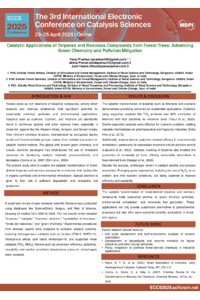
The utilization of terpenes and resinous compounds derived from forest ecosystems presents a sustainable approach to developing catalytic materials for organic synthesis and environmental remediation. Terpenes, such as limonene and α-pinene, undergo various transformations—including oxidation, epoxidation, and isomerization—using heterogeneous catalysts like zeolites and acid resins. These processes facilitate the production of pharmaceuticals, fragrances, and biofuels, thereby enhancing both sustainability and economic viability. In the realm of environmental remediation, catalytic technologies play a pivotal role in converting pollutants into non-toxic substances. For instance, the epoxidation of terpenes has been explored for generating bio-based polymers, which can be utilized in applications like wastewater treatment and bioplastic production. Additionally, the conversion of terpenes to biofuels addresses environmental concerns by providing renewable energy sources and reducing greenhouse gas emissions, particularly in the aviation sector (Lapuert et al., 2023). Despite these advancements, challenges persist in optimizing the efficiency of catalysts and reducing associated costs. Recent studies have focused on developing both catalytic and non-catalytic processes for terpene epoxidation, employing various oxidizing agents and process intensification techniques. These efforts aim to improve the reaction selectivity, rates, and scalability, contributing to the commercial feasibility of terpene-derived products (Resul et al., 2023). This study delves into the catalytic capabilities of specific terpene compounds, emphasizing their effectiveness in pollutant removal and their roles in green chemical transformations. By examining their physicochemical properties and catalytic processes, the research underscores the potential of these compounds as environmentally benign alternatives to conventional catalysts. The findings highlight the significance of terpenes and resinous substances in advancing sustainable practices across various sectors, including pharmaceutical synthesis, wastewater treatment, and bioplastic production. In conclusion, harnessing terpenes and resinous compounds from forest ecosystems offers a promising pathway toward sustainable catalytic applications. Continuous research and innovation are crucial for optimizing processes and maximizing natural compounds' environmental and economic benefits.
Keywords
Terpenes
Resinous compounds
Environmental catalysis
Green chemistry
Organic synthesis
Poster
sciforum_113290_B_slides_POSTER_IECCS.pdf
Heat-shedding TiO2/VAE Nanocoating Formulation for Advanced self-cleaning and Coolant Fabrics
Tuning Perovskite Catalysts for Dry Reforming of Methane via Strontium Doping