Event submissions
Published
This submission belongs to the session B. Environmental Catalysis of the event The 3rd International Electronic Conference on Catalysis Sciences
Published date
21 Apr, 2025
Academic Editor
'%3e%3cpath%20d='M12.6657%2010.9104C12.4185%2010.325%2012.0599%209.79327%2011.6097%209.34482C11.1609%208.89508%2010.6293%208.5365%2010.0442%208.28888C10.0389%208.28626%2010.0337%208.28495%2010.0285%208.28233C10.8446%207.69279%2011.3752%206.73249%2011.3752%205.64904C11.3752%203.8542%209.92103%202.39999%208.1262%202.39999C6.33136%202.39999%204.87715%203.8542%204.87715%205.64904C4.87715%206.73249%205.40774%207.69279%206.22393%208.28364C6.21869%208.28626%206.21345%208.28757%206.20821%208.29019C5.62129%208.5378%205.09463%208.89284%204.64265%209.34613C4.1929%209.79493%203.83432%2010.3266%203.58671%2010.9117C3.34345%2011.4845%203.21226%2012.0987%203.20023%2012.7209C3.19988%2012.7349%203.20233%2012.7488%203.20744%2012.7619C3.21255%2012.7749%203.22022%2012.7867%203.22998%2012.7968C3.23975%2012.8068%203.25142%2012.8147%203.26431%2012.8202C3.2772%2012.8256%203.29105%2012.8284%203.30504%2012.8284H4.09109C4.14874%2012.8284%204.19459%2012.7825%204.1959%2012.7262C4.2221%2011.7148%204.62823%2010.7676%205.34617%2010.0497C6.08899%209.30683%207.0755%208.89808%208.1262%208.89808C9.17689%208.89808%2010.1634%209.30683%2010.9062%2010.0497C11.6242%2010.7676%2012.0303%2011.7148%2012.0565%2012.7262C12.0578%2012.7838%2012.1037%2012.8284%2012.1613%2012.8284H12.9474C12.9613%2012.8284%2012.9752%2012.8256%2012.9881%2012.8202C13.001%2012.8147%2013.0126%2012.8068%2013.0224%2012.7968C13.0322%2012.7867%2013.0398%2012.7749%2013.0449%2012.7619C13.0501%2012.7488%2013.0525%2012.7349%2013.0522%2012.7209C13.0391%2012.0947%2012.9094%2011.4855%2012.6657%2010.9104ZM8.1262%207.9024C7.52486%207.9024%206.9589%207.6679%206.53312%207.24211C6.10733%206.81633%205.87283%206.25037%205.87283%205.64904C5.87283%205.0477%206.10733%204.48174%206.53312%204.05596C6.9589%203.63018%207.52486%203.39567%208.1262%203.39567C8.72753%203.39567%209.29349%203.63018%209.71927%204.05596C10.1451%204.48174%2010.3796%205.0477%2010.3796%205.64904C10.3796%206.25037%2010.1451%206.81633%209.71927%207.24211C9.29349%207.6679%208.72753%207.9024%208.1262%207.9024Z'%20fill='%235D1EE1'/%3e%3c/g%3e%3c/svg%3e) Albin Pintar
Albin PintarCitation
Anastasia D. Meretoudi, Athanasia K. Tolkou, Ioanna Koumentakou, Rigini Papi, Dimitra A. Lambropoulou, George Z. Kyzas, Chitosan/Carboxymethylcellulose/Vanillin@Graphene oxide nanocomposites for the removal of ketoprofen and naproxen from wastewater, in Proceedings of The 3rd International Electronic Conference on Catalysis Sciences, 23 April–25 April 2025, MDPI: Basel, Switzerland
Share
Email
Facebook
Twitter
LinkedIn
Chitosan/Carboxymethylcellulose/Vanillin@Graphene oxide nanocomposites for the removal of ketoprofen and naproxen from wastewater
'%3e%3cpath%20d='M12.6647%2010.9104C12.4176%2010.325%2012.0589%209.7933%2011.6088%209.34485C11.16%208.89511%2010.6283%208.53653%2010.0432%208.28891C10.038%208.28629%2010.0327%208.28498%2010.0275%208.28236C10.8437%207.69282%2011.3743%206.73252%2011.3743%205.64907C11.3743%203.85423%209.92005%202.40002%208.12522%202.40002C6.33038%202.40002%204.87618%203.85423%204.87618%205.64907C4.87618%206.73252%205.40677%207.69282%206.22296%208.28367C6.21772%208.28629%206.21248%208.2876%206.20724%208.29022C5.62031%208.53783%205.09365%208.89287%204.64167%209.34616C4.19192%209.79496%203.83334%2010.3266%203.58573%2010.9117C3.34247%2011.4846%203.21128%2012.0987%203.19925%2012.721C3.1989%2012.735%203.20135%2012.7489%203.20646%2012.7619C3.21157%2012.7749%203.21924%2012.7868%203.22901%2012.7968C3.23877%2012.8068%203.25045%2012.8148%203.26334%2012.8202C3.27623%2012.8256%203.29007%2012.8284%203.30406%2012.8284H4.09012C4.14776%2012.8284%204.19362%2012.7825%204.19493%2012.7262C4.22113%2011.7148%204.62726%2010.7676%205.34519%2010.0497C6.08802%209.30686%207.07452%208.89811%208.12522%208.89811C9.17592%208.89811%2010.1624%209.30686%2010.9052%2010.0497C11.6232%2010.7676%2012.0293%2011.7148%2012.0555%2012.7262C12.0568%2012.7839%2012.1027%2012.8284%2012.1603%2012.8284H12.9464C12.9604%2012.8284%2012.9742%2012.8256%2012.9871%2012.8202C13%2012.8148%2013.0117%2012.8068%2013.0214%2012.7968C13.0312%2012.7868%2013.0389%2012.7749%2013.044%2012.7619C13.0491%2012.7489%2013.0515%2012.735%2013.0512%2012.721C13.0381%2012.0947%2012.9084%2011.4856%2012.6647%2010.9104ZM8.12522%207.90243C7.52388%207.90243%206.95792%207.66793%206.53214%207.24215C6.10636%206.81636%205.87185%206.2504%205.87185%205.64907C5.87185%205.04773%206.10636%204.48177%206.53214%204.05599C6.95792%203.63021%207.52388%203.3957%208.12522%203.3957C8.72655%203.3957%209.29252%203.63021%209.7183%204.05599C10.1441%204.48177%2010.3786%205.04773%2010.3786%205.64907C10.3786%206.2504%2010.1441%206.81636%209.7183%207.24215C9.29252%207.66793%208.72655%207.90243%208.12522%207.90243Z'%20fill='%235D1EE1'/%3e%3c/g%3e%3c/svg%3e)
Anastasia D. Meretoudi 1

Athanasia K. Tolkou 1
Ioanna Koumentakou 1

Rigini Papi 2
Dimitra A. Lambropoulou 3

George Z. Kyzas 4
1. Hephaestus Laboratory, School of Chemistry, Faculty of Sciences, Democritus University of Thrace, Kavala, Greece
2. Laboratory of Biochemistry, Department of Chemistry, Aristotle University of Thessaloniki, 54124 Thessaloniki, Greece
3. Department of Chemistry, Aristotle University of Thessaloniki, 54124 Thessaloniki, Greece
4. Hephaestus Laboratory, School of Chemistry, Faculty of Sciences, Democritus University of Thrace, GR-65404, Kavala, Greece
Abstract
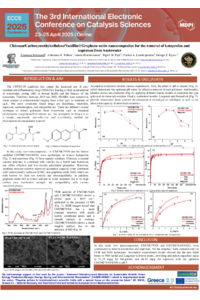
Introduction: The COVID-19 pandemic has resulted in the increased use of non-steroidal anti-inflammatory drugs (NSAIDs), leading to their accumulation in wastewater, posing risks to human health and the balance of the ecosystem. Therefore, between 2019 and 2021, NSAIDs were detected in water sources at concentrations ranging from a few ng/L to hundreds of μg/L. The most commonly found drugs are diclofenac, ibuprofen, naproxen, acetaminophen, and ketoprofen. Though there are several techniques to reduce the emissions of environmentally unacceptable compounds from wastewater, such as Advanced Oxidation Processes (AOPs), adsorption, chemical precipitation, coagulation/flocculation, and flotation, adsorption is emerging as a simple, sustainable, cost-effective, and eco-friendly method for pharmaceutical contaminant removal.
Methods: In this study, two nanocomposites, i.e., CS/CMC/VAN and the further modified CS/CMC/VAN@GO, were synthesized to remove ketoprofen and naproxen from aquatic solutions. Chitosan, a natural cationic polymer, is combined with vanillin via a Schiff base formation and offers effective and low-toxicity adsorption properties. Moreover, modified chitosan exhibits improved adsorption capacity when combined with carboxymethyl cellulose (CMC) and graphene oxide (GO), which are both known for their low toxicity and biocompatibility. In addition, graphene oxide is widely utilized in water treatment due to its high surface area, mechanical strength, and compatibility with various functional groups.
Results: All the materials were characterized via FTIR and SEM techniques. Adsorption experimental results showed that the data fit better to the PSO model and the Langmuir isotherm model, providing adsorption capacities equal to 51.29 mg/g for ketoprofen and 46.30 mg/g for naproxen, with the optimum CS/CMC/VAN@GO at pH 5.
Conclusion: This research contributes valuable knowledge to the field of water and wastewater treatment, providing a viable solution for controlling pharmaceuticals’ environmental pollution.
Keywords
Chitosan
Carboxymethylcellulose
Vanillin
Graphene Oxide
Adsorption
NSAIDs
Poster
sciforum_112800_B_slides_A_Meretoudi_3rd_ICCE_07_04_2025_final.pdf
GAS-PHASE SELECTIVE OXIDATION OF SOME PYRIDINE DERIVATIVES WITH A “GREEN OXIDIZER”—N2O IN THE COHERENT SYNCHRONIZATION MODE
Green hydrogen production from catalytic ammonia decomposition