Event submissions
Published
This submission belongs to the session B. Environmental Catalysis of the event The 3rd International Electronic Conference on Catalysis Sciences
Published date
21 Apr, 2025
Academic Editor
'%3e%3cpath%20d='M12.6657%2010.9104C12.4185%2010.325%2012.0599%209.79327%2011.6097%209.34482C11.1609%208.89508%2010.6293%208.5365%2010.0442%208.28888C10.0389%208.28626%2010.0337%208.28495%2010.0285%208.28233C10.8446%207.69279%2011.3752%206.73249%2011.3752%205.64904C11.3752%203.8542%209.92103%202.39999%208.1262%202.39999C6.33136%202.39999%204.87715%203.8542%204.87715%205.64904C4.87715%206.73249%205.40774%207.69279%206.22393%208.28364C6.21869%208.28626%206.21345%208.28757%206.20821%208.29019C5.62129%208.5378%205.09463%208.89284%204.64265%209.34613C4.1929%209.79493%203.83432%2010.3266%203.58671%2010.9117C3.34345%2011.4845%203.21226%2012.0987%203.20023%2012.7209C3.19988%2012.7349%203.20233%2012.7488%203.20744%2012.7619C3.21255%2012.7749%203.22022%2012.7867%203.22998%2012.7968C3.23975%2012.8068%203.25142%2012.8147%203.26431%2012.8202C3.2772%2012.8256%203.29105%2012.8284%203.30504%2012.8284H4.09109C4.14874%2012.8284%204.19459%2012.7825%204.1959%2012.7262C4.2221%2011.7148%204.62823%2010.7676%205.34617%2010.0497C6.08899%209.30683%207.0755%208.89808%208.1262%208.89808C9.17689%208.89808%2010.1634%209.30683%2010.9062%2010.0497C11.6242%2010.7676%2012.0303%2011.7148%2012.0565%2012.7262C12.0578%2012.7838%2012.1037%2012.8284%2012.1613%2012.8284H12.9474C12.9613%2012.8284%2012.9752%2012.8256%2012.9881%2012.8202C13.001%2012.8147%2013.0126%2012.8068%2013.0224%2012.7968C13.0322%2012.7867%2013.0398%2012.7749%2013.0449%2012.7619C13.0501%2012.7488%2013.0525%2012.7349%2013.0522%2012.7209C13.0391%2012.0947%2012.9094%2011.4855%2012.6657%2010.9104ZM8.1262%207.9024C7.52486%207.9024%206.9589%207.6679%206.53312%207.24211C6.10733%206.81633%205.87283%206.25037%205.87283%205.64904C5.87283%205.0477%206.10733%204.48174%206.53312%204.05596C6.9589%203.63018%207.52486%203.39567%208.1262%203.39567C8.72753%203.39567%209.29349%203.63018%209.71927%204.05596C10.1451%204.48174%2010.3796%205.0477%2010.3796%205.64904C10.3796%206.25037%2010.1451%206.81633%209.71927%207.24211C9.29349%207.6679%208.72753%207.9024%208.1262%207.9024Z'%20fill='%235D1EE1'/%3e%3c/g%3e%3c/svg%3e) Albin Pintar
Albin PintarCitation
Koki Aoshima, Hideyuki Katsumata, Ikki Tateishi, Mai Furukawa, Satoshi Kaneco, Improved activation of peroxymonosulfate with NaBH₄-treated transition bi-metal oxide catalysts for Reactive Yellow 86 decolorization, in Proceedings of The 3rd International Electronic Conference on Catalysis Sciences, 23 April–25 April 2025, MDPI: Basel, Switzerland
Share
Email
Facebook
Twitter
LinkedIn
Improved activation of peroxymonosulfate with NaBH4-treated transition bi-metal oxide catalysts for Reactive Yellow 86 decolorization
'%3e%3cpath%20d='M12.6647%2010.9104C12.4176%2010.325%2012.0589%209.7933%2011.6088%209.34485C11.16%208.89511%2010.6283%208.53653%2010.0432%208.28891C10.038%208.28629%2010.0327%208.28498%2010.0275%208.28236C10.8437%207.69282%2011.3743%206.73252%2011.3743%205.64907C11.3743%203.85423%209.92005%202.40002%208.12522%202.40002C6.33038%202.40002%204.87618%203.85423%204.87618%205.64907C4.87618%206.73252%205.40677%207.69282%206.22296%208.28367C6.21772%208.28629%206.21248%208.2876%206.20724%208.29022C5.62031%208.53783%205.09365%208.89287%204.64167%209.34616C4.19192%209.79496%203.83334%2010.3266%203.58573%2010.9117C3.34247%2011.4846%203.21128%2012.0987%203.19925%2012.721C3.1989%2012.735%203.20135%2012.7489%203.20646%2012.7619C3.21157%2012.7749%203.21924%2012.7868%203.22901%2012.7968C3.23877%2012.8068%203.25045%2012.8148%203.26334%2012.8202C3.27623%2012.8256%203.29007%2012.8284%203.30406%2012.8284H4.09012C4.14776%2012.8284%204.19362%2012.7825%204.19493%2012.7262C4.22113%2011.7148%204.62726%2010.7676%205.34519%2010.0497C6.08802%209.30686%207.07452%208.89811%208.12522%208.89811C9.17592%208.89811%2010.1624%209.30686%2010.9052%2010.0497C11.6232%2010.7676%2012.0293%2011.7148%2012.0555%2012.7262C12.0568%2012.7839%2012.1027%2012.8284%2012.1603%2012.8284H12.9464C12.9604%2012.8284%2012.9742%2012.8256%2012.9871%2012.8202C13%2012.8148%2013.0117%2012.8068%2013.0214%2012.7968C13.0312%2012.7868%2013.0389%2012.7749%2013.044%2012.7619C13.0491%2012.7489%2013.0515%2012.735%2013.0512%2012.721C13.0381%2012.0947%2012.9084%2011.4856%2012.6647%2010.9104ZM8.12522%207.90243C7.52388%207.90243%206.95792%207.66793%206.53214%207.24215C6.10636%206.81636%205.87185%206.2504%205.87185%205.64907C5.87185%205.04773%206.10636%204.48177%206.53214%204.05599C6.95792%203.63021%207.52388%203.3957%208.12522%203.3957C8.72655%203.3957%209.29252%203.63021%209.7183%204.05599C10.1441%204.48177%2010.3786%205.04773%2010.3786%205.64907C10.3786%206.2504%2010.1441%206.81636%209.7183%207.24215C9.29252%207.66793%208.72655%207.90243%208.12522%207.90243Z'%20fill='%235D1EE1'/%3e%3c/g%3e%3c/svg%3e)
Koki Aoshima 1
Hideyuki Katsumata 1
Ikki Tateishi 2
Mai Furukawa 1
Satoshi Kaneco 1
1. Department of Applied Chemistry, Graduate School of Engineering, Mie University
2. Center for Global Environment Education & Research, Mie University
Abstract
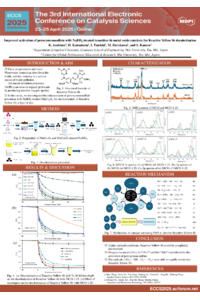
Dyes are persistent and toxic pollutants that significantly contribute to water pollution, particularly from the textile and dye industries. Advanced oxidation processes (AOPs) have attracted considerable interest as they are believed to be effective in removing persistent and toxic organic pollutants from water by generating reactive oxygen species. In addition, NaBH4 treatment is believed to enhance catalyst reactivity by generating abundant oxygen vacancies. This study explored the activation of peroxymonosulfate (PMS) and the decolorization of Reactive Yellow 86 using MnCo2O4 catalysts treated with NaBH4.
The MnCo₂O₄ (MCO) catalyst was synthesized by hydrothermal and calcination methods followed by NaBH4 treatment, yielding the modified catalyst MCO-1.25. The catalytic performance of MCO and MCO-1.25 was compared in decolorizing Reactive Yellow 86 in the presence of PMS. Specifically, 1 mg of catalyst was added to a vessel containing 10 mL of 50 mg/L Reactive Yellow 86 and 10 mL buffer solution and stirred for 30 min. After adsorption equilibrium was reached, 0.48 mM PMS solution was added to initiate the decolorization reaction. The solution was aliquoted at regular intervals, and the reaction was quenched by the addition of methanol. After centrifugation, the supernatant was measured in a spectrophotometer and the decolorization rate was determined from the measured absorbance.
With MCO, approximately 90% of Reactive Yellow 86 was decolorized after 30 min. In contrast, with MCO-1.25, approximately 100% was decolorized after 20 min. The enhanced performance of MCO-1.25 was attributed to the increased oxygen vacancies induced by the NaBH4 treatment, resulting in improved PMS activation. These modifications improved the generation and utilization of reactive oxygen species, leading to faster and more efficient decolorization.
Keywords
MnCo₂O₄ catalyst
Oxygen vacancy
Peroxymonosulfate
Poster
Koki Aoshima _ Poster.pdf
Development of a Solid Phase Extraction Method for Cadmium and Nickel Using Stearic Acid Modified Activated Carbon
Oxidative denitrogenation of quinoline using cobalt ferrite catalysts