Event submissions
Published
This submission belongs to the session C. Photocatalysis of the event The 3rd International Electronic Conference on Catalysis Sciences
Published date
21 Apr, 2025
Academic Editor
'%3e%3cpath%20d='M12.6657%2010.9104C12.4185%2010.325%2012.0599%209.79327%2011.6097%209.34482C11.1609%208.89508%2010.6293%208.5365%2010.0442%208.28888C10.0389%208.28626%2010.0337%208.28495%2010.0285%208.28233C10.8446%207.69279%2011.3752%206.73249%2011.3752%205.64904C11.3752%203.8542%209.92103%202.39999%208.1262%202.39999C6.33136%202.39999%204.87715%203.8542%204.87715%205.64904C4.87715%206.73249%205.40774%207.69279%206.22393%208.28364C6.21869%208.28626%206.21345%208.28757%206.20821%208.29019C5.62129%208.5378%205.09463%208.89284%204.64265%209.34613C4.1929%209.79493%203.83432%2010.3266%203.58671%2010.9117C3.34345%2011.4845%203.21226%2012.0987%203.20023%2012.7209C3.19988%2012.7349%203.20233%2012.7488%203.20744%2012.7619C3.21255%2012.7749%203.22022%2012.7867%203.22998%2012.7968C3.23975%2012.8068%203.25142%2012.8147%203.26431%2012.8202C3.2772%2012.8256%203.29105%2012.8284%203.30504%2012.8284H4.09109C4.14874%2012.8284%204.19459%2012.7825%204.1959%2012.7262C4.2221%2011.7148%204.62823%2010.7676%205.34617%2010.0497C6.08899%209.30683%207.0755%208.89808%208.1262%208.89808C9.17689%208.89808%2010.1634%209.30683%2010.9062%2010.0497C11.6242%2010.7676%2012.0303%2011.7148%2012.0565%2012.7262C12.0578%2012.7838%2012.1037%2012.8284%2012.1613%2012.8284H12.9474C12.9613%2012.8284%2012.9752%2012.8256%2012.9881%2012.8202C13.001%2012.8147%2013.0126%2012.8068%2013.0224%2012.7968C13.0322%2012.7867%2013.0398%2012.7749%2013.0449%2012.7619C13.0501%2012.7488%2013.0525%2012.7349%2013.0522%2012.7209C13.0391%2012.0947%2012.9094%2011.4855%2012.6657%2010.9104ZM8.1262%207.9024C7.52486%207.9024%206.9589%207.6679%206.53312%207.24211C6.10733%206.81633%205.87283%206.25037%205.87283%205.64904C5.87283%205.0477%206.10733%204.48174%206.53312%204.05596C6.9589%203.63018%207.52486%203.39567%208.1262%203.39567C8.72753%203.39567%209.29349%203.63018%209.71927%204.05596C10.1451%204.48174%2010.3796%205.0477%2010.3796%205.64904C10.3796%206.25037%2010.1451%206.81633%209.71927%207.24211C9.29349%207.6679%208.72753%207.9024%208.1262%207.9024Z'%20fill='%235D1EE1'/%3e%3c/g%3e%3c/svg%3e) Ioannis Konstantinou
Ioannis KonstantinouCitation
Elena-Alexandra Ilie (Săndulescu), Crina Anastasescu, Luminita Predoana, Jeanina Pandele-Cusu, Silviu Preda, Adriana Rusu, Dana Culita, Ioan Balint, Maria Zaharescu, Noble metal-modified TiO₂ obtained by the sol--gel method: Ethanol photodegradation, in Proceedings of The 3rd International Electronic Conference on Catalysis Sciences, 23 April–25 April 2025, MDPI: Basel, Switzerland
Share
Email
Facebook
Twitter
LinkedIn
Noble metal-modified TiO2 obtained by the sol--gel method: Ethanol photodegradation
.jpg)
Elena-Alexandra Ilie (Săndulescu) 1
'%3e%3cpath%20d='M12.6647%2010.9104C12.4176%2010.325%2012.0589%209.7933%2011.6088%209.34485C11.16%208.89511%2010.6283%208.53653%2010.0432%208.28891C10.038%208.28629%2010.0327%208.28498%2010.0275%208.28236C10.8437%207.69282%2011.3743%206.73252%2011.3743%205.64907C11.3743%203.85423%209.92005%202.40002%208.12522%202.40002C6.33038%202.40002%204.87618%203.85423%204.87618%205.64907C4.87618%206.73252%205.40677%207.69282%206.22296%208.28367C6.21772%208.28629%206.21248%208.2876%206.20724%208.29022C5.62031%208.53783%205.09365%208.89287%204.64167%209.34616C4.19192%209.79496%203.83334%2010.3266%203.58573%2010.9117C3.34247%2011.4846%203.21128%2012.0987%203.19925%2012.721C3.1989%2012.735%203.20135%2012.7489%203.20646%2012.7619C3.21157%2012.7749%203.21924%2012.7868%203.22901%2012.7968C3.23877%2012.8068%203.25045%2012.8148%203.26334%2012.8202C3.27623%2012.8256%203.29007%2012.8284%203.30406%2012.8284H4.09012C4.14776%2012.8284%204.19362%2012.7825%204.19493%2012.7262C4.22113%2011.7148%204.62726%2010.7676%205.34519%2010.0497C6.08802%209.30686%207.07452%208.89811%208.12522%208.89811C9.17592%208.89811%2010.1624%209.30686%2010.9052%2010.0497C11.6232%2010.7676%2012.0293%2011.7148%2012.0555%2012.7262C12.0568%2012.7839%2012.1027%2012.8284%2012.1603%2012.8284H12.9464C12.9604%2012.8284%2012.9742%2012.8256%2012.9871%2012.8202C13%2012.8148%2013.0117%2012.8068%2013.0214%2012.7968C13.0312%2012.7868%2013.0389%2012.7749%2013.044%2012.7619C13.0491%2012.7489%2013.0515%2012.735%2013.0512%2012.721C13.0381%2012.0947%2012.9084%2011.4856%2012.6647%2010.9104ZM8.12522%207.90243C7.52388%207.90243%206.95792%207.66793%206.53214%207.24215C6.10636%206.81636%205.87185%206.2504%205.87185%205.64907C5.87185%205.04773%206.10636%204.48177%206.53214%204.05599C6.95792%203.63021%207.52388%203.3957%208.12522%203.3957C8.72655%203.3957%209.29252%203.63021%209.7183%204.05599C10.1441%204.48177%2010.3786%205.04773%2010.3786%205.64907C10.3786%206.2504%2010.1441%206.81636%209.7183%207.24215C9.29252%207.66793%208.72655%207.90243%208.12522%207.90243Z'%20fill='%235D1EE1'/%3e%3c/g%3e%3c/svg%3e)
Crina Anastasescu 2
Luminita Predoana 2
Jeanina Pandele-Cusu 2
Silviu Preda 2
Adriana Rusu 2
Dana Culita 2

Ioan Balint 2
Maria Zaharescu 3
1. "Ilie Murgulescu” Institute of Physical Chemistry, Romanian Academy, Bucharest, 060021, Romania
2. „Ilie Murgulescu” Institute of Physical Chemistry of the Romanian Academy, 202 Spl. Independentei, 6th district, 060021 Bucharest, Romania
3. Romanian Academy, 125 Victoriei Avenue, 1st district, 010071 Bucharest, Romania
Abstract
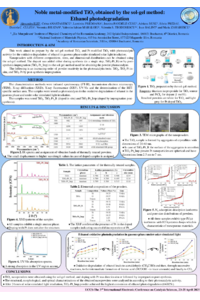
Introduction: Nanopowders with different compositions, purities, sizes, and dimensional distributions can be created using the sol--gel method [1,2]. The metal precursors were added either during synthesis (in a single step) or by post-synthesis impregnation to the sol--gel method used for obtaining the powder photocatalysts.
Methods: The materials used include ethanol, TiO2, and Pt/TiO2 powders (obtained by the sol--gel method). Characterization methods such as thermal analysis (DTA), infrared spectroscopy (IR), X-ray diffraction (XRD), and X-ray fluorescence (XRF), and the determination of the specific BET surface area and pore distribution, are complementary and necessary.
Results: As a result of the post-synthesis heat treatment, oxide compounds were obtained in the form of white (TiO2) and gray (Pt-modified TiO2) crystallized powder. The photocatalytic activity of titanium dioxide synthesized by the sol--gel route was compared to that of pristine and platinum doped photocatalysts, both during synthesis and by post-synthesis impregnation. As a result of the post-synthesis heat treatment, oxide compounds were obtained in the form of white (TiO2) and gray (Pt-modified TiO2) crystallized powder. The photocatalytic activity of titanium dioxide synthesized by the sol-gel route was compared to that of pristine and platinum-doped photocatalysts, both during synthesis and by post-synthesis impregnation. The samples were tested as photocatalysts in the oxidative degradation of ethanol in the gaseous phase and under solar simulated light irradiation. The folliwing is an increasing order of powder reactivity in the photocatalytic tests: TiO2, TiO2-Pt in-situ, and TiO2-Pt by post-synthesis impregnation (with the highest conversion being 72,24%).
Conclusions: The topic of this paper focuses on the development of the photocatalytic activity of simple and noble metal-modified TiO2 used for the degradation of contaminants in the gas phase and ambient conditions.
References:
- Sakka, Sol-gel process and applications, Handbook of Advances Ceramics, Elsevier, 883–910 (2013).
- Savolainen et all, Nanotechnologies, engineered nanomaterials and occupational health and safety, Safety Science, 48 (8), 957–963 (2010).
Keywords
sol-gel method
catalyst
photocatalysis
Pt-doped titanium dioxide
Poster
Poster ECCS_Elena-Alexandra ILIE_23-25 Aprilie 2025.pdf
Synthesis of n-type Zinc-doped metal dichalcogenide for efficient visible light photocatalytic degradation of Antibiotic and photo-electrochemical study
Photocatalytic degradation of dyes using TpPa-COF-Cl2 membrane