Event submissions
Published
This submission belongs to the session C. Photocatalysis of the event The 3rd International Electronic Conference on Catalysis Sciences
Published date
21 Apr, 2025
Academic Editor
'%3e%3cpath%20d='M12.6657%2010.9104C12.4185%2010.325%2012.0599%209.79327%2011.6097%209.34482C11.1609%208.89508%2010.6293%208.5365%2010.0442%208.28888C10.0389%208.28626%2010.0337%208.28495%2010.0285%208.28233C10.8446%207.69279%2011.3752%206.73249%2011.3752%205.64904C11.3752%203.8542%209.92103%202.39999%208.1262%202.39999C6.33136%202.39999%204.87715%203.8542%204.87715%205.64904C4.87715%206.73249%205.40774%207.69279%206.22393%208.28364C6.21869%208.28626%206.21345%208.28757%206.20821%208.29019C5.62129%208.5378%205.09463%208.89284%204.64265%209.34613C4.1929%209.79493%203.83432%2010.3266%203.58671%2010.9117C3.34345%2011.4845%203.21226%2012.0987%203.20023%2012.7209C3.19988%2012.7349%203.20233%2012.7488%203.20744%2012.7619C3.21255%2012.7749%203.22022%2012.7867%203.22998%2012.7968C3.23975%2012.8068%203.25142%2012.8147%203.26431%2012.8202C3.2772%2012.8256%203.29105%2012.8284%203.30504%2012.8284H4.09109C4.14874%2012.8284%204.19459%2012.7825%204.1959%2012.7262C4.2221%2011.7148%204.62823%2010.7676%205.34617%2010.0497C6.08899%209.30683%207.0755%208.89808%208.1262%208.89808C9.17689%208.89808%2010.1634%209.30683%2010.9062%2010.0497C11.6242%2010.7676%2012.0303%2011.7148%2012.0565%2012.7262C12.0578%2012.7838%2012.1037%2012.8284%2012.1613%2012.8284H12.9474C12.9613%2012.8284%2012.9752%2012.8256%2012.9881%2012.8202C13.001%2012.8147%2013.0126%2012.8068%2013.0224%2012.7968C13.0322%2012.7867%2013.0398%2012.7749%2013.0449%2012.7619C13.0501%2012.7488%2013.0525%2012.7349%2013.0522%2012.7209C13.0391%2012.0947%2012.9094%2011.4855%2012.6657%2010.9104ZM8.1262%207.9024C7.52486%207.9024%206.9589%207.6679%206.53312%207.24211C6.10733%206.81633%205.87283%206.25037%205.87283%205.64904C5.87283%205.0477%206.10733%204.48174%206.53312%204.05596C6.9589%203.63018%207.52486%203.39567%208.1262%203.39567C8.72753%203.39567%209.29349%203.63018%209.71927%204.05596C10.1451%204.48174%2010.3796%205.0477%2010.3796%205.64904C10.3796%206.25037%2010.1451%206.81633%209.71927%207.24211C9.29349%207.6679%208.72753%207.9024%208.1262%207.9024Z'%20fill='%235D1EE1'/%3e%3c/g%3e%3c/svg%3e) Ioannis Konstantinou
Ioannis KonstantinouCitation
Gabriela Albuquerque, Hugo Oliveira, Max Taylo Araújo Lima, Goreti Pereira, Giovannia A.L. Pereira, Copper-based quantum dots for efficient photodegradation of methyl orange dye, in Proceedings of The 3rd International Electronic Conference on Catalysis Sciences, 23 April–25 April 2025, MDPI: Basel, Switzerland
Share
Email
Facebook
Twitter
LinkedIn
Copper-based quantum dots for efficient photodegradation of methyl orange dye
'%3e%3cpath%20d='M12.6647%2010.9104C12.4176%2010.325%2012.0589%209.7933%2011.6088%209.34485C11.16%208.89511%2010.6283%208.53653%2010.0432%208.28891C10.038%208.28629%2010.0327%208.28498%2010.0275%208.28236C10.8437%207.69282%2011.3743%206.73252%2011.3743%205.64907C11.3743%203.85423%209.92005%202.40002%208.12522%202.40002C6.33038%202.40002%204.87618%203.85423%204.87618%205.64907C4.87618%206.73252%205.40677%207.69282%206.22296%208.28367C6.21772%208.28629%206.21248%208.2876%206.20724%208.29022C5.62031%208.53783%205.09365%208.89287%204.64167%209.34616C4.19192%209.79496%203.83334%2010.3266%203.58573%2010.9117C3.34247%2011.4846%203.21128%2012.0987%203.19925%2012.721C3.1989%2012.735%203.20135%2012.7489%203.20646%2012.7619C3.21157%2012.7749%203.21924%2012.7868%203.22901%2012.7968C3.23877%2012.8068%203.25045%2012.8148%203.26334%2012.8202C3.27623%2012.8256%203.29007%2012.8284%203.30406%2012.8284H4.09012C4.14776%2012.8284%204.19362%2012.7825%204.19493%2012.7262C4.22113%2011.7148%204.62726%2010.7676%205.34519%2010.0497C6.08802%209.30686%207.07452%208.89811%208.12522%208.89811C9.17592%208.89811%2010.1624%209.30686%2010.9052%2010.0497C11.6232%2010.7676%2012.0293%2011.7148%2012.0555%2012.7262C12.0568%2012.7839%2012.1027%2012.8284%2012.1603%2012.8284H12.9464C12.9604%2012.8284%2012.9742%2012.8256%2012.9871%2012.8202C13%2012.8148%2013.0117%2012.8068%2013.0214%2012.7968C13.0312%2012.7868%2013.0389%2012.7749%2013.044%2012.7619C13.0491%2012.7489%2013.0515%2012.735%2013.0512%2012.721C13.0381%2012.0947%2012.9084%2011.4856%2012.6647%2010.9104ZM8.12522%207.90243C7.52388%207.90243%206.95792%207.66793%206.53214%207.24215C6.10636%206.81636%205.87185%206.2504%205.87185%205.64907C5.87185%205.04773%206.10636%204.48177%206.53214%204.05599C6.95792%203.63021%207.52388%203.3957%208.12522%203.3957C8.72655%203.3957%209.29252%203.63021%209.7183%204.05599C10.1441%204.48177%2010.3786%205.04773%2010.3786%205.64907C10.3786%206.2504%2010.1441%206.81636%209.7183%207.24215C9.29252%207.66793%208.72655%207.90243%208.12522%207.90243Z'%20fill='%235D1EE1'/%3e%3c/g%3e%3c/svg%3e)
Gabriela Albuquerque 1
Hugo Oliveira 1
Max Taylo Araújo Lima 1

Goreti Pereira 2
Giovannia A.L. Pereira 3
1. Materials Science Department, Federal University of Pernambuco, Brazil
2. Department of Chemistry & CESAM, University of Aveiro, Portugal
3. Fundamental Chemistry Department, Federal University of Pernambuco, Brazil
Abstract
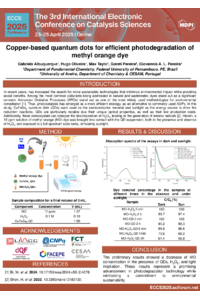
In recent years, there has been a consensus in the scientific community to seek more sustainable technologies that minimize environmental impact while providing social benefits. Among the most common pollutants being addressed in natural and wastewater, dyes stand out as a significant concern. Advanced Oxidative Processes (APOs) stand out as one of the most widely used methodologies for environmental remediation. These methods employ catalysts to generate reactive oxidative species, such as hydrogen peroxide (H2O2), which produces hydroxyl radicals and water as products after a catalytic reaction [1]. However, controlling the amount of peroxide involved in the reaction, as well as the excess released into the environment, is essential. Thus, photocatalysis has emerged as a more efficient strategy and as an alternative to commonly used AOPs. This approach requires only a semiconductor material and sunlight as an energy source to drive the reduction reactions. Among semiconductor materials, Quantum Dots (QDs) are particularly notable due their unique optical properties, which arise from quantum confinement, as well as their low production costs. Additionally, these nanocrystals can catalyze the decomposition of H2O2, leading to the generation of anionic radicals [2]. In this study, copper-based QDs were prepared by colloidal synthesis in an aqueous medium. A 10 ppm solution of methyl orange (MO) dye was brought into contact with the QD suspension, both in the presence and absence of H2O2, and exposed to a full-spectrum solar lamp, simulating sunlight. The photodegradation process of the dye was characterized using UV/Vis spectroscopy. The preliminary results showed a significant decrease in MO concentration in the presence of QDs and light irradiation. These results represent a promising advancement in photodegradation technology while reinforcing a commitment to environmental sustainability.
[1] Bi, W. et al. 2024. 10.17159/wsa/2024.v50.i2.4078.
[2] Shen, H. et al. 2022. 10.3390/nano12183130.
Keywords
photocatalysis
green chemistry
dye removal
nanocatalysts
environmental sustainability.
Poster
Pôster_ECCS 2025_Gabriela Albuquerque.pdf
Photocatalytic degradation of dyes using TpPa-COF-Cl2 membrane
Photocatalytic Behaviour of Powdered Manganese (Mn)- and Iron (Fe)-doped Tin Oxide nanomaterials