Event submissions
Published
This submission belongs to the session C. Photocatalysis of the event The 3rd International Electronic Conference on Catalysis Sciences
Published date
21 Apr, 2025
Academic Editor
'%3e%3cpath%20d='M12.6657%2010.9104C12.4185%2010.325%2012.0599%209.79327%2011.6097%209.34482C11.1609%208.89508%2010.6293%208.5365%2010.0442%208.28888C10.0389%208.28626%2010.0337%208.28495%2010.0285%208.28233C10.8446%207.69279%2011.3752%206.73249%2011.3752%205.64904C11.3752%203.8542%209.92103%202.39999%208.1262%202.39999C6.33136%202.39999%204.87715%203.8542%204.87715%205.64904C4.87715%206.73249%205.40774%207.69279%206.22393%208.28364C6.21869%208.28626%206.21345%208.28757%206.20821%208.29019C5.62129%208.5378%205.09463%208.89284%204.64265%209.34613C4.1929%209.79493%203.83432%2010.3266%203.58671%2010.9117C3.34345%2011.4845%203.21226%2012.0987%203.20023%2012.7209C3.19988%2012.7349%203.20233%2012.7488%203.20744%2012.7619C3.21255%2012.7749%203.22022%2012.7867%203.22998%2012.7968C3.23975%2012.8068%203.25142%2012.8147%203.26431%2012.8202C3.2772%2012.8256%203.29105%2012.8284%203.30504%2012.8284H4.09109C4.14874%2012.8284%204.19459%2012.7825%204.1959%2012.7262C4.2221%2011.7148%204.62823%2010.7676%205.34617%2010.0497C6.08899%209.30683%207.0755%208.89808%208.1262%208.89808C9.17689%208.89808%2010.1634%209.30683%2010.9062%2010.0497C11.6242%2010.7676%2012.0303%2011.7148%2012.0565%2012.7262C12.0578%2012.7838%2012.1037%2012.8284%2012.1613%2012.8284H12.9474C12.9613%2012.8284%2012.9752%2012.8256%2012.9881%2012.8202C13.001%2012.8147%2013.0126%2012.8068%2013.0224%2012.7968C13.0322%2012.7867%2013.0398%2012.7749%2013.0449%2012.7619C13.0501%2012.7488%2013.0525%2012.7349%2013.0522%2012.7209C13.0391%2012.0947%2012.9094%2011.4855%2012.6657%2010.9104ZM8.1262%207.9024C7.52486%207.9024%206.9589%207.6679%206.53312%207.24211C6.10733%206.81633%205.87283%206.25037%205.87283%205.64904C5.87283%205.0477%206.10733%204.48174%206.53312%204.05596C6.9589%203.63018%207.52486%203.39567%208.1262%203.39567C8.72753%203.39567%209.29349%203.63018%209.71927%204.05596C10.1451%204.48174%2010.3796%205.0477%2010.3796%205.64904C10.3796%206.25037%2010.1451%206.81633%209.71927%207.24211C9.29349%207.6679%208.72753%207.9024%208.1262%207.9024Z'%20fill='%235D1EE1'/%3e%3c/g%3e%3c/svg%3e) Ioannis Konstantinou
Ioannis KonstantinouCitation
Ashish Kumar, Deepika Maan, Karishma Jain, Sushil Kumar Jain, Balram Tripathi, Photocatalytic Behaviour of Powdered Manganese (Mn)- and Iron (Fe)-doped Tin Oxide nanomaterials, in Proceedings of The 3rd International Electronic Conference on Catalysis Sciences, 23 April–25 April 2025, MDPI: Basel, Switzerland
Share
Email
Facebook
Twitter
LinkedIn
Photocatalytic Behaviour of Powdered Manganese (Mn)- and Iron (Fe)-doped Tin Oxide nanomaterials
'%3e%3cpath%20d='M12.6647%2010.9104C12.4176%2010.325%2012.0589%209.7933%2011.6088%209.34485C11.16%208.89511%2010.6283%208.53653%2010.0432%208.28891C10.038%208.28629%2010.0327%208.28498%2010.0275%208.28236C10.8437%207.69282%2011.3743%206.73252%2011.3743%205.64907C11.3743%203.85423%209.92005%202.40002%208.12522%202.40002C6.33038%202.40002%204.87618%203.85423%204.87618%205.64907C4.87618%206.73252%205.40677%207.69282%206.22296%208.28367C6.21772%208.28629%206.21248%208.2876%206.20724%208.29022C5.62031%208.53783%205.09365%208.89287%204.64167%209.34616C4.19192%209.79496%203.83334%2010.3266%203.58573%2010.9117C3.34247%2011.4846%203.21128%2012.0987%203.19925%2012.721C3.1989%2012.735%203.20135%2012.7489%203.20646%2012.7619C3.21157%2012.7749%203.21924%2012.7868%203.22901%2012.7968C3.23877%2012.8068%203.25045%2012.8148%203.26334%2012.8202C3.27623%2012.8256%203.29007%2012.8284%203.30406%2012.8284H4.09012C4.14776%2012.8284%204.19362%2012.7825%204.19493%2012.7262C4.22113%2011.7148%204.62726%2010.7676%205.34519%2010.0497C6.08802%209.30686%207.07452%208.89811%208.12522%208.89811C9.17592%208.89811%2010.1624%209.30686%2010.9052%2010.0497C11.6232%2010.7676%2012.0293%2011.7148%2012.0555%2012.7262C12.0568%2012.7839%2012.1027%2012.8284%2012.1603%2012.8284H12.9464C12.9604%2012.8284%2012.9742%2012.8256%2012.9871%2012.8202C13%2012.8148%2013.0117%2012.8068%2013.0214%2012.7968C13.0312%2012.7868%2013.0389%2012.7749%2013.044%2012.7619C13.0491%2012.7489%2013.0515%2012.735%2013.0512%2012.721C13.0381%2012.0947%2012.9084%2011.4856%2012.6647%2010.9104ZM8.12522%207.90243C7.52388%207.90243%206.95792%207.66793%206.53214%207.24215C6.10636%206.81636%205.87185%206.2504%205.87185%205.64907C5.87185%205.04773%206.10636%204.48177%206.53214%204.05599C6.95792%203.63021%207.52388%203.3957%208.12522%203.3957C8.72655%203.3957%209.29252%203.63021%209.7183%204.05599C10.1441%204.48177%2010.3786%205.04773%2010.3786%205.64907C10.3786%206.2504%2010.1441%206.81636%209.7183%207.24215C9.29252%207.66793%208.72655%207.90243%208.12522%207.90243Z'%20fill='%235D1EE1'/%3e%3c/g%3e%3c/svg%3e)
Ashish Kumar 1
Deepika Maan 1
Karishma Jain 1
Sushil Kumar Jain 1
Balram Tripathi 2
1. Department of Physics, School of physical and biosciences, Manipal University Jaipur, Jaipur -303007, India
2. Department of Physics, S.S. Jain Subodh PG (Auto.) College Jaipur-302004, India
Abstract
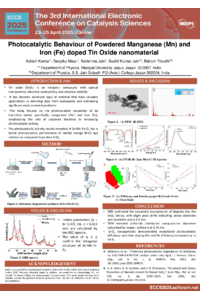
Semiconductor metal-substituted tin oxide (SnO2) has drawn a great deal of attention due to its excellent properties. This study focuses on the photocatalytic properties of 3d transition metals, specifically manganese (Mn) and iron (Fe), emphasizing the role of unpaired electrons in enhancing photocatalytic activity. A Sn0.99-Mn0.05-Fe0.05O2 sample was synthesized by the sol–gel wet chemical precipitation method. The crystallite size and structure of doped SnO2 were determined usinga modified Debye Scherer’s formula. Lattice constants were evaluated from peaks obtained by the X-ray diffraction (XRD) technique. The value of crystallite size estimated by Debye Scherer’s formula lies in the range 3–5 nm, indicating the nano-crystalline nature of the sample. Using transmission electron microscopy (TEM), the obtained average diameter was 3.75 nm, calculated with the help of ImageJ, which is in good agreement with the crystallite size obtained via XRD. The irregular morphology of the sample was analyzed by field emission scanning electron microscopy (FESEM). An energy dispersive X-ray (EDX) analysis confirmed the presence of elements such as tin, oxygen, manganese and iron. Fourier transform infrared (FT-IR) spectrum displayed Sn-O characteristic bands as well as inculcated metal elements. The optical and photocatalytic results were characterized using UV-Visible spectroscopy. The absorbance for pristine and intercalated samples was observed at 217 nm and 218 nm, respectively. Their optical band gaps were 3.10 eV and 2.69 eV, respectively, indicating that the band gaps narrow upon intercalation. Photoluminescence spectra were obtained in the visible spectrum range (300–600 nm) and confirmed the defects and impurity states formed due to the intercalation of Mn and Fe transition elements. The photocatalytic activity results revealed that Mn-Fe/SnO2 has a better photocatalytic performance of methylene blue (MB) dye solutioncompared to pristine SnO2.
Keywords
Nanomaterial
Dye
semiconductor
XRD
Optical
Poster
Ashish kumar -poster.pdf
Copper-based quantum dots for efficient photodegradation of methyl orange dye
Photocatalytic Study of Rose Bengal Dye using Sol–Gel-Synthesized Titanium dioxide incorporated with Transition metal elements (Manganese and Cobalt)