Event submissions
Published
This submission belongs to the session C. Photocatalysis of the event The 3rd International Electronic Conference on Catalysis Sciences
Published date
21 Apr, 2025
Academic Editor
'%3e%3cpath%20d='M12.6657%2010.9104C12.4185%2010.325%2012.0599%209.79327%2011.6097%209.34482C11.1609%208.89508%2010.6293%208.5365%2010.0442%208.28888C10.0389%208.28626%2010.0337%208.28495%2010.0285%208.28233C10.8446%207.69279%2011.3752%206.73249%2011.3752%205.64904C11.3752%203.8542%209.92103%202.39999%208.1262%202.39999C6.33136%202.39999%204.87715%203.8542%204.87715%205.64904C4.87715%206.73249%205.40774%207.69279%206.22393%208.28364C6.21869%208.28626%206.21345%208.28757%206.20821%208.29019C5.62129%208.5378%205.09463%208.89284%204.64265%209.34613C4.1929%209.79493%203.83432%2010.3266%203.58671%2010.9117C3.34345%2011.4845%203.21226%2012.0987%203.20023%2012.7209C3.19988%2012.7349%203.20233%2012.7488%203.20744%2012.7619C3.21255%2012.7749%203.22022%2012.7867%203.22998%2012.7968C3.23975%2012.8068%203.25142%2012.8147%203.26431%2012.8202C3.2772%2012.8256%203.29105%2012.8284%203.30504%2012.8284H4.09109C4.14874%2012.8284%204.19459%2012.7825%204.1959%2012.7262C4.2221%2011.7148%204.62823%2010.7676%205.34617%2010.0497C6.08899%209.30683%207.0755%208.89808%208.1262%208.89808C9.17689%208.89808%2010.1634%209.30683%2010.9062%2010.0497C11.6242%2010.7676%2012.0303%2011.7148%2012.0565%2012.7262C12.0578%2012.7838%2012.1037%2012.8284%2012.1613%2012.8284H12.9474C12.9613%2012.8284%2012.9752%2012.8256%2012.9881%2012.8202C13.001%2012.8147%2013.0126%2012.8068%2013.0224%2012.7968C13.0322%2012.7867%2013.0398%2012.7749%2013.0449%2012.7619C13.0501%2012.7488%2013.0525%2012.7349%2013.0522%2012.7209C13.0391%2012.0947%2012.9094%2011.4855%2012.6657%2010.9104ZM8.1262%207.9024C7.52486%207.9024%206.9589%207.6679%206.53312%207.24211C6.10733%206.81633%205.87283%206.25037%205.87283%205.64904C5.87283%205.0477%206.10733%204.48174%206.53312%204.05596C6.9589%203.63018%207.52486%203.39567%208.1262%203.39567C8.72753%203.39567%209.29349%203.63018%209.71927%204.05596C10.1451%204.48174%2010.3796%205.0477%2010.3796%205.64904C10.3796%206.25037%2010.1451%206.81633%209.71927%207.24211C9.29349%207.6679%208.72753%207.9024%208.1262%207.9024Z'%20fill='%235D1EE1'/%3e%3c/g%3e%3c/svg%3e) Ioannis Konstantinou
Ioannis KonstantinouCitation
Deepika Maan, Ashish Kumar, Karishma Jain, Sushil Kumar Jain, Balram Tripathi, Photocatalytic Study of Rose Bengal Dye using Sol–Gel-Synthesized Titanium dioxide incorporated with Transition metal elements (Manganese and Cobalt), in Proceedings of The 3rd International Electronic Conference on Catalysis Sciences, 23 April–25 April 2025, MDPI: Basel, Switzerland
Share
Email
Facebook
Twitter
LinkedIn
Photocatalytic Study of Rose Bengal Dye using Sol–Gel-Synthesized Titanium dioxide incorporated with Transition metal elements (Manganese and Cobalt)
'%3e%3cpath%20d='M12.6647%2010.9104C12.4176%2010.325%2012.0589%209.7933%2011.6088%209.34485C11.16%208.89511%2010.6283%208.53653%2010.0432%208.28891C10.038%208.28629%2010.0327%208.28498%2010.0275%208.28236C10.8437%207.69282%2011.3743%206.73252%2011.3743%205.64907C11.3743%203.85423%209.92005%202.40002%208.12522%202.40002C6.33038%202.40002%204.87618%203.85423%204.87618%205.64907C4.87618%206.73252%205.40677%207.69282%206.22296%208.28367C6.21772%208.28629%206.21248%208.2876%206.20724%208.29022C5.62031%208.53783%205.09365%208.89287%204.64167%209.34616C4.19192%209.79496%203.83334%2010.3266%203.58573%2010.9117C3.34247%2011.4846%203.21128%2012.0987%203.19925%2012.721C3.1989%2012.735%203.20135%2012.7489%203.20646%2012.7619C3.21157%2012.7749%203.21924%2012.7868%203.22901%2012.7968C3.23877%2012.8068%203.25045%2012.8148%203.26334%2012.8202C3.27623%2012.8256%203.29007%2012.8284%203.30406%2012.8284H4.09012C4.14776%2012.8284%204.19362%2012.7825%204.19493%2012.7262C4.22113%2011.7148%204.62726%2010.7676%205.34519%2010.0497C6.08802%209.30686%207.07452%208.89811%208.12522%208.89811C9.17592%208.89811%2010.1624%209.30686%2010.9052%2010.0497C11.6232%2010.7676%2012.0293%2011.7148%2012.0555%2012.7262C12.0568%2012.7839%2012.1027%2012.8284%2012.1603%2012.8284H12.9464C12.9604%2012.8284%2012.9742%2012.8256%2012.9871%2012.8202C13%2012.8148%2013.0117%2012.8068%2013.0214%2012.7968C13.0312%2012.7868%2013.0389%2012.7749%2013.044%2012.7619C13.0491%2012.7489%2013.0515%2012.735%2013.0512%2012.721C13.0381%2012.0947%2012.9084%2011.4856%2012.6647%2010.9104ZM8.12522%207.90243C7.52388%207.90243%206.95792%207.66793%206.53214%207.24215C6.10636%206.81636%205.87185%206.2504%205.87185%205.64907C5.87185%205.04773%206.10636%204.48177%206.53214%204.05599C6.95792%203.63021%207.52388%203.3957%208.12522%203.3957C8.72655%203.3957%209.29252%203.63021%209.7183%204.05599C10.1441%204.48177%2010.3786%205.04773%2010.3786%205.64907C10.3786%206.2504%2010.1441%206.81636%209.7183%207.24215C9.29252%207.66793%208.72655%207.90243%208.12522%207.90243Z'%20fill='%235D1EE1'/%3e%3c/g%3e%3c/svg%3e)
Deepika Maan 1
Ashish Kumar 1
Karishma Jain 1
Sushil Kumar Jain 1
Balram Tripathi 2
1. Manipal University Jaipur
2. SS Jain Subodh Pg (Auto) College
Abstract
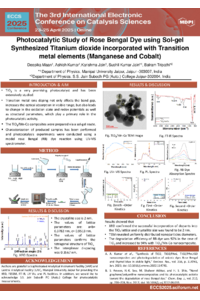
This study is concerned with the photocatalytic degradation of rose bengal dye using modified titanium dioxide, specifically using different metal ions, like manganese (Mn) and cobalt (Co). The TiO2/Mn/Co composites were prepared via a sol–gel route since it favors the homogenous introduction of metal ions into the TiO2 matrix. For the preparation of the composites, titanium dioxide (0.89 mol) was mixed with manganese (II) chloride (0.05 mol) and cobalt chloride hexahydrate (0.06 mol). The structural and morphological properties of the synthesized photocatalysts were assessed by characterization techniques such as X-ray diffraction (XRD) and transmission electron microscopy (TEM), Fourier-Transform Infrared (FT-IR) and UV-VIS spectroscopy. The average particle size was found to be 74.8 nm, which was calculated using image J software, and the interplanar d-spacing was 0.3567 nm, as calculated from HR-TEM images. The TEM images also revealed the spherical morphology of the composite. Optical studies have revealed the narrowed band gap of the TiO2/Mn/Co nanocomposite. Photocatalytic performance under sunlight was evaluated, indicating enhancement in the efficiency of rose bengal degradation compared to pure TiO2 through the incorporation of manganese and cobalt. The degradation efficiency was 92% in the case of TiO2 and increased to 94% with the TiO2/Mn/Co nanocomposite. The suggested mechanism for the degradation process, through the generation of reactive oxygen species during sunlight irradiation, elucidates an essential role of the latter in breaking down the molecular structure of the dye. Overall, these results prove that TiO2/Mn/Co composites may have the potential to offer an effective solution for dye removal from wastewater, thereby making a positive contribution towards environmental sustainability.
Keywords
Titanium dioxide
Manganese
Cobalt
Dye wastewater
Photocatalysis.
Poster
poster for Switzerland.pdf
Photocatalytic Behaviour of Powdered Manganese (Mn)- and Iron (Fe)-doped Tin Oxide nanomaterials
Development of a ZnO–Graphene Oxide Composite for Enhanced Photodegradation of Sandalfix Orange P3R and Sandalfix Turquoise Blue PG Dyes Under Sunlight Irradiation