Event submissions
Published
This submission belongs to the session C. Photocatalysis of the event The 3rd International Electronic Conference on Catalysis Sciences
Published date
21 Apr, 2025
Academic Editor
'%3e%3cpath%20d='M12.6657%2010.9104C12.4185%2010.325%2012.0599%209.79327%2011.6097%209.34482C11.1609%208.89508%2010.6293%208.5365%2010.0442%208.28888C10.0389%208.28626%2010.0337%208.28495%2010.0285%208.28233C10.8446%207.69279%2011.3752%206.73249%2011.3752%205.64904C11.3752%203.8542%209.92103%202.39999%208.1262%202.39999C6.33136%202.39999%204.87715%203.8542%204.87715%205.64904C4.87715%206.73249%205.40774%207.69279%206.22393%208.28364C6.21869%208.28626%206.21345%208.28757%206.20821%208.29019C5.62129%208.5378%205.09463%208.89284%204.64265%209.34613C4.1929%209.79493%203.83432%2010.3266%203.58671%2010.9117C3.34345%2011.4845%203.21226%2012.0987%203.20023%2012.7209C3.19988%2012.7349%203.20233%2012.7488%203.20744%2012.7619C3.21255%2012.7749%203.22022%2012.7867%203.22998%2012.7968C3.23975%2012.8068%203.25142%2012.8147%203.26431%2012.8202C3.2772%2012.8256%203.29105%2012.8284%203.30504%2012.8284H4.09109C4.14874%2012.8284%204.19459%2012.7825%204.1959%2012.7262C4.2221%2011.7148%204.62823%2010.7676%205.34617%2010.0497C6.08899%209.30683%207.0755%208.89808%208.1262%208.89808C9.17689%208.89808%2010.1634%209.30683%2010.9062%2010.0497C11.6242%2010.7676%2012.0303%2011.7148%2012.0565%2012.7262C12.0578%2012.7838%2012.1037%2012.8284%2012.1613%2012.8284H12.9474C12.9613%2012.8284%2012.9752%2012.8256%2012.9881%2012.8202C13.001%2012.8147%2013.0126%2012.8068%2013.0224%2012.7968C13.0322%2012.7867%2013.0398%2012.7749%2013.0449%2012.7619C13.0501%2012.7488%2013.0525%2012.7349%2013.0522%2012.7209C13.0391%2012.0947%2012.9094%2011.4855%2012.6657%2010.9104ZM8.1262%207.9024C7.52486%207.9024%206.9589%207.6679%206.53312%207.24211C6.10733%206.81633%205.87283%206.25037%205.87283%205.64904C5.87283%205.0477%206.10733%204.48174%206.53312%204.05596C6.9589%203.63018%207.52486%203.39567%208.1262%203.39567C8.72753%203.39567%209.29349%203.63018%209.71927%204.05596C10.1451%204.48174%2010.3796%205.0477%2010.3796%205.64904C10.3796%206.25037%2010.1451%206.81633%209.71927%207.24211C9.29349%207.6679%208.72753%207.9024%208.1262%207.9024Z'%20fill='%235D1EE1'/%3e%3c/g%3e%3c/svg%3e) Ioannis Konstantinou
Ioannis KonstantinouCitation
Nelda Xanath Martinez-Galero, Miguel Angel García-Muñoz, Adolfo Amador-Mendoza, Rocío Meza-Gordillo, Sebastián López-Martínez, The degradation of endocrine disruptors via photocatalysis in a continuous-flow microreactor: a proposal for numbering-up, in Proceedings of The 3rd International Electronic Conference on Catalysis Sciences, 23 April–25 April 2025, MDPI: Basel, Switzerland
Share
Email
Facebook
Twitter
LinkedIn
The degradation of endocrine disruptors via photocatalysis in a continuous-flow microreactor: a proposal for numbering-up

Nelda Xanath Martinez-Galero 1
'%3e%3cpath%20d='M12.6647%2010.9104C12.4176%2010.325%2012.0589%209.7933%2011.6088%209.34485C11.16%208.89511%2010.6283%208.53653%2010.0432%208.28891C10.038%208.28629%2010.0327%208.28498%2010.0275%208.28236C10.8437%207.69282%2011.3743%206.73252%2011.3743%205.64907C11.3743%203.85423%209.92005%202.40002%208.12522%202.40002C6.33038%202.40002%204.87618%203.85423%204.87618%205.64907C4.87618%206.73252%205.40677%207.69282%206.22296%208.28367C6.21772%208.28629%206.21248%208.2876%206.20724%208.29022C5.62031%208.53783%205.09365%208.89287%204.64167%209.34616C4.19192%209.79496%203.83334%2010.3266%203.58573%2010.9117C3.34247%2011.4846%203.21128%2012.0987%203.19925%2012.721C3.1989%2012.735%203.20135%2012.7489%203.20646%2012.7619C3.21157%2012.7749%203.21924%2012.7868%203.22901%2012.7968C3.23877%2012.8068%203.25045%2012.8148%203.26334%2012.8202C3.27623%2012.8256%203.29007%2012.8284%203.30406%2012.8284H4.09012C4.14776%2012.8284%204.19362%2012.7825%204.19493%2012.7262C4.22113%2011.7148%204.62726%2010.7676%205.34519%2010.0497C6.08802%209.30686%207.07452%208.89811%208.12522%208.89811C9.17592%208.89811%2010.1624%209.30686%2010.9052%2010.0497C11.6232%2010.7676%2012.0293%2011.7148%2012.0555%2012.7262C12.0568%2012.7839%2012.1027%2012.8284%2012.1603%2012.8284H12.9464C12.9604%2012.8284%2012.9742%2012.8256%2012.9871%2012.8202C13%2012.8148%2013.0117%2012.8068%2013.0214%2012.7968C13.0312%2012.7868%2013.0389%2012.7749%2013.044%2012.7619C13.0491%2012.7489%2013.0515%2012.735%2013.0512%2012.721C13.0381%2012.0947%2012.9084%2011.4856%2012.6647%2010.9104ZM8.12522%207.90243C7.52388%207.90243%206.95792%207.66793%206.53214%207.24215C6.10636%206.81636%205.87185%206.2504%205.87185%205.64907C5.87185%205.04773%206.10636%204.48177%206.53214%204.05599C6.95792%203.63021%207.52388%203.3957%208.12522%203.3957C8.72655%203.3957%209.29252%203.63021%209.7183%204.05599C10.1441%204.48177%2010.3786%205.04773%2010.3786%205.64907C10.3786%206.2504%2010.1441%206.81636%209.7183%207.24215C9.29252%207.66793%208.72655%207.90243%208.12522%207.90243Z'%20fill='%235D1EE1'/%3e%3c/g%3e%3c/svg%3e)
Miguel Angel García-Muñoz 1
Adolfo Amador-Mendoza 2
Rocío Meza-Gordillo 3
Sebastián López-Martínez 4
1. Instituto de Química Aplicada del Centro de Investigaciones Científicas, Universidad del Papaloapan
2. Instituto de Agroingeniería, Universidad del Papaloapan
3. Instituto Tecnológico de Tuxtla Gutiérrez
4. Ingeniería en Biotecnología, Universidad del Papaloapan
Abstract
Numbering-up is a strategy used to scale up microchemical processes by distributing fluids in microchannels, used as microreactors, which allows efficient mass transport under laminar flow conditions. Due to the reduced diffusion path from the aqueous solution of the contaminant to the catalyst layer, mass transport limitations are reduced, which easuky overcomes one of the main drawbacks of catalyst immobilization.
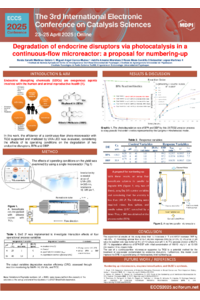
In this work, the efficiency of a continuous-flow photo-microreactor with TiO2 supported on a silicone column and irradiated by UVA-LED was evaluated, considering the effects of its operating conditions on the degradation of two endocrine disruptors, BPA and DBP.
The experimental design was 2k and considered pH, temperature, H2O2 concentration, and volumetric flow rate as the process variables. The controlled reaction included equipment, such as injection pumps, peltier, pressure control, and online sensors (pH, ORP, NMR 1H). The output variables were the photocatalytic efficiency of the reactor, assessed through reaction monitoring by NMR-1H, IR, UV-Vis, and TOC. Variations in Reynolds numbers were measured from the viscosity of the solutions at the set up and end of the reactions.
The optimal operational parameters for BPA degradation were pH = 4, T = 20 ° C, Q = 1 mL/min, and [H2O2] = 2 ppm, while, with a reaction time of 0.25 h, a higher degradation efficiency of BPA (99.3%) was achieved. For the same reaction conditions, the highest degradation efficiency of DBP was 78%.
The use of a continuous-flow microreactor supported by TiO2 is a potential method for the treatment of wastewater contaminated by endocrine disruptors.
Keywords
Microreactors
endocrine disruptors
emerging pollutants
chemical processes
on-line instrumentation
Poster
sciforum112703 ECCS 2025 abril Photocatalysis poster NXMG.pdf
Novel Strategy to Evaluate Platinum Photocatalysts for Hydrosilation-Curable Silicones
PHOTOCATALYTIC PERFORMANCE OF IRON-MODIFIED CARBON NITRIDE USING UV-A IRRADIATION