Event submissions
Published
This submission belongs to the session C. Photocatalysis of the event The 3rd International Electronic Conference on Catalysis Sciences
Published date
21 Apr, 2025
Academic Editor
'%3e%3cpath%20d='M12.6657%2010.9104C12.4185%2010.325%2012.0599%209.79327%2011.6097%209.34482C11.1609%208.89508%2010.6293%208.5365%2010.0442%208.28888C10.0389%208.28626%2010.0337%208.28495%2010.0285%208.28233C10.8446%207.69279%2011.3752%206.73249%2011.3752%205.64904C11.3752%203.8542%209.92103%202.39999%208.1262%202.39999C6.33136%202.39999%204.87715%203.8542%204.87715%205.64904C4.87715%206.73249%205.40774%207.69279%206.22393%208.28364C6.21869%208.28626%206.21345%208.28757%206.20821%208.29019C5.62129%208.5378%205.09463%208.89284%204.64265%209.34613C4.1929%209.79493%203.83432%2010.3266%203.58671%2010.9117C3.34345%2011.4845%203.21226%2012.0987%203.20023%2012.7209C3.19988%2012.7349%203.20233%2012.7488%203.20744%2012.7619C3.21255%2012.7749%203.22022%2012.7867%203.22998%2012.7968C3.23975%2012.8068%203.25142%2012.8147%203.26431%2012.8202C3.2772%2012.8256%203.29105%2012.8284%203.30504%2012.8284H4.09109C4.14874%2012.8284%204.19459%2012.7825%204.1959%2012.7262C4.2221%2011.7148%204.62823%2010.7676%205.34617%2010.0497C6.08899%209.30683%207.0755%208.89808%208.1262%208.89808C9.17689%208.89808%2010.1634%209.30683%2010.9062%2010.0497C11.6242%2010.7676%2012.0303%2011.7148%2012.0565%2012.7262C12.0578%2012.7838%2012.1037%2012.8284%2012.1613%2012.8284H12.9474C12.9613%2012.8284%2012.9752%2012.8256%2012.9881%2012.8202C13.001%2012.8147%2013.0126%2012.8068%2013.0224%2012.7968C13.0322%2012.7867%2013.0398%2012.7749%2013.0449%2012.7619C13.0501%2012.7488%2013.0525%2012.7349%2013.0522%2012.7209C13.0391%2012.0947%2012.9094%2011.4855%2012.6657%2010.9104ZM8.1262%207.9024C7.52486%207.9024%206.9589%207.6679%206.53312%207.24211C6.10733%206.81633%205.87283%206.25037%205.87283%205.64904C5.87283%205.0477%206.10733%204.48174%206.53312%204.05596C6.9589%203.63018%207.52486%203.39567%208.1262%203.39567C8.72753%203.39567%209.29349%203.63018%209.71927%204.05596C10.1451%204.48174%2010.3796%205.0477%2010.3796%205.64904C10.3796%206.25037%2010.1451%206.81633%209.71927%207.24211C9.29349%207.6679%208.72753%207.9024%208.1262%207.9024Z'%20fill='%235D1EE1'/%3e%3c/g%3e%3c/svg%3e) Jingrun Ran
Jingrun RanCitation
Hinata Suzuki, Hideyuki Katsumata, Ikki Tateishi, Mai Furukawa, Satoshi Kanaco, Photocatalytic dye degradation using modified g-C₃N₄, in Proceedings of The 3rd International Electronic Conference on Catalysis Sciences, 23 April–25 April 2025, MDPI: Basel, Switzerland
Share
Email
Facebook
Twitter
LinkedIn
Photocatalytic dye degradation using modified g-C₃N₄
'%3e%3cpath%20d='M12.6647%2010.9104C12.4176%2010.325%2012.0589%209.7933%2011.6088%209.34485C11.16%208.89511%2010.6283%208.53653%2010.0432%208.28891C10.038%208.28629%2010.0327%208.28498%2010.0275%208.28236C10.8437%207.69282%2011.3743%206.73252%2011.3743%205.64907C11.3743%203.85423%209.92005%202.40002%208.12522%202.40002C6.33038%202.40002%204.87618%203.85423%204.87618%205.64907C4.87618%206.73252%205.40677%207.69282%206.22296%208.28367C6.21772%208.28629%206.21248%208.2876%206.20724%208.29022C5.62031%208.53783%205.09365%208.89287%204.64167%209.34616C4.19192%209.79496%203.83334%2010.3266%203.58573%2010.9117C3.34247%2011.4846%203.21128%2012.0987%203.19925%2012.721C3.1989%2012.735%203.20135%2012.7489%203.20646%2012.7619C3.21157%2012.7749%203.21924%2012.7868%203.22901%2012.7968C3.23877%2012.8068%203.25045%2012.8148%203.26334%2012.8202C3.27623%2012.8256%203.29007%2012.8284%203.30406%2012.8284H4.09012C4.14776%2012.8284%204.19362%2012.7825%204.19493%2012.7262C4.22113%2011.7148%204.62726%2010.7676%205.34519%2010.0497C6.08802%209.30686%207.07452%208.89811%208.12522%208.89811C9.17592%208.89811%2010.1624%209.30686%2010.9052%2010.0497C11.6232%2010.7676%2012.0293%2011.7148%2012.0555%2012.7262C12.0568%2012.7839%2012.1027%2012.8284%2012.1603%2012.8284H12.9464C12.9604%2012.8284%2012.9742%2012.8256%2012.9871%2012.8202C13%2012.8148%2013.0117%2012.8068%2013.0214%2012.7968C13.0312%2012.7868%2013.0389%2012.7749%2013.044%2012.7619C13.0491%2012.7489%2013.0515%2012.735%2013.0512%2012.721C13.0381%2012.0947%2012.9084%2011.4856%2012.6647%2010.9104ZM8.12522%207.90243C7.52388%207.90243%206.95792%207.66793%206.53214%207.24215C6.10636%206.81636%205.87185%206.2504%205.87185%205.64907C5.87185%205.04773%206.10636%204.48177%206.53214%204.05599C6.95792%203.63021%207.52388%203.3957%208.12522%203.3957C8.72655%203.3957%209.29252%203.63021%209.7183%204.05599C10.1441%204.48177%2010.3786%205.04773%2010.3786%205.64907C10.3786%206.2504%2010.1441%206.81636%209.7183%207.24215C9.29252%207.66793%208.72655%207.90243%208.12522%207.90243Z'%20fill='%235D1EE1'/%3e%3c/g%3e%3c/svg%3e)
Hinata Suzuki 1
Hideyuki Katsumata 1
Ikki Tateishi 2
Mai Furukawa 1
Satoshi Kanaco 1
1. Department of Applied Chemistry, Graduate School of Engineering, Mie University
2. Center for Global Environment Education & Research, Mie University
Abstract
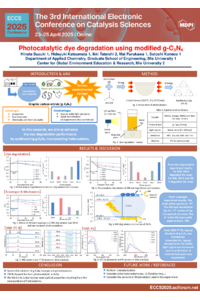
Dye wastewater is a highly toxic organic pollutant that is not easily degraded. For that reason, it causes serious environmental damage to nature and ecosystems. Therefore, the degradation research of organic matter by using photocatalysts is attracting attention because of their low cost and environmental friendliness. Graphitic carbon nitride (g-C₃N₄), a photocatalyst, has the advantages of being inexpensive, chemically and thermally stable, and easy to prepare. On the other hand, g-C₃N₄ possesses a small surface area, narrow visible light absorption, and a quick-recombination photogenerated electron–hole pair. Photocatalysts are also known to incorporate heteroatoms within their structures and to develop various characteristics depending on the atoms incorporated. In this research, we aim to enhance the dye degradation performance by synthesizing g-C₃N₄, incorporating heteroatoms.
The photocatalyst was obtained by mixing urea, a carbon nitride source, and a heteroatom source, followed by thermal treatment. Bulk g-C₃N₄ (CN-U), N-deficient g-C₃N₄ (CN-N), Br-doped g-C₃N₄ (CN-Br), S-doped g-C₃N₄ (CN-S), and O-doped g-C₃N₄ (CN-O) were prepared. Photocatalytic degradation was carried out under visible light irradiation using a Xenon lamp equipped with a cutoff filter. Methyl orange (MO) and methylene blue (MB) were selected as decolorizing targets. They were characterized in a variety of ways to clarify their photocatalytic properties.
A series of characterization results showed that the typical structure of g-C₃N₄ was maintained. It has been shown that doping carbon nitride with heteroatoms changes the optical properties of carbon nitride. Furthermore, we confirmed that doping carbon nitride with heteroatoms prevents the recombination of photogenerated electron–hole pairs. From the results of the dye degradation experiment, for MO, CN-N degraded the most. For MB, CN-U and CN-N degraded the most. We think this is due to the improved optical properties resulting from the incorporation of heteroatoms.
Keywords
Photocatalyst
g-C₃N₄
Dye degradation
Characterization
Poster
ECCS poster Hinata Suzuki.pdf
Improvement in hydrogen production activity under visible-light irradiation using Tp-Pa-COF photocatalyst
Graphitic Carbon Nitride Modified with 1,3-Benzothiazole-2-carbaldehyde for Enhancement of Visible Light Hydrogen Production Activity