Event submissions
Published
This submission belongs to the session E. Biocatalysis of the event The 3rd International Electronic Conference on Catalysis Sciences
Published date
21 Apr, 2025
Academic Editor
'%3e%3cpath%20d='M12.6657%2010.9104C12.4185%2010.325%2012.0599%209.79327%2011.6097%209.34482C11.1609%208.89508%2010.6293%208.5365%2010.0442%208.28888C10.0389%208.28626%2010.0337%208.28495%2010.0285%208.28233C10.8446%207.69279%2011.3752%206.73249%2011.3752%205.64904C11.3752%203.8542%209.92103%202.39999%208.1262%202.39999C6.33136%202.39999%204.87715%203.8542%204.87715%205.64904C4.87715%206.73249%205.40774%207.69279%206.22393%208.28364C6.21869%208.28626%206.21345%208.28757%206.20821%208.29019C5.62129%208.5378%205.09463%208.89284%204.64265%209.34613C4.1929%209.79493%203.83432%2010.3266%203.58671%2010.9117C3.34345%2011.4845%203.21226%2012.0987%203.20023%2012.7209C3.19988%2012.7349%203.20233%2012.7488%203.20744%2012.7619C3.21255%2012.7749%203.22022%2012.7867%203.22998%2012.7968C3.23975%2012.8068%203.25142%2012.8147%203.26431%2012.8202C3.2772%2012.8256%203.29105%2012.8284%203.30504%2012.8284H4.09109C4.14874%2012.8284%204.19459%2012.7825%204.1959%2012.7262C4.2221%2011.7148%204.62823%2010.7676%205.34617%2010.0497C6.08899%209.30683%207.0755%208.89808%208.1262%208.89808C9.17689%208.89808%2010.1634%209.30683%2010.9062%2010.0497C11.6242%2010.7676%2012.0303%2011.7148%2012.0565%2012.7262C12.0578%2012.7838%2012.1037%2012.8284%2012.1613%2012.8284H12.9474C12.9613%2012.8284%2012.9752%2012.8256%2012.9881%2012.8202C13.001%2012.8147%2013.0126%2012.8068%2013.0224%2012.7968C13.0322%2012.7867%2013.0398%2012.7749%2013.0449%2012.7619C13.0501%2012.7488%2013.0525%2012.7349%2013.0522%2012.7209C13.0391%2012.0947%2012.9094%2011.4855%2012.6657%2010.9104ZM8.1262%207.9024C7.52486%207.9024%206.9589%207.6679%206.53312%207.24211C6.10733%206.81633%205.87283%206.25037%205.87283%205.64904C5.87283%205.0477%206.10733%204.48174%206.53312%204.05596C6.9589%203.63018%207.52486%203.39567%208.1262%203.39567C8.72753%203.39567%209.29349%203.63018%209.71927%204.05596C10.1451%204.48174%2010.3796%205.0477%2010.3796%205.64904C10.3796%206.25037%2010.1451%206.81633%209.71927%207.24211C9.29349%207.6679%208.72753%207.9024%208.1262%207.9024Z'%20fill='%235D1EE1'/%3e%3c/g%3e%3c/svg%3e) Frank Hollmann
Frank HollmannCitation
Igor Gamm, Tobias Heinks, Katrin Hofmann, Simon Last, Luise Blach, Ren Wei, Uwe T. Bornscheuer, Jan von Langermann, Christof Hamel, Reaction Network Analysis and Kinetic Modeling of BHET Depolymerization as (Sub-)Network of PET, in Proceedings of The 3rd International Electronic Conference on Catalysis Sciences, 23 April–25 April 2025, MDPI: Basel, Switzerland
Share
Email
Facebook
Twitter
LinkedIn
Reaction Network Analysis and Kinetic Modeling of BHET Depolymerization as (Sub-)Network of PET
'%3e%3cpath%20d='M12.6647%2010.9104C12.4176%2010.325%2012.0589%209.7933%2011.6088%209.34485C11.16%208.89511%2010.6283%208.53653%2010.0432%208.28891C10.038%208.28629%2010.0327%208.28498%2010.0275%208.28236C10.8437%207.69282%2011.3743%206.73252%2011.3743%205.64907C11.3743%203.85423%209.92005%202.40002%208.12522%202.40002C6.33038%202.40002%204.87618%203.85423%204.87618%205.64907C4.87618%206.73252%205.40677%207.69282%206.22296%208.28367C6.21772%208.28629%206.21248%208.2876%206.20724%208.29022C5.62031%208.53783%205.09365%208.89287%204.64167%209.34616C4.19192%209.79496%203.83334%2010.3266%203.58573%2010.9117C3.34247%2011.4846%203.21128%2012.0987%203.19925%2012.721C3.1989%2012.735%203.20135%2012.7489%203.20646%2012.7619C3.21157%2012.7749%203.21924%2012.7868%203.22901%2012.7968C3.23877%2012.8068%203.25045%2012.8148%203.26334%2012.8202C3.27623%2012.8256%203.29007%2012.8284%203.30406%2012.8284H4.09012C4.14776%2012.8284%204.19362%2012.7825%204.19493%2012.7262C4.22113%2011.7148%204.62726%2010.7676%205.34519%2010.0497C6.08802%209.30686%207.07452%208.89811%208.12522%208.89811C9.17592%208.89811%2010.1624%209.30686%2010.9052%2010.0497C11.6232%2010.7676%2012.0293%2011.7148%2012.0555%2012.7262C12.0568%2012.7839%2012.1027%2012.8284%2012.1603%2012.8284H12.9464C12.9604%2012.8284%2012.9742%2012.8256%2012.9871%2012.8202C13%2012.8148%2013.0117%2012.8068%2013.0214%2012.7968C13.0312%2012.7868%2013.0389%2012.7749%2013.044%2012.7619C13.0491%2012.7489%2013.0515%2012.735%2013.0512%2012.721C13.0381%2012.0947%2012.9084%2011.4856%2012.6647%2010.9104ZM8.12522%207.90243C7.52388%207.90243%206.95792%207.66793%206.53214%207.24215C6.10636%206.81636%205.87185%206.2504%205.87185%205.64907C5.87185%205.04773%206.10636%204.48177%206.53214%204.05599C6.95792%203.63021%207.52388%203.3957%208.12522%203.3957C8.72655%203.3957%209.29252%203.63021%209.7183%204.05599C10.1441%204.48177%2010.3786%205.04773%2010.3786%205.64907C10.3786%206.2504%2010.1441%206.81636%209.7183%207.24215C9.29252%207.66793%208.72655%207.90243%208.12522%207.90243Z'%20fill='%235D1EE1'/%3e%3c/g%3e%3c/svg%3e)
Igor Gamm 1
Tobias Heinks 1
Katrin Hofmann 2
Simon Last 1
Luise Blach 1

Ren Wei 3

Uwe T. Bornscheuer 3
Jan von Langermann 1
Christof Hamel 1
1. Otto-von-Guericke-Universität Magdeburg
2. Hochschule Anhalt
3. Universität Greifswald
Abstract
Reaction Network Analysis and Kinetic Modeling of BHET Depolymerization as (Sub-)Network of PET
Introduction
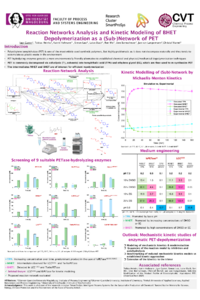
Polyethylene terephthalate (PET) is widely used in fibers, films, and containers. Due to the low cost of virgin PET and the inferior properties of recycled PET [1-3], recycling remains economically unattractive in many regions [4]. Consequently, large amounts of PET are incinerated or end up in the environment, causing significant ecological damage [5]. Enzymatic depolymerization offers a sustainable alternative with mild conditions, energy efficiency, and environmental benefits [4]. While most studies focus on total depolymerization to terephthalic acid (TPA), this work targets the selective production of intermediates such as MHET and BHET, which are increasingly in demand for PET re-synthesis [6].
Experimental and Modeling
Two enzymes identified from prior screenings [6] were tested in different reaction media to analyze their effects on kinetics, equilibria, and product distribution. Ethylene glycol and DMSO shifted the product spectrum toward MHET. Mechanistic kinetic modeling, considering substrate, enzyme, and product inhibition, was performed to describe the reaction sub-network of BHET depolymerization with high accuracy.
Results and Outlook
A simplified reaction network for enzymatic PET depolymerization was established based on HPLC analysis. Reaction kinetics for BHET depolymerization were successfully modeled, providing a foundation for process design and optimization. Future work will extend the modeling to trimers and dimers and adapt the findings to PEF systems.
Keywords
Reaction Network Analysis Kinetic Modeling
Poster
ECCS_2025_IGOR_GAMM.pdf
Juniperus brevifolia as a potential biomass source for the construction of efficient oxygen (electro)catalysts
Screening biocatalysts for the selective enzymatic separation of polyester blends