Event submissions
Published
This submission belongs to the session E. Biocatalysis of the event The 3rd International Electronic Conference on Catalysis Sciences
Published date
21 Apr, 2025
Academic Editor
'%3e%3cpath%20d='M12.6657%2010.9104C12.4185%2010.325%2012.0599%209.79327%2011.6097%209.34482C11.1609%208.89508%2010.6293%208.5365%2010.0442%208.28888C10.0389%208.28626%2010.0337%208.28495%2010.0285%208.28233C10.8446%207.69279%2011.3752%206.73249%2011.3752%205.64904C11.3752%203.8542%209.92103%202.39999%208.1262%202.39999C6.33136%202.39999%204.87715%203.8542%204.87715%205.64904C4.87715%206.73249%205.40774%207.69279%206.22393%208.28364C6.21869%208.28626%206.21345%208.28757%206.20821%208.29019C5.62129%208.5378%205.09463%208.89284%204.64265%209.34613C4.1929%209.79493%203.83432%2010.3266%203.58671%2010.9117C3.34345%2011.4845%203.21226%2012.0987%203.20023%2012.7209C3.19988%2012.7349%203.20233%2012.7488%203.20744%2012.7619C3.21255%2012.7749%203.22022%2012.7867%203.22998%2012.7968C3.23975%2012.8068%203.25142%2012.8147%203.26431%2012.8202C3.2772%2012.8256%203.29105%2012.8284%203.30504%2012.8284H4.09109C4.14874%2012.8284%204.19459%2012.7825%204.1959%2012.7262C4.2221%2011.7148%204.62823%2010.7676%205.34617%2010.0497C6.08899%209.30683%207.0755%208.89808%208.1262%208.89808C9.17689%208.89808%2010.1634%209.30683%2010.9062%2010.0497C11.6242%2010.7676%2012.0303%2011.7148%2012.0565%2012.7262C12.0578%2012.7838%2012.1037%2012.8284%2012.1613%2012.8284H12.9474C12.9613%2012.8284%2012.9752%2012.8256%2012.9881%2012.8202C13.001%2012.8147%2013.0126%2012.8068%2013.0224%2012.7968C13.0322%2012.7867%2013.0398%2012.7749%2013.0449%2012.7619C13.0501%2012.7488%2013.0525%2012.7349%2013.0522%2012.7209C13.0391%2012.0947%2012.9094%2011.4855%2012.6657%2010.9104ZM8.1262%207.9024C7.52486%207.9024%206.9589%207.6679%206.53312%207.24211C6.10733%206.81633%205.87283%206.25037%205.87283%205.64904C5.87283%205.0477%206.10733%204.48174%206.53312%204.05596C6.9589%203.63018%207.52486%203.39567%208.1262%203.39567C8.72753%203.39567%209.29349%203.63018%209.71927%204.05596C10.1451%204.48174%2010.3796%205.0477%2010.3796%205.64904C10.3796%206.25037%2010.1451%206.81633%209.71927%207.24211C9.29349%207.6679%208.72753%207.9024%208.1262%207.9024Z'%20fill='%235D1EE1'/%3e%3c/g%3e%3c/svg%3e) Frank Hollmann
Frank HollmannCitation
Konstantinos Makryniotis, Efstratios Nikolaivits, Evangelos Topakas, Screening biocatalysts for the selective enzymatic separation of polyester blends , in Proceedings of The 3rd International Electronic Conference on Catalysis Sciences, 23 April–25 April 2025, MDPI: Basel, Switzerland
Share
Email
Facebook
Twitter
LinkedIn
Screening biocatalysts for the selective enzymatic separation of polyester blends
'%3e%3cpath%20d='M12.6647%2010.9104C12.4176%2010.325%2012.0589%209.7933%2011.6088%209.34485C11.16%208.89511%2010.6283%208.53653%2010.0432%208.28891C10.038%208.28629%2010.0327%208.28498%2010.0275%208.28236C10.8437%207.69282%2011.3743%206.73252%2011.3743%205.64907C11.3743%203.85423%209.92005%202.40002%208.12522%202.40002C6.33038%202.40002%204.87618%203.85423%204.87618%205.64907C4.87618%206.73252%205.40677%207.69282%206.22296%208.28367C6.21772%208.28629%206.21248%208.2876%206.20724%208.29022C5.62031%208.53783%205.09365%208.89287%204.64167%209.34616C4.19192%209.79496%203.83334%2010.3266%203.58573%2010.9117C3.34247%2011.4846%203.21128%2012.0987%203.19925%2012.721C3.1989%2012.735%203.20135%2012.7489%203.20646%2012.7619C3.21157%2012.7749%203.21924%2012.7868%203.22901%2012.7968C3.23877%2012.8068%203.25045%2012.8148%203.26334%2012.8202C3.27623%2012.8256%203.29007%2012.8284%203.30406%2012.8284H4.09012C4.14776%2012.8284%204.19362%2012.7825%204.19493%2012.7262C4.22113%2011.7148%204.62726%2010.7676%205.34519%2010.0497C6.08802%209.30686%207.07452%208.89811%208.12522%208.89811C9.17592%208.89811%2010.1624%209.30686%2010.9052%2010.0497C11.6232%2010.7676%2012.0293%2011.7148%2012.0555%2012.7262C12.0568%2012.7839%2012.1027%2012.8284%2012.1603%2012.8284H12.9464C12.9604%2012.8284%2012.9742%2012.8256%2012.9871%2012.8202C13%2012.8148%2013.0117%2012.8068%2013.0214%2012.7968C13.0312%2012.7868%2013.0389%2012.7749%2013.044%2012.7619C13.0491%2012.7489%2013.0515%2012.735%2013.0512%2012.721C13.0381%2012.0947%2012.9084%2011.4856%2012.6647%2010.9104ZM8.12522%207.90243C7.52388%207.90243%206.95792%207.66793%206.53214%207.24215C6.10636%206.81636%205.87185%206.2504%205.87185%205.64907C5.87185%205.04773%206.10636%204.48177%206.53214%204.05599C6.95792%203.63021%207.52388%203.3957%208.12522%203.3957C8.72655%203.3957%209.29252%203.63021%209.7183%204.05599C10.1441%204.48177%2010.3786%205.04773%2010.3786%205.64907C10.3786%206.2504%2010.1441%206.81636%209.7183%207.24215C9.29252%207.66793%208.72655%207.90243%208.12522%207.90243Z'%20fill='%235D1EE1'/%3e%3c/g%3e%3c/svg%3e)
Konstantinos Makryniotis 1
Efstratios Nikolaivits 1

Evangelos Topakas 1
1. National Technical University of Athens, Industrial Biotechnology & Biocatalysis Group, School of Chemical Engineering, Athens, Greece
Abstract
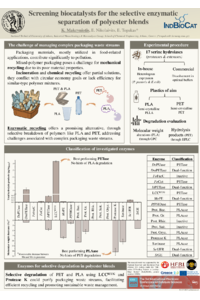
Packaging materials account for 40% of Europe’s annual 50 million tons of plastic demand, and are primarily used in food applications. Their short lifespan and increasing usecontribute significantly to environmental pollution. Mechanical recycling addresses only a small portion of food packaging waste due to the complexity of mixed-polymer packaging. These unsorted blends exhibit poor mechanical, thermal, and optical properties, rendering conventional recycling methods inefficient. Although incineration provides energy recovery, it contradicts circular economy principles, while chemical recycling lacks economic feasibility and fails in specificity for plastic mixtures containing polymers of the same type, such as polyesters. Enzymatic recycling offers a promising, sustainable alternative. This selective depolymerization method can address challenges associated with complex packaging waste streams by enabling the targeted breakdown of polymers like PLA and PET.
Herein, 17 serine hydrolase enzymes (esterases and proteases), both in-house and commercial, were investigated for their specificity in polyester degradation. In-house enzymes were heterologously expressed in Escherichia coli or Pichia pastoris and their degradation potential was tested through reactions with semi-crystalline PET and two PLA grades: semi-crystalline PLLA and amorphous PDLLA. The degradation yield was evaluated by measuring the variation in molecular weight, through Gel Permeation Chromatography (GPC) for PLA and the concentration of hydrolysis products, and through High Performance Liquid Chromatography (HPLC) for PET.
The results show that most esterases cannot distinguish between PET and PLA, while proteases are specific to PLA. LCCICCG was the most efficient PETase (15 μgprod/mgPET) that could not degrade PLA, while Protease K and Savinase effectively degraded both amorphous (Mw,reduction = 16.5 %) and semi-crystalline (Mw,reduction = 28.2 %) PLA, respectively, but not PET.
Consequently, the treatment of packaging waste streams with the aforementioned PETase and PLAases could lead to the selective degradation of these polymers, purifying the mixture and facilitating further recycling, providing a sustainable pathway for advancing plastic waste management.
Keywords
enzymatic degradation
hydrolases
polyesters
plastic waste
Poster
ECCS25_Makryniotis Konstantinos-Poster.pdf
Reaction Network Analysis and Kinetic Modeling of BHET Depolymerization as (Sub-)Network of PET
Comparing the secretome response of Aspergillus and Fusarium species on chemically treated plastics