Event submissions
Published
This submission belongs to the session E. Biocatalysis of the event The 3rd International Electronic Conference on Catalysis Sciences
Published date
21 Apr, 2025
Academic Editor
'%3e%3cpath%20d='M12.6657%2010.9104C12.4185%2010.325%2012.0599%209.79327%2011.6097%209.34482C11.1609%208.89508%2010.6293%208.5365%2010.0442%208.28888C10.0389%208.28626%2010.0337%208.28495%2010.0285%208.28233C10.8446%207.69279%2011.3752%206.73249%2011.3752%205.64904C11.3752%203.8542%209.92103%202.39999%208.1262%202.39999C6.33136%202.39999%204.87715%203.8542%204.87715%205.64904C4.87715%206.73249%205.40774%207.69279%206.22393%208.28364C6.21869%208.28626%206.21345%208.28757%206.20821%208.29019C5.62129%208.5378%205.09463%208.89284%204.64265%209.34613C4.1929%209.79493%203.83432%2010.3266%203.58671%2010.9117C3.34345%2011.4845%203.21226%2012.0987%203.20023%2012.7209C3.19988%2012.7349%203.20233%2012.7488%203.20744%2012.7619C3.21255%2012.7749%203.22022%2012.7867%203.22998%2012.7968C3.23975%2012.8068%203.25142%2012.8147%203.26431%2012.8202C3.2772%2012.8256%203.29105%2012.8284%203.30504%2012.8284H4.09109C4.14874%2012.8284%204.19459%2012.7825%204.1959%2012.7262C4.2221%2011.7148%204.62823%2010.7676%205.34617%2010.0497C6.08899%209.30683%207.0755%208.89808%208.1262%208.89808C9.17689%208.89808%2010.1634%209.30683%2010.9062%2010.0497C11.6242%2010.7676%2012.0303%2011.7148%2012.0565%2012.7262C12.0578%2012.7838%2012.1037%2012.8284%2012.1613%2012.8284H12.9474C12.9613%2012.8284%2012.9752%2012.8256%2012.9881%2012.8202C13.001%2012.8147%2013.0126%2012.8068%2013.0224%2012.7968C13.0322%2012.7867%2013.0398%2012.7749%2013.0449%2012.7619C13.0501%2012.7488%2013.0525%2012.7349%2013.0522%2012.7209C13.0391%2012.0947%2012.9094%2011.4855%2012.6657%2010.9104ZM8.1262%207.9024C7.52486%207.9024%206.9589%207.6679%206.53312%207.24211C6.10733%206.81633%205.87283%206.25037%205.87283%205.64904C5.87283%205.0477%206.10733%204.48174%206.53312%204.05596C6.9589%203.63018%207.52486%203.39567%208.1262%203.39567C8.72753%203.39567%209.29349%203.63018%209.71927%204.05596C10.1451%204.48174%2010.3796%205.0477%2010.3796%205.64904C10.3796%206.25037%2010.1451%206.81633%209.71927%207.24211C9.29349%207.6679%208.72753%207.9024%208.1262%207.9024Z'%20fill='%235D1EE1'/%3e%3c/g%3e%3c/svg%3e) Frank Hollmann
Frank HollmannCitation
Evangelia Loukia Giouroukou, Angeliki Koutouvali, Romanos Siaperas, Martina Samiotaki, Vassileios Daskalopoulos, George I. Zervakis, Evangelos Topakas, Anthi Karnaouri, Exploiting basidiomycetes and their enzymatic systems for the degradation of synthetic polymers, in Proceedings of The 3rd International Electronic Conference on Catalysis Sciences, 23 April–25 April 2025, MDPI: Basel, Switzerland
Share
Email
Facebook
Twitter
LinkedIn
Exploiting basidiomycetes and their enzymatic systems for the degradation of synthetic polymers
'%3e%3cpath%20d='M12.6647%2010.9104C12.4176%2010.325%2012.0589%209.7933%2011.6088%209.34485C11.16%208.89511%2010.6283%208.53653%2010.0432%208.28891C10.038%208.28629%2010.0327%208.28498%2010.0275%208.28236C10.8437%207.69282%2011.3743%206.73252%2011.3743%205.64907C11.3743%203.85423%209.92005%202.40002%208.12522%202.40002C6.33038%202.40002%204.87618%203.85423%204.87618%205.64907C4.87618%206.73252%205.40677%207.69282%206.22296%208.28367C6.21772%208.28629%206.21248%208.2876%206.20724%208.29022C5.62031%208.53783%205.09365%208.89287%204.64167%209.34616C4.19192%209.79496%203.83334%2010.3266%203.58573%2010.9117C3.34247%2011.4846%203.21128%2012.0987%203.19925%2012.721C3.1989%2012.735%203.20135%2012.7489%203.20646%2012.7619C3.21157%2012.7749%203.21924%2012.7868%203.22901%2012.7968C3.23877%2012.8068%203.25045%2012.8148%203.26334%2012.8202C3.27623%2012.8256%203.29007%2012.8284%203.30406%2012.8284H4.09012C4.14776%2012.8284%204.19362%2012.7825%204.19493%2012.7262C4.22113%2011.7148%204.62726%2010.7676%205.34519%2010.0497C6.08802%209.30686%207.07452%208.89811%208.12522%208.89811C9.17592%208.89811%2010.1624%209.30686%2010.9052%2010.0497C11.6232%2010.7676%2012.0293%2011.7148%2012.0555%2012.7262C12.0568%2012.7839%2012.1027%2012.8284%2012.1603%2012.8284H12.9464C12.9604%2012.8284%2012.9742%2012.8256%2012.9871%2012.8202C13%2012.8148%2013.0117%2012.8068%2013.0214%2012.7968C13.0312%2012.7868%2013.0389%2012.7749%2013.044%2012.7619C13.0491%2012.7489%2013.0515%2012.735%2013.0512%2012.721C13.0381%2012.0947%2012.9084%2011.4856%2012.6647%2010.9104ZM8.12522%207.90243C7.52388%207.90243%206.95792%207.66793%206.53214%207.24215C6.10636%206.81636%205.87185%206.2504%205.87185%205.64907C5.87185%205.04773%206.10636%204.48177%206.53214%204.05599C6.95792%203.63021%207.52388%203.3957%208.12522%203.3957C8.72655%203.3957%209.29252%203.63021%209.7183%204.05599C10.1441%204.48177%2010.3786%205.04773%2010.3786%205.64907C10.3786%206.2504%2010.1441%206.81636%209.7183%207.24215C9.29252%207.66793%208.72655%207.90243%208.12522%207.90243Z'%20fill='%235D1EE1'/%3e%3c/g%3e%3c/svg%3e)
Evangelia Loukia Giouroukou 1
Angeliki Koutouvali 1
Romanos Siaperas 2
Martina Samiotaki 3
Vassileios Daskalopoulos 1
George I. Zervakis 1

Evangelos Topakas 2

Anthi Karnaouri 1
1. Laboratory of General and Agricultural Microbiology, Department of Crop Science, Agricultural University of Athens, 11855, Greece
2. Industrial Biotechnology & Biocatalysis Group, Biotechnology Laboratory, School of Chemical Engineering, National Technical University of Athens, 15772, Greece
3. Institute for Bio-Innovation, Biomedical Sciences Research Center "Alexander Fleming", 16672, Greece
Abstract
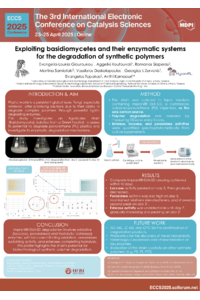
The increasing environmental burden of synthetic polymer waste has intensified the need for sustainable solutions to plastic pollution [1]. Microbial enzymes, particularly those from fungal strains, are emerging as promising biotechnological tools for waste circularity [2]. White-rot fungi, known for producing ligninolytic enzymes (oxidases and hydrolases), can degrade complex polymers (lignin, cutin, waxes, plastics) by disrupting their chemical structure [3,4]. This study investigates a strain of the order Agaricales (Basidiomycota), previously isolated from a Greek habitat and identified through ITS rRNA gene sequencing, that has shown great potential for plant-litter degradation but remains largely unexplored in terms of the depolymerization of xenobiotic polymers (plastics). The strain was tested for its ability to grow on polyester- or polyether-polyurethane (Impranil® DLN-SD, Impranil® DL 2077) as the sole carbon source, demonstrating efficient substrate degradation and high biomass yield. To explore the underlying biodegradation mechanism, a spectrophotometric assessment of extracellular enzymatic activities (hydrolases and oxidative enzymes) on Impranil® DLN-SD culture supernatants was performed; the results indicated high oxidative enzyme activity. Substrate modifications were detected through attenuated total reflectance–Fourier-transform infrared spectroscopy (ATR-FTIR), while gas chromatography–mass spectrometry (GC-MS) analysis was performed to identify the biodegradation products. Proteomic analysis of culture supernatants was conducted to identify and quantify enzymes involved in polymer degradation. This study highlights the potential of this strain as an effective biocatalyst for polymer degradation, providing a sustainable approach to plastic waste management and byproduct valorization.
Keywords
Biocatalysis
Fungus
Microbial degradation
Enzymes
Plastics
Polyurethane
Poster
ECCS_poster 24.04.pdf
Use of DERA in Development of Novel N-heterocycle-based Statin Precursors
Enzymatic oxidation of lignocellulosic biomass-derived furans using novel redox biocatalysts