Event submissions
Published
This submission belongs to the session E. Biocatalysis of the event The 3rd International Electronic Conference on Catalysis Sciences
Published date
21 Apr, 2025
Academic Editor
'%3e%3cpath%20d='M12.6657%2010.9104C12.4185%2010.325%2012.0599%209.79327%2011.6097%209.34482C11.1609%208.89508%2010.6293%208.5365%2010.0442%208.28888C10.0389%208.28626%2010.0337%208.28495%2010.0285%208.28233C10.8446%207.69279%2011.3752%206.73249%2011.3752%205.64904C11.3752%203.8542%209.92103%202.39999%208.1262%202.39999C6.33136%202.39999%204.87715%203.8542%204.87715%205.64904C4.87715%206.73249%205.40774%207.69279%206.22393%208.28364C6.21869%208.28626%206.21345%208.28757%206.20821%208.29019C5.62129%208.5378%205.09463%208.89284%204.64265%209.34613C4.1929%209.79493%203.83432%2010.3266%203.58671%2010.9117C3.34345%2011.4845%203.21226%2012.0987%203.20023%2012.7209C3.19988%2012.7349%203.20233%2012.7488%203.20744%2012.7619C3.21255%2012.7749%203.22022%2012.7867%203.22998%2012.7968C3.23975%2012.8068%203.25142%2012.8147%203.26431%2012.8202C3.2772%2012.8256%203.29105%2012.8284%203.30504%2012.8284H4.09109C4.14874%2012.8284%204.19459%2012.7825%204.1959%2012.7262C4.2221%2011.7148%204.62823%2010.7676%205.34617%2010.0497C6.08899%209.30683%207.0755%208.89808%208.1262%208.89808C9.17689%208.89808%2010.1634%209.30683%2010.9062%2010.0497C11.6242%2010.7676%2012.0303%2011.7148%2012.0565%2012.7262C12.0578%2012.7838%2012.1037%2012.8284%2012.1613%2012.8284H12.9474C12.9613%2012.8284%2012.9752%2012.8256%2012.9881%2012.8202C13.001%2012.8147%2013.0126%2012.8068%2013.0224%2012.7968C13.0322%2012.7867%2013.0398%2012.7749%2013.0449%2012.7619C13.0501%2012.7488%2013.0525%2012.7349%2013.0522%2012.7209C13.0391%2012.0947%2012.9094%2011.4855%2012.6657%2010.9104ZM8.1262%207.9024C7.52486%207.9024%206.9589%207.6679%206.53312%207.24211C6.10733%206.81633%205.87283%206.25037%205.87283%205.64904C5.87283%205.0477%206.10733%204.48174%206.53312%204.05596C6.9589%203.63018%207.52486%203.39567%208.1262%203.39567C8.72753%203.39567%209.29349%203.63018%209.71927%204.05596C10.1451%204.48174%2010.3796%205.0477%2010.3796%205.64904C10.3796%206.25037%2010.1451%206.81633%209.71927%207.24211C9.29349%207.6679%208.72753%207.9024%208.1262%207.9024Z'%20fill='%235D1EE1'/%3e%3c/g%3e%3c/svg%3e) Frank Hollmann
Frank HollmannCitation
Maria Konstantina Karonidi, Panagiotis Ktenas, Asimina Marianou, Evangelia-Loukia Giouroukou, Κoar Chorozian, Angelos Lappas, Evangelos Topakas, Anthi Karnaouri, Enzymatic oxidation of lignocellulosic biomass-derived furans using novel redox biocatalysts, in Proceedings of The 3rd International Electronic Conference on Catalysis Sciences, 23 April–25 April 2025, MDPI: Basel, Switzerland
Share
Email
Facebook
Twitter
LinkedIn
Enzymatic oxidation of lignocellulosic biomass-derived furans using novel redox biocatalysts
'%3e%3cpath%20d='M12.6647%2010.9104C12.4176%2010.325%2012.0589%209.7933%2011.6088%209.34485C11.16%208.89511%2010.6283%208.53653%2010.0432%208.28891C10.038%208.28629%2010.0327%208.28498%2010.0275%208.28236C10.8437%207.69282%2011.3743%206.73252%2011.3743%205.64907C11.3743%203.85423%209.92005%202.40002%208.12522%202.40002C6.33038%202.40002%204.87618%203.85423%204.87618%205.64907C4.87618%206.73252%205.40677%207.69282%206.22296%208.28367C6.21772%208.28629%206.21248%208.2876%206.20724%208.29022C5.62031%208.53783%205.09365%208.89287%204.64167%209.34616C4.19192%209.79496%203.83334%2010.3266%203.58573%2010.9117C3.34247%2011.4846%203.21128%2012.0987%203.19925%2012.721C3.1989%2012.735%203.20135%2012.7489%203.20646%2012.7619C3.21157%2012.7749%203.21924%2012.7868%203.22901%2012.7968C3.23877%2012.8068%203.25045%2012.8148%203.26334%2012.8202C3.27623%2012.8256%203.29007%2012.8284%203.30406%2012.8284H4.09012C4.14776%2012.8284%204.19362%2012.7825%204.19493%2012.7262C4.22113%2011.7148%204.62726%2010.7676%205.34519%2010.0497C6.08802%209.30686%207.07452%208.89811%208.12522%208.89811C9.17592%208.89811%2010.1624%209.30686%2010.9052%2010.0497C11.6232%2010.7676%2012.0293%2011.7148%2012.0555%2012.7262C12.0568%2012.7839%2012.1027%2012.8284%2012.1603%2012.8284H12.9464C12.9604%2012.8284%2012.9742%2012.8256%2012.9871%2012.8202C13%2012.8148%2013.0117%2012.8068%2013.0214%2012.7968C13.0312%2012.7868%2013.0389%2012.7749%2013.044%2012.7619C13.0491%2012.7489%2013.0515%2012.735%2013.0512%2012.721C13.0381%2012.0947%2012.9084%2011.4856%2012.6647%2010.9104ZM8.12522%207.90243C7.52388%207.90243%206.95792%207.66793%206.53214%207.24215C6.10636%206.81636%205.87185%206.2504%205.87185%205.64907C5.87185%205.04773%206.10636%204.48177%206.53214%204.05599C6.95792%203.63021%207.52388%203.3957%208.12522%203.3957C8.72655%203.3957%209.29252%203.63021%209.7183%204.05599C10.1441%204.48177%2010.3786%205.04773%2010.3786%205.64907C10.3786%206.2504%2010.1441%206.81636%209.7183%207.24215C9.29252%207.66793%208.72655%207.90243%208.12522%207.90243Z'%20fill='%235D1EE1'/%3e%3c/g%3e%3c/svg%3e)
Maria Konstantina Karonidi 1
Panagiotis Ktenas 1
Asimina Marianou 2
Evangelia-Loukia Giouroukou 1
Κoar Chorozian 3

Angelos Lappas 2

Evangelos Topakas 3

Anthi Karnaouri 1
1. Laboratory of General and Agricultural Microbiology, Department of Crop Science, Agricultural University of Athens, 11855, Athens, Greece
2. Chemical Process and Energy Resources Institute (CPERI), Centre for Research and Technology Hellas (CERTH), 57001, Thessaloniki, Greece
3. Industrial Biotechnology & Biocatalysis Group, Biotechnology Laboratory, School of Chemical Engineering, National Technical University of Athens, 15772, Athens, Greece
Abstract
Lignocellulosic biomass, a readily available and abundant organic material, is an ideal source of high-value compounds that can replace petroleum-based products. Among these, 5-hydroxymethylfurfural (HMF), obtained by the catalytic dehydration of biomass sugars [1], is a significant intermediate that can be converted into valuable compounds, including 2,5-furandicarboxylic acid (FDCA), a promising precursor for biopolymers [2]. Biocatalysis offers an environmentally friendly and efficient alternative to traditional chemical methods [3-5]. This study explores the biotransformation of HMF towards its oxidized derivatives using novel fungal enzymes from the Auxiliary Activity family AA5 of the CAZy database. Using the targeted exploration of fungal genomes, two promising enzymes, a glyoxal oxidase (GlGlyOx) and a galactose oxidase (FoGalOx), were identified and expressed heterologously in Pichia pastoris. The recombinant proteins were purified and tested for their ability to oxidize model furans (HMF and its derivative compounds). Our results reveal that both enzymes facilitate the production of oxidized monomers, with GlGlyOx showing efficiency in the biotransformation of HMF to 5-hydroxy-2-furancarboxylic acid (HMFCA) and furan-2,5-dicarbaldehyde (DFF) to 5- formylfurancarboxylic acid (FFCA), while FoGalOx was more efficient in oxidizing HMF to DFF and HMFCA to FFCA. The enzymes were also tested for their ability to transform HMF obtained from real biomass hydrolysates from OxiOrganosolv pretreated wheat straw pulps [6] via enzymatic saccharification and isomerization, followed by catalytic dehydration in mild conditions. Various acidic catalysts, including homogeneous (heteropolyacids, organic acids) and heterogeneous (zeolites, supported heteropolyacids) systems, were evaluated for their efficiency in dehydrating sugars to furans. The results highlight that the type and ratio of Brønsted to Lewis acidity play a key role in determining the reaction pathways for sugar conversion, significantly influencing the product distribution. This work demonstrates the potential of enzymatic biotransformation as a sustainable route for converting lignocellulosic biomass into valuable chemicals for green polymer production and other industrial applications.
Keywords
biocatalysis
oxidoreductases
furan derivatives
HMF
FDCA
lignocellulose valorisation
heterogeneous catalysis
fructose dehydration
Poster
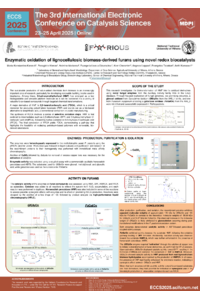
Poster_ECCS_2025_Karonidi.pdf
Exploiting basidiomycetes and their enzymatic systems for the degradation of synthetic polymers
Oxidation of Malachite Green by Illite Impregnated with Iron/Indium