Event submissions
Published
This submission belongs to the session F. Biomass Catalysis of the event The 3rd International Electronic Conference on Catalysis Sciences
Published date
21 Apr, 2025
Academic Editor
'%3e%3cpath%20d='M12.6657%2010.9104C12.4185%2010.325%2012.0599%209.79327%2011.6097%209.34482C11.1609%208.89508%2010.6293%208.5365%2010.0442%208.28888C10.0389%208.28626%2010.0337%208.28495%2010.0285%208.28233C10.8446%207.69279%2011.3752%206.73249%2011.3752%205.64904C11.3752%203.8542%209.92103%202.39999%208.1262%202.39999C6.33136%202.39999%204.87715%203.8542%204.87715%205.64904C4.87715%206.73249%205.40774%207.69279%206.22393%208.28364C6.21869%208.28626%206.21345%208.28757%206.20821%208.29019C5.62129%208.5378%205.09463%208.89284%204.64265%209.34613C4.1929%209.79493%203.83432%2010.3266%203.58671%2010.9117C3.34345%2011.4845%203.21226%2012.0987%203.20023%2012.7209C3.19988%2012.7349%203.20233%2012.7488%203.20744%2012.7619C3.21255%2012.7749%203.22022%2012.7867%203.22998%2012.7968C3.23975%2012.8068%203.25142%2012.8147%203.26431%2012.8202C3.2772%2012.8256%203.29105%2012.8284%203.30504%2012.8284H4.09109C4.14874%2012.8284%204.19459%2012.7825%204.1959%2012.7262C4.2221%2011.7148%204.62823%2010.7676%205.34617%2010.0497C6.08899%209.30683%207.0755%208.89808%208.1262%208.89808C9.17689%208.89808%2010.1634%209.30683%2010.9062%2010.0497C11.6242%2010.7676%2012.0303%2011.7148%2012.0565%2012.7262C12.0578%2012.7838%2012.1037%2012.8284%2012.1613%2012.8284H12.9474C12.9613%2012.8284%2012.9752%2012.8256%2012.9881%2012.8202C13.001%2012.8147%2013.0126%2012.8068%2013.0224%2012.7968C13.0322%2012.7867%2013.0398%2012.7749%2013.0449%2012.7619C13.0501%2012.7488%2013.0525%2012.7349%2013.0522%2012.7209C13.0391%2012.0947%2012.9094%2011.4855%2012.6657%2010.9104ZM8.1262%207.9024C7.52486%207.9024%206.9589%207.6679%206.53312%207.24211C6.10733%206.81633%205.87283%206.25037%205.87283%205.64904C5.87283%205.0477%206.10733%204.48174%206.53312%204.05596C6.9589%203.63018%207.52486%203.39567%208.1262%203.39567C8.72753%203.39567%209.29349%203.63018%209.71927%204.05596C10.1451%204.48174%2010.3796%205.0477%2010.3796%205.64904C10.3796%206.25037%2010.1451%206.81633%209.71927%207.24211C9.29349%207.6679%208.72753%207.9024%208.1262%207.9024Z'%20fill='%235D1EE1'/%3e%3c/g%3e%3c/svg%3e) Francesco Mauriello
Francesco MaurielloCitation
Nataliia Nastasiienko, Tetiana Kulik, Borys Palianytsia, Thermal decomposition of 4-methoxy cinnamic acid over nanoceria, in Proceedings of The 3rd International Electronic Conference on Catalysis Sciences, 23 April–25 April 2025, MDPI: Basel, Switzerland
Share
Email
Facebook
Twitter
LinkedIn
Thermal decomposition of 4-methoxy cinnamic acid over nanoceria
'%3e%3cpath%20d='M12.6647%2010.9104C12.4176%2010.325%2012.0589%209.7933%2011.6088%209.34485C11.16%208.89511%2010.6283%208.53653%2010.0432%208.28891C10.038%208.28629%2010.0327%208.28498%2010.0275%208.28236C10.8437%207.69282%2011.3743%206.73252%2011.3743%205.64907C11.3743%203.85423%209.92005%202.40002%208.12522%202.40002C6.33038%202.40002%204.87618%203.85423%204.87618%205.64907C4.87618%206.73252%205.40677%207.69282%206.22296%208.28367C6.21772%208.28629%206.21248%208.2876%206.20724%208.29022C5.62031%208.53783%205.09365%208.89287%204.64167%209.34616C4.19192%209.79496%203.83334%2010.3266%203.58573%2010.9117C3.34247%2011.4846%203.21128%2012.0987%203.19925%2012.721C3.1989%2012.735%203.20135%2012.7489%203.20646%2012.7619C3.21157%2012.7749%203.21924%2012.7868%203.22901%2012.7968C3.23877%2012.8068%203.25045%2012.8148%203.26334%2012.8202C3.27623%2012.8256%203.29007%2012.8284%203.30406%2012.8284H4.09012C4.14776%2012.8284%204.19362%2012.7825%204.19493%2012.7262C4.22113%2011.7148%204.62726%2010.7676%205.34519%2010.0497C6.08802%209.30686%207.07452%208.89811%208.12522%208.89811C9.17592%208.89811%2010.1624%209.30686%2010.9052%2010.0497C11.6232%2010.7676%2012.0293%2011.7148%2012.0555%2012.7262C12.0568%2012.7839%2012.1027%2012.8284%2012.1603%2012.8284H12.9464C12.9604%2012.8284%2012.9742%2012.8256%2012.9871%2012.8202C13%2012.8148%2013.0117%2012.8068%2013.0214%2012.7968C13.0312%2012.7868%2013.0389%2012.7749%2013.044%2012.7619C13.0491%2012.7489%2013.0515%2012.735%2013.0512%2012.721C13.0381%2012.0947%2012.9084%2011.4856%2012.6647%2010.9104ZM8.12522%207.90243C7.52388%207.90243%206.95792%207.66793%206.53214%207.24215C6.10636%206.81636%205.87185%206.2504%205.87185%205.64907C5.87185%205.04773%206.10636%204.48177%206.53214%204.05599C6.95792%203.63021%207.52388%203.3957%208.12522%203.3957C8.72655%203.3957%209.29252%203.63021%209.7183%204.05599C10.1441%204.48177%2010.3786%205.04773%2010.3786%205.64907C10.3786%206.2504%2010.1441%206.81636%209.7183%207.24215C9.29252%207.66793%208.72655%207.90243%208.12522%207.90243Z'%20fill='%235D1EE1'/%3e%3c/g%3e%3c/svg%3e)
Nataliia Nastasiienko 1
Tetiana Kulik 1,2
Borys Palianytsia 1
1. Laboratory of Kinetics and Mechanisms of Chemical Transformations on Solids Surface, Chuiko Institute of Surface Chemistry, NAS of Ukraine, Kyiv 03164, Ukraine
2. Cardiff Catalysis Institute, School of Chemistry, Cardiff University, Cardiff, CF24 4HQ, UK
Abstract
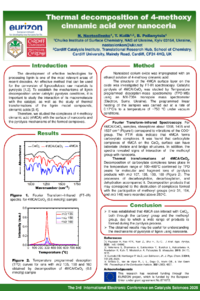
The development of effective technologies for processing lignin has become a main area of interest in recent decades. An effective method that can be used for the conversion of lignocellulosic raw materials is pyrolysis. To establish the mechanisms of lignin decomposition under catalytic pyrolysis conditions, it is important to study the interaction of its macromolecule with the catalyst, as well as to study the thermal transformations of the lignin model compounds, cinnamic acids. Therefore, we studied the complexes of 4-methoxy cinnamic acid (4MCA) with the surface of nanoceria and the pyrolysis mechanisms of the formed complexes. The catalyst was impregnated with an ethanol solution of 4MCA. The obtained samples were investigated using the IR–Fourier spectroscopy method. Their thermal transformations were investigated using temperature-programmed desorption mass spectrometry using a МKH-7304А monopole mass spectrometer (Sumy, Ukraine) with electron impact ionization, which was adapted for thermodesorption measurements. In the 4MCA/СеО2 samples, absorptions were detected at about 1398, 1495, and 1537 cm‒1, which corresponded to the vibrations of the СОО‒ group. The FTIR data indicate that 4MCA forms carboxylate complexes with bidentate bridge and chelate structures. In addition, the spectra revealed signs of interaction of the methoxyl group with nanoceria. Thermal decomposition of carboxylate complexes takes place in the temperature range of 100оС‒400оС, which was confirmed based on the TPD peaks for the molecular and fragment ions of the pyrolysis products with m/z 107, 135, 150, and 160. The processes of decarbonylation, decarboxylation, and dehydration accompanied it. Decomposition products that may correspond to the destruction of complexes formed with the participation of methoxyl groups (m/z 31, 148, 164) when recorded above 250oС. The obtained results may be useful for understanding the mechanisms of pyrolysis of lignin using nanoceria.
Acknowledgments
This research has received funding through the EURIZON project, which is funded by the European Union under grant agreement No.871072.
Keywords
surface complexes
catalysis
pyrolysis
biomass
lignin
conversion
IR-Fourier spectroscopy
Poster
Nastasiienko.pdf
A novel xyloglucanase from the white rot fungus Abortiporus biennis and its potential role as an accessory biocatalyst in the enzymatic degradation of xyloglucan-contianing substrates
Emerging Catalysts and Techniques in Microalgae-Based Biodiesel Production