Event submissions
Published
This submission belongs to the session F. Biomass Catalysis of the event The 3rd International Electronic Conference on Catalysis Sciences
Published date
21 Apr, 2025
Academic Editor
'%3e%3cpath%20d='M12.6657%2010.9104C12.4185%2010.325%2012.0599%209.79327%2011.6097%209.34482C11.1609%208.89508%2010.6293%208.5365%2010.0442%208.28888C10.0389%208.28626%2010.0337%208.28495%2010.0285%208.28233C10.8446%207.69279%2011.3752%206.73249%2011.3752%205.64904C11.3752%203.8542%209.92103%202.39999%208.1262%202.39999C6.33136%202.39999%204.87715%203.8542%204.87715%205.64904C4.87715%206.73249%205.40774%207.69279%206.22393%208.28364C6.21869%208.28626%206.21345%208.28757%206.20821%208.29019C5.62129%208.5378%205.09463%208.89284%204.64265%209.34613C4.1929%209.79493%203.83432%2010.3266%203.58671%2010.9117C3.34345%2011.4845%203.21226%2012.0987%203.20023%2012.7209C3.19988%2012.7349%203.20233%2012.7488%203.20744%2012.7619C3.21255%2012.7749%203.22022%2012.7867%203.22998%2012.7968C3.23975%2012.8068%203.25142%2012.8147%203.26431%2012.8202C3.2772%2012.8256%203.29105%2012.8284%203.30504%2012.8284H4.09109C4.14874%2012.8284%204.19459%2012.7825%204.1959%2012.7262C4.2221%2011.7148%204.62823%2010.7676%205.34617%2010.0497C6.08899%209.30683%207.0755%208.89808%208.1262%208.89808C9.17689%208.89808%2010.1634%209.30683%2010.9062%2010.0497C11.6242%2010.7676%2012.0303%2011.7148%2012.0565%2012.7262C12.0578%2012.7838%2012.1037%2012.8284%2012.1613%2012.8284H12.9474C12.9613%2012.8284%2012.9752%2012.8256%2012.9881%2012.8202C13.001%2012.8147%2013.0126%2012.8068%2013.0224%2012.7968C13.0322%2012.7867%2013.0398%2012.7749%2013.0449%2012.7619C13.0501%2012.7488%2013.0525%2012.7349%2013.0522%2012.7209C13.0391%2012.0947%2012.9094%2011.4855%2012.6657%2010.9104ZM8.1262%207.9024C7.52486%207.9024%206.9589%207.6679%206.53312%207.24211C6.10733%206.81633%205.87283%206.25037%205.87283%205.64904C5.87283%205.0477%206.10733%204.48174%206.53312%204.05596C6.9589%203.63018%207.52486%203.39567%208.1262%203.39567C8.72753%203.39567%209.29349%203.63018%209.71927%204.05596C10.1451%204.48174%2010.3796%205.0477%2010.3796%205.64904C10.3796%206.25037%2010.1451%206.81633%209.71927%207.24211C9.29349%207.6679%208.72753%207.9024%208.1262%207.9024Z'%20fill='%235D1EE1'/%3e%3c/g%3e%3c/svg%3e) Francesco Mauriello
Francesco MaurielloCitation
Partha Protim Borthakur, Pranjal Sarmah, Emerging Catalysts and Techniques in Microalgae-Based Biodiesel Production, in Proceedings of The 3rd International Electronic Conference on Catalysis Sciences, 23 April–25 April 2025, MDPI: Basel, Switzerland
Share
Email
Facebook
Twitter
LinkedIn
Emerging Catalysts and Techniques in Microalgae-Based Biodiesel Production

Partha Protim Borthakur 1
'%3e%3cpath%20d='M12.6647%2010.9104C12.4176%2010.325%2012.0589%209.7933%2011.6088%209.34485C11.16%208.89511%2010.6283%208.53653%2010.0432%208.28891C10.038%208.28629%2010.0327%208.28498%2010.0275%208.28236C10.8437%207.69282%2011.3743%206.73252%2011.3743%205.64907C11.3743%203.85423%209.92005%202.40002%208.12522%202.40002C6.33038%202.40002%204.87618%203.85423%204.87618%205.64907C4.87618%206.73252%205.40677%207.69282%206.22296%208.28367C6.21772%208.28629%206.21248%208.2876%206.20724%208.29022C5.62031%208.53783%205.09365%208.89287%204.64167%209.34616C4.19192%209.79496%203.83334%2010.3266%203.58573%2010.9117C3.34247%2011.4846%203.21128%2012.0987%203.19925%2012.721C3.1989%2012.735%203.20135%2012.7489%203.20646%2012.7619C3.21157%2012.7749%203.21924%2012.7868%203.22901%2012.7968C3.23877%2012.8068%203.25045%2012.8148%203.26334%2012.8202C3.27623%2012.8256%203.29007%2012.8284%203.30406%2012.8284H4.09012C4.14776%2012.8284%204.19362%2012.7825%204.19493%2012.7262C4.22113%2011.7148%204.62726%2010.7676%205.34519%2010.0497C6.08802%209.30686%207.07452%208.89811%208.12522%208.89811C9.17592%208.89811%2010.1624%209.30686%2010.9052%2010.0497C11.6232%2010.7676%2012.0293%2011.7148%2012.0555%2012.7262C12.0568%2012.7839%2012.1027%2012.8284%2012.1603%2012.8284H12.9464C12.9604%2012.8284%2012.9742%2012.8256%2012.9871%2012.8202C13%2012.8148%2013.0117%2012.8068%2013.0214%2012.7968C13.0312%2012.7868%2013.0389%2012.7749%2013.044%2012.7619C13.0491%2012.7489%2013.0515%2012.735%2013.0512%2012.721C13.0381%2012.0947%2012.9084%2011.4856%2012.6647%2010.9104ZM8.12522%207.90243C7.52388%207.90243%206.95792%207.66793%206.53214%207.24215C6.10636%206.81636%205.87185%206.2504%205.87185%205.64907C5.87185%205.04773%206.10636%204.48177%206.53214%204.05599C6.95792%203.63021%207.52388%203.3957%208.12522%203.3957C8.72655%203.3957%209.29252%203.63021%209.7183%204.05599C10.1441%204.48177%2010.3786%205.04773%2010.3786%205.64907C10.3786%206.2504%2010.1441%206.81636%209.7183%207.24215C9.29252%207.66793%208.72655%207.90243%208.12522%207.90243Z'%20fill='%235D1EE1'/%3e%3c/g%3e%3c/svg%3e)
Pranjal Sarmah 1
1. Mechanical Engineering Department, Dibrugarh University, Dibrugarh, Assam, India, Pin: 786004
Abstract
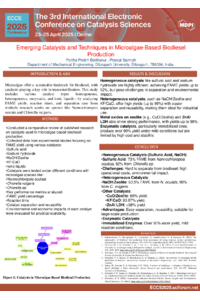
The production of biodiesel from microalgae presents a sustainable and renewable solution to the growing global energy demands, with catalysts playing a critical role in optimizing the transesterification process. This review examines the emerging catalysts and innovative techniques utilized in converting microalgal lipids into fatty acid methyl esters, emphasizing their impact on reaction efficiency, yield, and environmental sustainability. Catalysts are integral to the transesterification process, facilitating the conversion of lipids into biodiesel while reducing processing time and energy requirements. Homogeneous catalysts, such as sulfuric acid and sodium hydroxide, are widely used for their high reactivity and cost-effectiveness. Sulfuric acid demonstrates excellent performance in in situ transesterification, achieving biodiesel yields of 73% and 92% from Nannochloropsis oculata and Chlorella sp., respectively. However, the difficulty in separating these catalysts from the reaction mixture increases operational costs and environmental concerns. Heterogeneous catalysts offer a promising alternative due to their reusability and ease of separation. Examples include NaOH/zeolite, which has achieved biodiesel yields exceeding 98%, and KF/CaO, which demonstrated a yield of 93.07% when coupled with advanced techniques like ultrasound and microwave irradiation. Metal oxides such as CuO, NiO, and MgO supported on zeolite, as well as ZnAl-layered double hydroxides (LDHs), further enhance reaction performance through their high activity and stability. Enzymatic catalysts, particularly immobilized lipases, provide a more environmentally friendly option, offering high yields (>90%) and the ability to operate under mild conditions. However, their high cost and limited reusability pose significant challenges. Meanwhile, ionic liquid catalysts, such as tetrabutylphosphonium carboxylate, streamline the process by eliminating the need for drying and lipid extraction, achieving yields as high as 98% from wet biomass.
Keywords
Microalgae-based biodiesel
Transesterification catalysts
Fatty acid methyl esters (FAME)
Enzymatic catalysis
Ionic liquid catalysts.
Poster
sciforum_114908_F_slides_partha_protim_Borthakur.pdf
Thermal decomposition of 4-methoxy cinnamic acid over nanoceria
Grafted polyoxometalates as recoverable catalysts for biomass valorisation