Event submissions
Published

This submission belongs to the session e. Computational Chemistry of the event The 17th International Electronic Conference on Synthetic Organic Chemistry
Published date
31 Oct, 2013
Citation
Andrea Defant, Costantino Tomasi, Ines Mancini, A Joint Study on Juglone Metal Complexes by Infrared Spectroscopy and Density Functional Theory Calculations, in Proceedings of The 17th International Electronic Conference on Synthetic Organic Chemistry, 1 November–30 November 2013, MDPI: Basel, Switzerland, doi: 10.3390/ecsoc-17-e005
Share
Email
Facebook
Twitter
LinkedIn
A Joint Study on Juglone Metal Complexes by Infrared Spectroscopy and Density Functional Theory Calculations
'%3e%3cpath%20d='M12.6647%2010.9104C12.4176%2010.325%2012.0589%209.7933%2011.6088%209.34485C11.16%208.89511%2010.6283%208.53653%2010.0432%208.28891C10.038%208.28629%2010.0327%208.28498%2010.0275%208.28236C10.8437%207.69282%2011.3743%206.73252%2011.3743%205.64907C11.3743%203.85423%209.92005%202.40002%208.12522%202.40002C6.33038%202.40002%204.87618%203.85423%204.87618%205.64907C4.87618%206.73252%205.40677%207.69282%206.22296%208.28367C6.21772%208.28629%206.21248%208.2876%206.20724%208.29022C5.62031%208.53783%205.09365%208.89287%204.64167%209.34616C4.19192%209.79496%203.83334%2010.3266%203.58573%2010.9117C3.34247%2011.4846%203.21128%2012.0987%203.19925%2012.721C3.1989%2012.735%203.20135%2012.7489%203.20646%2012.7619C3.21157%2012.7749%203.21924%2012.7868%203.22901%2012.7968C3.23877%2012.8068%203.25045%2012.8148%203.26334%2012.8202C3.27623%2012.8256%203.29007%2012.8284%203.30406%2012.8284H4.09012C4.14776%2012.8284%204.19362%2012.7825%204.19493%2012.7262C4.22113%2011.7148%204.62726%2010.7676%205.34519%2010.0497C6.08802%209.30686%207.07452%208.89811%208.12522%208.89811C9.17592%208.89811%2010.1624%209.30686%2010.9052%2010.0497C11.6232%2010.7676%2012.0293%2011.7148%2012.0555%2012.7262C12.0568%2012.7839%2012.1027%2012.8284%2012.1603%2012.8284H12.9464C12.9604%2012.8284%2012.9742%2012.8256%2012.9871%2012.8202C13%2012.8148%2013.0117%2012.8068%2013.0214%2012.7968C13.0312%2012.7868%2013.0389%2012.7749%2013.044%2012.7619C13.0491%2012.7489%2013.0515%2012.735%2013.0512%2012.721C13.0381%2012.0947%2012.9084%2011.4856%2012.6647%2010.9104ZM8.12522%207.90243C7.52388%207.90243%206.95792%207.66793%206.53214%207.24215C6.10636%206.81636%205.87185%206.2504%205.87185%205.64907C5.87185%205.04773%206.10636%204.48177%206.53214%204.05599C6.95792%203.63021%207.52388%203.3957%208.12522%203.3957C8.72655%203.3957%209.29252%203.63021%209.7183%204.05599C10.1441%204.48177%2010.3786%205.04773%2010.3786%205.64907C10.3786%206.2504%2010.1441%206.81636%209.7183%207.24215C9.29252%207.66793%208.72655%207.90243%208.12522%207.90243Z'%20fill='%235D1EE1'/%3e%3c/g%3e%3c/svg%3e)
Andrea Defant 1
Costantino Tomasi 1

Ines Mancini 1
1. Laboratorio di Chimica Bioorganica, Dipartimento di Fisica, Università di Trento, via Sommarive 14, I-38123 Povo-Trento, Italy
Abstract
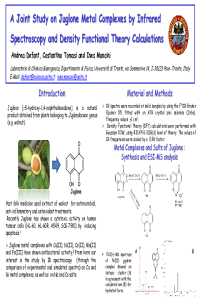
Juglone [=5-hydroxy-1,4-naphthalenedione] is a natural product obtained from plants belonging to Juglandaceae genus (e.g. walnut). Past folk medicine used extract of walnut for antimicrobial, anti-inflammatory and antioxidant treatments. Recently juglone has shown a cytotoxic activity on (HL-60, HL-60R, A549 and SCG-7901) human tumor cells by inducing apoptosis, and its complexes with transition metal ions were proved antibacterial activity.2 From here our interest in the structural analysis of Cu(II) and Ni(II) complexes of juglone. Over the last decades, infrared spectroscopy (IR) has experienced a renewed role in the molecular structure elucidation of organic compounds, due to the availability of simulated spectra by density functional theory (DFT) calculations able to assign the frequencies associated to vibrational modes obtained by experimental spectra. The juglone metal complexes, whose stoichiometry was supported by ESI-MS/MS experiments were analyzed by FT-IR spectroscopy equipped with the attenuated total reflectance (ATR) technique and the frequencies assigned by DFT calculated spectra using a B3LYP/6-311G(d) basis set. The changes induced by metal chelation are discussed also in comparison with the ion-dipole interactions observed for Na and Cs salts of juglone.
Keywords
DFT calculations
IR Spectroscopy
Juglone
Metal complexes
Manuscript
Defant 2013 manuscript.pdf
Poster
Defant 2013 Presentation.pdf
A Divergent Synthesis of Polyurethane Dendrimers
A new Tool for the Interrogation of Macromolecular Structure