Event submissions
Published
This submission belongs to the session F. Biomass Catalysis of the event The 3rd International Electronic Conference on Catalysis Sciences
Published date
21 Apr, 2025
Academic Editor
'%3e%3cpath%20d='M12.6657%2010.9104C12.4185%2010.325%2012.0599%209.79327%2011.6097%209.34482C11.1609%208.89508%2010.6293%208.5365%2010.0442%208.28888C10.0389%208.28626%2010.0337%208.28495%2010.0285%208.28233C10.8446%207.69279%2011.3752%206.73249%2011.3752%205.64904C11.3752%203.8542%209.92103%202.39999%208.1262%202.39999C6.33136%202.39999%204.87715%203.8542%204.87715%205.64904C4.87715%206.73249%205.40774%207.69279%206.22393%208.28364C6.21869%208.28626%206.21345%208.28757%206.20821%208.29019C5.62129%208.5378%205.09463%208.89284%204.64265%209.34613C4.1929%209.79493%203.83432%2010.3266%203.58671%2010.9117C3.34345%2011.4845%203.21226%2012.0987%203.20023%2012.7209C3.19988%2012.7349%203.20233%2012.7488%203.20744%2012.7619C3.21255%2012.7749%203.22022%2012.7867%203.22998%2012.7968C3.23975%2012.8068%203.25142%2012.8147%203.26431%2012.8202C3.2772%2012.8256%203.29105%2012.8284%203.30504%2012.8284H4.09109C4.14874%2012.8284%204.19459%2012.7825%204.1959%2012.7262C4.2221%2011.7148%204.62823%2010.7676%205.34617%2010.0497C6.08899%209.30683%207.0755%208.89808%208.1262%208.89808C9.17689%208.89808%2010.1634%209.30683%2010.9062%2010.0497C11.6242%2010.7676%2012.0303%2011.7148%2012.0565%2012.7262C12.0578%2012.7838%2012.1037%2012.8284%2012.1613%2012.8284H12.9474C12.9613%2012.8284%2012.9752%2012.8256%2012.9881%2012.8202C13.001%2012.8147%2013.0126%2012.8068%2013.0224%2012.7968C13.0322%2012.7867%2013.0398%2012.7749%2013.0449%2012.7619C13.0501%2012.7488%2013.0525%2012.7349%2013.0522%2012.7209C13.0391%2012.0947%2012.9094%2011.4855%2012.6657%2010.9104ZM8.1262%207.9024C7.52486%207.9024%206.9589%207.6679%206.53312%207.24211C6.10733%206.81633%205.87283%206.25037%205.87283%205.64904C5.87283%205.0477%206.10733%204.48174%206.53312%204.05596C6.9589%203.63018%207.52486%203.39567%208.1262%203.39567C8.72753%203.39567%209.29349%203.63018%209.71927%204.05596C10.1451%204.48174%2010.3796%205.0477%2010.3796%205.64904C10.3796%206.25037%2010.1451%206.81633%209.71927%207.24211C9.29349%207.6679%208.72753%207.9024%208.1262%207.9024Z'%20fill='%235D1EE1'/%3e%3c/g%3e%3c/svg%3e) Francesco Mauriello
Francesco MaurielloCitation
Abraham Thomas, Fadimatu Nyako Dabai, Benjamin Olufemi Aderemi, Yahaya Muhammed Sani, Extraction of Lignin from Sawdust (Chlorophora excelsa), in Proceedings of The 3rd International Electronic Conference on Catalysis Sciences, 23 April–25 April 2025, MDPI: Basel, Switzerland
Share
Email
Facebook
Twitter
LinkedIn
Extraction of Lignin from Sawdust (Chlorophora excelsa)
'%3e%3cpath%20d='M12.6647%2010.9104C12.4176%2010.325%2012.0589%209.7933%2011.6088%209.34485C11.16%208.89511%2010.6283%208.53653%2010.0432%208.28891C10.038%208.28629%2010.0327%208.28498%2010.0275%208.28236C10.8437%207.69282%2011.3743%206.73252%2011.3743%205.64907C11.3743%203.85423%209.92005%202.40002%208.12522%202.40002C6.33038%202.40002%204.87618%203.85423%204.87618%205.64907C4.87618%206.73252%205.40677%207.69282%206.22296%208.28367C6.21772%208.28629%206.21248%208.2876%206.20724%208.29022C5.62031%208.53783%205.09365%208.89287%204.64167%209.34616C4.19192%209.79496%203.83334%2010.3266%203.58573%2010.9117C3.34247%2011.4846%203.21128%2012.0987%203.19925%2012.721C3.1989%2012.735%203.20135%2012.7489%203.20646%2012.7619C3.21157%2012.7749%203.21924%2012.7868%203.22901%2012.7968C3.23877%2012.8068%203.25045%2012.8148%203.26334%2012.8202C3.27623%2012.8256%203.29007%2012.8284%203.30406%2012.8284H4.09012C4.14776%2012.8284%204.19362%2012.7825%204.19493%2012.7262C4.22113%2011.7148%204.62726%2010.7676%205.34519%2010.0497C6.08802%209.30686%207.07452%208.89811%208.12522%208.89811C9.17592%208.89811%2010.1624%209.30686%2010.9052%2010.0497C11.6232%2010.7676%2012.0293%2011.7148%2012.0555%2012.7262C12.0568%2012.7839%2012.1027%2012.8284%2012.1603%2012.8284H12.9464C12.9604%2012.8284%2012.9742%2012.8256%2012.9871%2012.8202C13%2012.8148%2013.0117%2012.8068%2013.0214%2012.7968C13.0312%2012.7868%2013.0389%2012.7749%2013.044%2012.7619C13.0491%2012.7489%2013.0515%2012.735%2013.0512%2012.721C13.0381%2012.0947%2012.9084%2011.4856%2012.6647%2010.9104ZM8.12522%207.90243C7.52388%207.90243%206.95792%207.66793%206.53214%207.24215C6.10636%206.81636%205.87185%206.2504%205.87185%205.64907C5.87185%205.04773%206.10636%204.48177%206.53214%204.05599C6.95792%203.63021%207.52388%203.3957%208.12522%203.3957C8.72655%203.3957%209.29252%203.63021%209.7183%204.05599C10.1441%204.48177%2010.3786%205.04773%2010.3786%205.64907C10.3786%206.2504%2010.1441%206.81636%209.7183%207.24215C9.29252%207.66793%208.72655%207.90243%208.12522%207.90243Z'%20fill='%235D1EE1'/%3e%3c/g%3e%3c/svg%3e)
Abraham Thomas 1
Fadimatu Nyako Dabai 2
Benjamin Olufemi Aderemi 1
Yahaya Muhammed Sani 1
1. Department of Chemical Engineering, Faculty of Engineering, Ahmadu Bello University, Zaria, Kaduna, Nigeria.
2. Department of Chemical Engineering, Faculty of Engineering, University of Abuja, FCT, Nigeria
Abstract
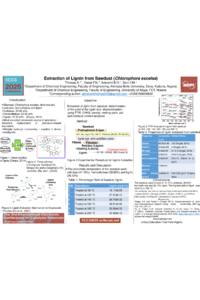
Sawdust is a plentiful source of lignocellulosic biomass, offering a sustainable alternative to fossil raw materials for the production of aromatics, fuels, and chemicals. Lignin, a key component of lignocellulosic biomass, serves as a renewable feedstock that can be depolymerized into aromatics suitable for use as octane enhancers or as precursors for high-value products. Additionally, lignin's multiple hydroxyl groups enable the synthesis of diverse polymers with potential industrial applications. This study investigates the extraction of lignin from Chlorophora excelsa sawdust using organosolv technology. The sawdust was collected and characterized, revealing a composition of 41.15% cellulose, 28.63% hemicellulose, and 26.13% lignin. The organosolv pretreatment process was conducted at temperatures of 100°C, 120°C, 140°C, 160°C, 180°C, and 200°C for 1 hour and 30 minutes. The sawdust was mixed with an ethanol–water solution (60:40 w/w) at a solid-to-liquid ratio of 1:10 (w/w), with 20% sulfuric acid as a catalyst. The highest lignin yield of 49.81% was achieved at 160°C, while the yields at 100°C, 120°C, 140°C, 180°C, and 200°C were 14.58%, 27.29%, 28.37%, 29.57%, and 24.48%, respectively. FTIR analysis confirmed that the lignin produced at 160°C contained multiple hydroxyl functional groups. Additionally, FTIR spectroscopy indicated chemical homogeneity across the extracted lignin samples. Elemental analysis using the Walkley–Black method, flame photometry, atomic absorption spectrometry, and wet digestion revealed the carbon, sodium, sulfur, and nitrogen contents of the lignin as 60.00%, 0.02%, 0.88%, and 0.40%, respectively. The bulk density, ash content, and moisture content of the extracted lignin were determined to be 0.264 g/cm³, 0.95%, and 1.88%, respectively.
Keywords
Sawdust
Lignocellulosic Biomass
Extraction
Sulfuric acid and Organosolv Lignin
Poster
Thomas Abraham Presentation..pdf
Effects of Precipitation Variables on Phenolic Hydroxyl Group Content of Lignin Recovered from Black Liquor
Production of xylo-oligosaccharides from banana peel and corn husk by xylanase treatment